Timeline of Nepal's Gen Z Protest: 16 Killed, Army Deployed, Curfew Imposed After Social Media Ban Sparks Violence
Synopsis
Nepal's Gen Z protests against social media restrictions turned violent as security forces used tear gas and rubber bullets. The army was deployed, a curfew imposed and shoot-at-sight orders issued to control unrest.
Nepal is facing widespread unrest as thousands of Gen Z protesters clash with security forces over the government’s decision to block social media platforms. At least 16 people have been killed and around 100 injured after police used tear gas and water cannons to disperse demonstrators. The protesters are demanding an end to the social media ban and action against government corruption. “So far, 10 protesters have died and 87 are injured,” said Shekhar Khanal, spokesperson for Kathmandu Valley Police earlier, speaking to AFP. What started as peaceful protests has now turned violent across the country.
Why are Gen Z protesting?
The protests started after the Nepali government imposed a social media ban on September 4, 2025. Popular platforms like Facebook, Instagram, WhatsApp, YouTube and others were blocked, targeting companies that did not register with the government. Officials claimed the ban was needed to prevent the spread of fake news, hate speechand misuse of fake IDs for committing crimes.
However, young protesters, mainly from the Gen Z generation, viewed this as an attack on freedom of expression. They argue the ban is a form of censorship intended to suppress dissent and hide government corruption.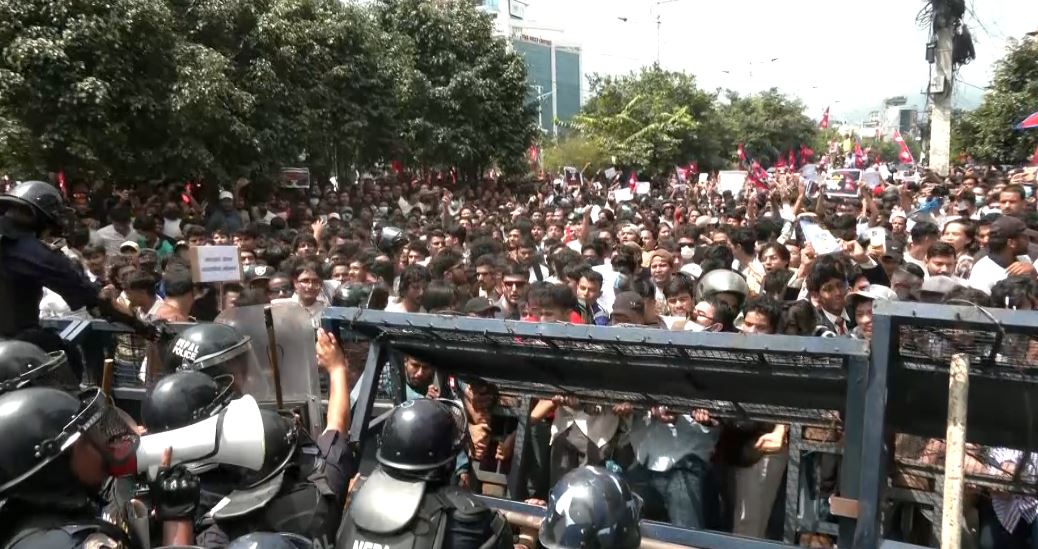
Escalation of protests in Kathmandu
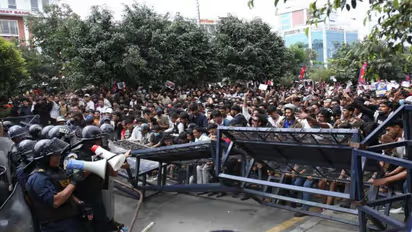
On Monday, as thousands of protesters marched from Maitighar Mandala toward the Parliament building in Kathmandu, tensions quickly escalated. Demonstrators broke through police barricades and entered restricted zones, attempting to storm the Parliament premises.
Security forces responded by using tear gas, rubber bullets, water cannons and batons to disperse the crowds. Muktiram Rijal, spokesperson for the Kathmandu district office, confirmed a curfew was imposed from 12:30 PM to 10 PM local time. The curfew covered not only the Parliament area but also the residences of the President, Prime Minister, Vice-President and Singha Durbar, the government’s administrative complex.
Army deployed to control situation
The situation worsened as the Nepali Army was deployed to assist the police in maintaining law and order. The decision came after protesters breached multiple restricted zones and caused significant damage, including setting fire to parts of the Parliament building. Authorities also issued shoot-at-sight orders to prevent further chaos.
The Himalayan Times reported that security forces were under pressure to control the highly volatile situation while ensuring the safety of civilians. Protesters threw tree branches and water bottles, shouted anti-government slogans and vandalised property. Some demonstrators managed to enter the Parliament premises.

Rising casualties and injuries
ANI quoted reports suggesting that nine protesters were killed as security forces used aggressive measures to suppress the unrest. One protester was shot in New Baneshwor while clashing with the police and later died at Civil Hospital. Another young demonstrator died while being treated at a trauma centre in Kathmandu.
Several others were injured in Damak city in Jhapa district, which happens to be Prime Minister KP Sharma Oli's hometown. In Damak, protesters marched from Damak Chowk toward the municipal office, burned an effigy of the Prime Minister and attempted to break municipal gates. Police intervened with rubber bullets, leaving one critically injured and demonstrators set fire to motorcycles.
Protests spread across Nepal
The protests were not limited to Kathmandu and Jhapa. Gen Z activists staged demonstrations in other regions, including Pokhara, Butwal, Chitwan, Nepalgunj and Biratnagar. In these areas, youth gathered to express their frustration over the government’s handling of social media platforms and corruption allegations.
Government's position
The Nepali government maintains that the social media ban is a necessary step to regulate platforms that failed to comply with local laws requiring registration and taxation. Authorities argue that these actions aim to prevent the misuse of fake IDs for spreading fake news, hate speech and other fraudulent activities.
Despite these claims, protesters insist the ban is politically motivated, aimed at silencing voices opposing government corruption.
Current status and future outlook
The curfew remains in place as authorities attempt to stabilize the situation. The Army continues to guard key government locations and police are actively preventing further incursions into restricted zones. The Nepal government’s firm stance has drawn widespread criticism domestically and internationally, with calls for dialogue and the restoration of online freedom.
The Gen Z protesters remain determined, asserting that their fight is for democracy, freedom of expression and transparent governance.
This unfolding situation in Nepal highlights the growing role of digital-savvy youth in political activism, especially in an age of social media where information and communication play a central role in public dissent.
(With inputs from agencies)