Nepal Gen Z Protest Aftermath: Hilton Hotel in Kathmandu Charred Amid Violent Agitation (WATCH)
Synopsis
The Hilton Hotel in Kathmandu was set ablaze during violent anti-corruption protests in Nepal. The unrest has seen property destruction, dozens of arrests and a nationwide curfew as protesters, mostly Gen Z, demand a corruption-free political system.
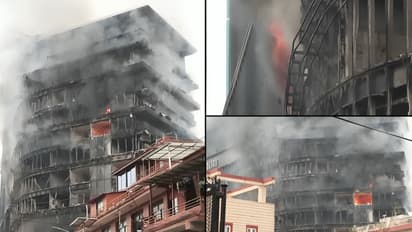
The peaceful anti-corruption protests in Nepal led by Gen Z youth took a violent turn, causing widespread destruction and serious loss. Among the most shocking incidents, the Hilton Hotel in Kathmandu was set on fire and completely charred as protesters expressed their anger against the government’s corruption and decisions.
The protests began on September 8, after the government banned major social media platforms like Facebook, X and YouTube on September 4. The official reason given was to improve tax revenue and safeguard cybersecurity, but the youth saw this as a way to suppress free speech and silence dissent.
Initially focused on demanding an end to institutionalised corruption and government favouritism, the protests quickly escalated. Protesters stormed several important government buildings, vandalised properties, and clashed with security forces. At least 19 people were killed and over 500 injured in violent clashes.
Destruction of landmarks and rising arrests
The Hilton Hotel in Kathmandu was completely charred after being set ablaze during the protests, leaving a strong symbol of the unrest. The protests, initially focused on government corruption and social media restrictions, turned violent, leaving deep scars across the capital. Similarly, 'Sital Niwas', the Nepalese Rashtrapati Bhawan (President's official residence), was vandalised and set on fire. In another tragic incident, the residence of former Prime Minister Jhalanath Khanal was attacked and torched, leading to the death of his wife, Rajyalaxmi Chitrakar, who succumbed to burn injuries.
Smoke still rises from the Kantipur Media Group headquarters, which was also set on fire amid the chaos.
In response, the Nepalese Army stepped in with a nationwide deployment of forces between 10 pm Tuesday and 10 am Wednesday. As reported by The Himalayan Times, a total of 27 individuals involved in looting, arson, and other violent acts were arrested during this period.
Authorities recovered NRs 3.37 million in stolen cash from suspects in Kathmandu's Gausala-Chabahil-Bouddha corridor. A large cache of weapons was also seized, including 31 firearms of different types, along with magazines and ammunition, 23 of these from Kathmandu and eight from Pokhara.
23 Nepal Police officers and three civilians were injured during the clashes and are being treated at military hospitals.
Curfew and prohibitory orders continue
The Nepalese Army imposed strict prohibitory orders and a nationwide curfew to control the situation. Initially, prohibitory orders remained in place until 5 pm on Wednesday, September 10, 2025, followed by a nationwide curfew starting at 6 am on September 11, 2025. The Army said further decisions would depend on the evolving security situation.
In its official statement, the Army expressed sorrow over the loss of life and property and urged citizens to cooperate in maintaining peace. The Army also warned that “lawless individuals and groups” were infiltrating the movement, using it to commit arson, looting, violent assaults, and attempted rape.
President steps in for dialogue
Following the resignation of Prime Minister KP Sharma Oli, President Ram Chandra Paudel announced efforts to resolve the crisis peacefully. He called for talks with the Gen Z protesters, urging all sides to “remain calm” and “prevent further harm to the nation.”
One of the protesters, Subhash, told ANI, "The violent protests of the last two days may stop, but our fight continues. We demand new rules against corruption, good leadership, and real opportunities for youth in Nepal."
The movement’s core demands are now clearer than ever:
- Rewrite the Constitution to build a transparent, accountable political system
- Investigate three decades of corrupt practices and looted assets
- Recognise the protest martyrs with state honours and relief for their families
- Implement special programs to tackle youth unemployment and reduce migration abroad
A movement with bigger purpose
What began as a protest against a social media ban has now turned into a large-scale movement demanding systemic change. Gen Z protesters say their goal is not political power, but a better future for their generation and their country.
As Nepal stands at a crossroads, the world watches closely. The coming days may determine whether dialogue can lead to a peaceful solution or if unrest will deepen further.
This unfolding story reflects a powerful wave of youth activism seeking to change a nation's destiny.
(With ANI inputs)