Middle East War: Iran Claims Over 1,000 Killed In Israel-US Strikes, Gulf on Edge
Synopsis
US‑Israeli strikes in Iran kill over 1,000, including civilians and military. Khamenei’s funeral postponed, Strait of Hormuz controlled by Iran, Middle East conflict spreads, global tensions rise.
Iran said Wednesday that more than 1,000 people have been killed nationwide since the start of US‑Israeli strikes over the weekend, as the conflict widened across the Middle East and fears grew over global energy supplies and regional stability.
According to Iran’s official news agency IRNA, the casualties include both civilians and military personnel.
"During the military aggression... 1,045 of our dear military personnel and civilians" were killed, IRNA said, citing a statement from Iran's Foundation of Martyrs and Veterans Affairs.
Asianet Newsable English was not in a position to independently verify the toll.
State funeral for Ayatollah Ali Khamenei postponed
Iran also announced that the state funeral for Supreme Leader Ayatollah Ali Khamenei — killed in the US‑Israeli strikes — has been postponed.
"The farewell ceremony for the martyred Imam has been postponed. The new date will be announced later," Iranian television reported on Wednesday.
Authorities had earlier planned a tribute ceremony in Tehran on Wednesday evening, after which Khamenei’s body was to be taken to the holy city of Mashhad for burial.
Officials said the delay was largely due to the anticipated turnout.
It was partly down to "the expected participation of millions of people and the need to provide the proper infrastructure" for such a crowd, Mohsen Mahmoudi, head of Tehran's Islamic Development Coordination Council, told state TV.
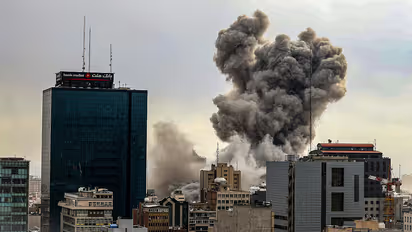
Strikes have continued to pound Tehran since Saturday, targeting military and government infrastructure across the capital.
Iran claims control over the Strait of Hormuz
In a major escalation with global implications, Iran’s Revolutionary Guards said they now have total control of the Strait of Hormuz, one of the world’s most critical energy transit routes.
The claim came as Israel launched another wave of strikes on Tehran and global shipping companies began suspending transit through the narrow waterway. Maritime agencies have reported several ships being attacked.
Energy markets reacted sharply, with prices already spiking amid fears that supplies could be disrupted.
Earlier, the Guards had warned ships against entering the strait. Meanwhile, the United States indicated it could deploy naval escorts for oil tankers.
US President Donald Trump said the US Navy was ready to secure shipping routes through the strategic channel.
War spreads across the region
The conflict has quickly spilled beyond Iran and Israel, affecting several countries in the Gulf and the wider Middle East.
A ballistic missile launched from Iran and heading toward Turkish airspace through Iraq and Syria was destroyed by air defence systems from NATO, Turkish officials said Wednesday.
Cities long considered relatively safe from regional conflict, including Dubai and Riyadh, have also been drawn into the crisis.
Saudi Arabia said it intercepted two cruise missiles and a drone targeting its massive Ras Tanura refinery. Drones struck near the US consulate in Dubai, sparking a fire, while a missile hit the US military base at Al‑Udeid in Qatar.
Authorities in the UAE said Abu Dhabi had been targeted by three ballistic missiles and 129 drones, intercepting all but eight drones. Kuwait also reported casualties, including an 11‑year‑old girl killed by falling shrapnel.
The Pentagon said four of the six US troops killed so far in the war died in a drone attack in Kuwait.
Israel expands strikes, tensions rise in Lebanon
In Lebanon, Israel warned residents south of the Litani River to move north, saying the army was "compelled to take military action" against the Iran‑backed group Hezbollah.
Israeli strikes hit areas around the presidential palace in Beirut and the group’s strongholds in the southern suburbs of the capital. Lebanese authorities said at least 11 people were killed.
An air strike also hit a hotel in Hazmieh near Beirut — the first reported Israeli attack on the predominantly Christian suburb near several embassies and the presidential palace.
The expansion of the war into Lebanon has raised fears of a broader regional confrontation.
Leadership vacuum and rising tensions in Tehran
Following Khamenei’s death, Iranian officials have said a successor will be appointed soon. Israel has already signalled it may target any new leader.
Israeli Prime Minister Benjamin Netanyahu and President Donald Trump have both urged Iranians to rise up, although Trump said regime change was not the stated goal of the operation.
"We are close, but the situation is a war situation," Ahmad Khatami, a member of the Assembly of Experts, told Iranian state TV.
Meanwhile, US officials said the initial barrage of strikes was unprecedented in scale.
The US military said it had hit nearly 2,000 targets since launching the operation, with a senior commander describing the first day’s assault as larger than the 2003 “shock and awe” campaign in Iraq.
Civilians caught in the middle
In Tehran, many residents who have not fled the city are staying indoors, bracing for more strikes.
Normally home to around 10 million people, parts of the capital now appear unusually quiet.
"There are so few people that you'd think no one ever lived here," said Samireh, a 33‑year‑old nurse in Tehran.
The humanitarian toll continues to rise. Iran’s Red Crescent earlier said US and Israeli attacks had killed 787 people, a figure that also could not be independently verified.
Beyond Iran, governments worldwide are scrambling to evacuate citizens as air travel across the region remains heavily disrupted.
Religious leaders condemn the war
In neighbouring Iraq, influential Shiite cleric Ali Sistani strongly criticised the conflict.
He denounced the war as "unjust" and called "on all Muslims and free people around the world to denounce" the war and "stand in solidarity with the Iranian people."
Sistani remains one of the most influential religious figures in the region, with followers across the Muslim world.
(With inputs from AFP)