Drone Attacks Hit Two Kuwait Oil Refineries as Middle East War Escalates, Fire Erupts (WATCH)
Synopsis
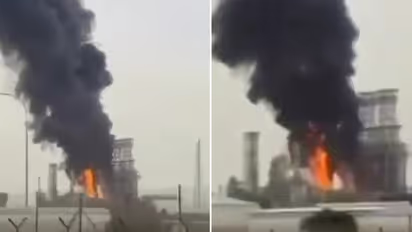
A drone attack sparked a fire at Kuwait’s Mina Abdullah refinery after another strike hit Mina Al-Ahmadi earlier the same day, raising fresh concerns over energy security in the Gulf amid escalating regional tensions.
A series of drone attacks struck two major oil refineries in Kuwait on Thursday, triggering fires and raising fresh concerns over the security of energy infrastructure in the Gulf.
According to state media, the first attack targeted the Mina Al-Ahmadi Refinery, one of Kuwait’s largest oil processing facilities. Authorities said the strike caused a limited blaze at one of the refinery’s operational units.
“Kuwait Petroleum Corporation announced that one of the operational units of the Mina Al-Ahmadi refinery... was the target of a drone attack, triggering a limited fire,” the Kuwait News Agency reported, adding that no injuries were recorded.
Just hours later, a second refinery owned by the national oil company was also targeted.
Second Strike Triggers Fire at Mina Abdullah Refinery
Officials confirmed that a drone struck the Mina Abdullah Refinery, causing another fire within the facility.
The Kuwait National Petroleum Company said the attack hit one of the refinery’s operating units.
"One of the operational units of the Mina Abdullah refinery, belonging to the Kuwait National Petroleum Company (KNPC) was targeted by a drone attack, triggering a fire at the site," Kuwait’s information ministry said on X.
Emergency teams were quickly deployed to contain the flames.
No Casualties Reported
Despite the strikes, officials said the situation was brought under control and no injuries were reported.
Both refineries are crucial components of Kuwait’s oil sector and play a key role in refining crude oil for domestic use and export.
The incidents have heightened fears that energy facilities across the Gulf could increasingly become targets as the regional conflict intensifies.
Energy Infrastructure Across the Region Under Pressure
The attacks in Kuwait come amid a broader escalation in the Middle East conflict, with several countries reporting strikes on key infrastructure.
In Qatar, civil defence teams battled fires at a major gas hub in the Ras Laffan Industrial Area after Iranian strikes damaged liquefied natural gas facilities.
“Civil Defence has fully brought all fires under control in the Ras Laffan Industrial Area without any reported injuries. Cooling and sites-securing operations are still ongoing,” the interior ministry said.
Qatar’s state-run energy company later confirmed that multiple LNG installations suffered “extensive” damage.
The ripple effects were quickly felt in global markets. European gas prices surged sharply, with the Dutch TTF benchmark contract jumping as much as 35 percent before easing slightly.
Rising Tensions and Threats of Military Response
Regional tensions have continued to rise as countries react to the growing conflict.
In Riyadh, Faisal bin Farhan Al Saud, the foreign minister of Saudi Arabia, warned that the kingdom could respond militarily to attacks.
"The kingdom is not going to succumb to pressure, and on the contrary, this pressure will backfire... and certainly, as we have stated quite clearly, we have reserved the right to take military actions if deemed necessary," he said.
Saudi officials also condemned repeated strikes on civilian infrastructure across Gulf states.
Wider Conflict Spreads Across the Region
Elsewhere, violence linked to the conflict continued to spread.
In Iraq, the Popular Mobilisation Forces said two of its fighters were killed in air strikes in the Nineveh region. The group blamed the attacks on Israel and the United States.
Meanwhile, China strongly criticised the killing of Iranian national security chief Ali Larijani in an Israeli air strike.
"We have always opposed the use of force in international relations. The acts of killing Iranian state leaders and attacking civilian targets are even more unacceptable," Chinese foreign ministry spokesman Lin Jian said.
Global Impact: Shipping, Aviation and Energy Markets
The widening conflict is beginning to affect global trade routes and aviation as well.
A projectile struck a vessel near the Strait of Hormuz, causing a fire, according to a British maritime security agency. The strategic waterway is one of the world’s most important oil shipping routes.
Air travel has also been disrupted. Cathay Pacific announced that it had suspended flights to Dubai and Riyadh until the end of April due to security concerns.
At the same time, the Federal Reserve warned that the war was contributing to an uncertain global economic outlook, raising its inflation projections while keeping interest rates unchanged.
(With inputs from AFP)