J&K's future is female: Women's empowerment highlighted at UNHRC
Synopsis
At a UNHRC session, Darakshan Hassan Bhat showcased the growing empowerment of women in Jammu & Kashmir, citing a female labour participation rate of 34.1% and the success of government schemes like Mission Shakti and Beti Bachao Beti Padhao.
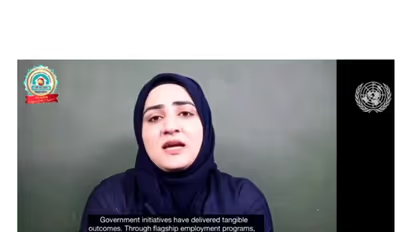
At the 61st session of the United Nations Human Rights Council in Geneva, Darakshan Hassan Bhat, representing Rashtriya Sewa Kendra Sangh (RSKS), highlighted the growing empowerment of women and girls in Jammu and Kashmir, pointing to significant social and economic transformations in the region.
In her statement, Bhat said new pathways to empowerment are emerging across the Union Territory, supported by government initiatives and community participation. "The future of Jammu & Kashmir is bright, determined, and unequivocally female," she said, emphasizing the increasing role of women in shaping the region's development.
Driving Economic Independence Through Employment
Highlighting key indicators, Bhat noted that the female labour force participation rate in Jammu and Kashmir has reached 34.1 per cent, which is higher than the national average. According to her, this reflects changing social norms and growing economic empowerment among women.
She also pointed to the impact of government-led employment initiatives, saying that more than half a million women have secured wage employment over the past five years through flagship programmes. "Through targeted employment programmes, women are gaining financial independence and strengthening the resilience of their households," Bhat said.
Comprehensive Support Through Mission Shakti
Institutional support has also expanded through initiatives such as Mission Shakti, which focuses on safety, security, and empowerment of women. Under its two verticals--Sambal and Samarthya--thousands of women have gained access to skill development, legal aid, financial literacy, and entrepreneurship opportunities.
Bhat said support mechanisms such as One Stop Centres, women's helplines, emergency response systems, and women help desks have been strengthened to ensure safety and assistance for women in need.
Meanwhile, economic and social empowerment programmes under Samarthya have benefited more than 1.16 million women. She also highlighted the growing participation of women in Self-Help Groups, with over 700,000 women now accessing micro-credit facilities and market linkages, contributing directly to local economic growth.
Improved Social Indicators and Legal Safeguards
Referring to social indicators, Bhat noted that the gender ratio in the region improved from 918 in 2011 to 942 in 2019 under initiatives such as Beti Bachao Beti Padhao (Save the Daughter, Educate the Daughter). She added that following the Abrogation of Article 370, key legal protections for women--including the Protection of Women from Domestic Violence Act and the Sexual Harassment of Women at Workplace Act--have been fully extended to the region.
Progress Amidst Challenges
Despite challenges posed by cross-border terrorism, Bhat said the region continues to move forward. "Despite persistent cross-border terrorism seeking to disrupt progress, India's integrated model of empowerment stands firm," she said.
Reiterating her message, Bhat concluded that the growing participation of women in education, employment, and governance is shaping a new and hopeful future for Jammu and Kashmir.
(ANI)
(Except for the headline, this story has not been edited by Asianet Newsable English staff and is published from a syndicated feed.)