JetBlue's Horror Plunge: Cosmic Ray Theory Sparks Chilling Questions for Airbus
Synopsis
JetBlue’s mid-air plunge has sparked a clash between Airbus and radiation experts, with new claims that a cosmic ray—not solar activity—may have corrupted the jet’s flight controls.
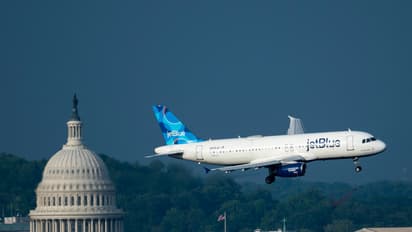
When JetBlue Flight 1230 lifted off from Cancun on October 30, nothing suggested the passengers were in for a bruising, chaotic plunge thousands of feet through the sky. Families were settling in, meals were being served, and the Airbus A320 was cruising smoothly at 35,000 feet on its way to Newark.
Just thirty minutes later, that calm would shatter. A sudden, uncontrolled drop rattled the aircraft, injuring at least 15 people and forcing the crew to divert to Tampa. What happened inside the cockpit has now triggered a global safety overhaul—and a scientific debate stretching from aerospace engineering to cosmic radiation physics.
A Terrifying Few Seconds in the Sky
The Federal Aviation Administration confirmed that Flight 1230’s crew reported a “flight control issue” before descending toward Tampa. The jet touched down at 2:19 pm ET, where medical teams were waiting. JetBlue later said the aircraft experienced an unexpected altitude loss and that “those needing additional care were transported to a local hospital.”
The plane was immediately removed from service. Flight data shows it climbed normally, cruised at 35,000 feet for about half an hour, and then rapidly diverted. Nothing about the trajectory hinted at turbulence or weather-related trouble.
What followed instead was an investigation that would eventually ground more than 6,000 Airbus jets worldwide—yet still leave experts divided on what actually caused the aircraft to malfunction.
Airbus Blames the Sun
Last week, Airbus closed its probe into the JetBlue incident with a stark conclusion: intense solar radiation interfered with the plane’s flight control systems.
“Analysis of a recent event involving an A320 Family aircraft has revealed that intense solar radiation may corrupt data critical to the functioning of flight controls,” the manufacturer said. “Airbus has consequently identified a significant number of A320 Family aircraft currently in service that may be impacted.”
Within hours, airlines received instructions to install urgent software updates across the A320 fleet.
The timing raised eyebrows. While Airbus’ findings were released weeks after the incident, the company issued the sweeping updates on the very day unusually high solar activity was detected—nearly two weeks after the JetBlue emergency.
A Different Culprit? Experts Point to Cosmic Rays
Not everyone is convinced the sun is to blame.
Clive Dyer, a renowned radiation and space environment specialist at the University of Surrey, says the solar conditions on the day of the flight tell a very different story.
“Solar radiation on the day of the flight was within normal levels and far too low to affect the aircraft,” Dyer told Space.com.
Instead, he points to something far more distant—and far more powerful.
A cosmic ray.
“Cosmic rays can interact with modern microelectronics and change the state of a circuit,” he said. “They can cause a simple bit flip, like a 0 to 1 or 1 to 0, messing up information and making things go wrong. They can even induce hardware failures when they generate a current in an electronic device and burn it out.”
Dyer’s argument rests on decades of research, including his work studying radiation-induced failures aboard satellites and even on the Concorde. He notes that cosmic-ray strikes—though rare—have disrupted aircraft systems before.
One of the most dramatic cases was Qantas Flight 72 in 2008, when an Airbus A330 suddenly pitched downward twice over the Pacific, injuring dozens. Dyer has long considered that incident a likely cosmic-ray-triggered “single-event upset.”
Cosmic Rays vs. Solar Radiation: What’s the Difference?
To the average passenger, “radiation” sounds like a single threat. But in aviation, two very different forms matter:
Cosmic Rays
Born from supernova explosions, these high-energy particles travel across the universe at near-light speed. When they hit Earth’s atmosphere, they produce cascades of secondary particles—muons, neutrons, positrons—that can pierce aircraft avionics.
If even one strikes a tiny portion of a circuit, it can flip a bit or overload a component. These momentary disruptions are known as single-event upsets.
Solar Radiation
This is electromagnetic energy emitted by the sun. During solar flares or coronal mass ejections, bursts of charged particles wash through the atmosphere. These events can dramatically increase the likelihood of electronic glitches.
What complicates the JetBlue investigation is the timing. While Dyer says solar activity on October 30 was ordinary, he notes something curious:
Solar radiation levels did spike to dangerous intensities less than two weeks later—precisely when Airbus rushed out its global update.
Aviation Caught Off Guard
Dyer believes the aviation world may have grown complacent.
“It's down to manufacturers to produce hardy electronics, especially in safety-critical units,” he said. “A slight problem is that over 20 years, they've become complacent, because there have not been any [significant solar weather] events.”
As modern aircraft rely more heavily on tightly packed microelectronics, the vulnerability to radiation—cosmic or solar—only grows. Even a single bit flip can interfere with flight control laws, sensors, or critical data pathways.
The JetBlue plunge, fortunately, ended with a safe landing. But the near-disaster has reignited questions about whether the industry has underestimated the invisible hazards above 30,000 feet.
Why Airbus Moved So Quickly
The rush to update thousands of Airbus A320s has fueled debate.
Some insiders believe the manufacturer acted after observing incoming solar storms, worried that other aircraft might be at risk during upcoming high-radiation windows. Dyer suggests the flare that struck days later “likely influenced Airbus' decision” to issue the fix.
Airbus has not publicly addressed the cosmic-ray theory—but its acknowledgment that intense radiation can corrupt flight-control data underscores how sensitive avionics have become.