Israel-US Bomb Iran: Joint Attack to Last For 4 Days? Trump Cites Nuclear Threat to Justify Force
Synopsis
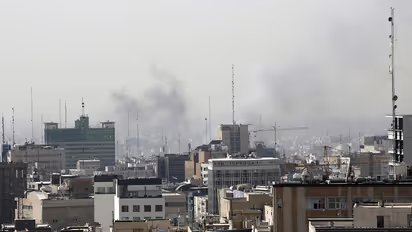
The US and Israel launched coordinated strikes on Iran, targeting regime-linked sites and military infrastructure, marking a major escalation in Middle East tensions.
Israel and the United States have launched a coordinated military operation targeting Iranian regime and military facilities, marking a major escalation in Middle East tensions. According to Israeli officials, the strikes were part of a long-planned joint strategy aimed at countering Iran’s capabilities, particularly concerning its nuclear programme.
Sources indicate that the operation had been in preparation for months, with both nations aligning closely on objectives and execution. The initial phase of the strikes is expected to last around four days, with Israel preparing for a broader period of conflict that could extend beyond the opening phase. Officials described the approach as aggressive, with Israel going “all out” while maintaining full coordination with the US.
A US official told Reuters that American strikes on Iran are being conducted through both air and sea operations.
The coordinated offensive began this morning, with the United States and Israel launching a wave of attacks against the Islamic Republic.
US President Donald Trump said on Saturday that “major combat” operations are underway, aimed at destroying Iran’s missile capabilities and crippling its naval forces.
"The United States' military began major combat operations in Iran," Trump said in a video message posted on his social media site while he spent the weekend at his Florida golf club. "Our objective is to defend the American people by eliminating imminent threats from the Iranian regime."
"We are going to destroy their missiles and raze their missile industry to the ground. It will be totally -- again -- obliterated. We're going to annihilate their navy," Trump said.
He offered the military there "immunity" or "certain death" and told Iranians the "hour of your freedom is at hand."
Israeli strikes on Iran were targeting "regime and military sites including ballistic missiles", the Kan public broadcaster reported, citing an Israeli official.
Israeli official said, “Regime targets and military sites are being attacked -- including ballistic missiles," appeared on the ticker of the Kan 11 television channel.
The timing of the attacks was deliberately chosen to maximise surprise, with strikes carried out during morning hours when Iran was less likely to anticipate an assault. The targets reportedly included key regime-linked and military infrastructure, signalling a focused attempt to weaken Iran’s operational capacity.
The developments come shortly after US President Donald Trump expressed frustration over stalled nuclear negotiations with Iran. He reiterated that Iran must not be allowed to possess nuclear weapons or uranium enrichment capabilities, and hinted at the potential necessity of military action.
Back in Israel, political leaders across the spectrum have voiced strong support for the operation, emphasising unity during a critical moment. Opposition Leader Yair Lapid highlighted national solidarity, stressing that the country stands together behind its military forces. Similarly, Avigdor Liberman invoked historical and cultural references to underscore resilience against perceived threats.
As the situation unfolds, the possibility of retaliation and a prolonged confrontation remains high, raising concerns about wider regional instability and the potential for further escalation.