Israel unhappy with Pak mediating US-Iran talks, hails India ties
Synopsis
Israeli Consul General Yaniv Revach expressed displeasure over Pakistan mediating US-Iran talks but trusts the US. He reiterated Israel's strong support for India's counter-terrorism efforts, citing help during Operation Sindoor.
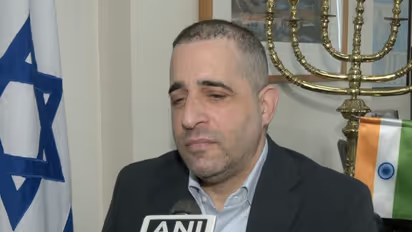
Yaniv Revach, Consul General of Israel in Mumbai said that Israel is not happy with the fact that Pakistan is mediating the war between the US and Iran. Revach, in a conversation with ANI, said that Israel has supported India significantly in its war against terrorism, especially during Operation Sindoor.
"Regarding the role of Pakistan mediating negotiations between the US and Iran, my government is not happy that Pakistan is the one mediating. However, Israel is not part of this negotiation. We are not negotiating with Pakistan. President Trump and the American government are leading the talks with Iran via Pakistan, and we trust the American government to take care of Israeli security interests in this matter," he said.
Israel Reiterates Support for India's Counter-Terrorism Efforts
Revach said that Israel will continue to support and work together with India when it comes to counter-terrorism. "Israel has supported India significantly in its war against terrorism, especially during Operation Sindoor and even before that when surgical strikes happened. Israel supported India not only with words but with strategic help as well. Israel will continue to support and work together with India when it comes to counter-terrorism. On April 22, 2025, in Pahalgam, we saw how terrorists separated men from their families and killed them specifically based on their religion. This is unacceptable. India undertook Operation Sindoor to punish the perpetrators of terrorism across the border. Israel supports India's right to protect its civilians and stands shoulder to shoulder with India in the fight against terrorism," he said.
Revach said further that India and Israel, both have suffered from terrorism across its border since independence and hence cooperation between both is pertinent. "Since the independence of both India and Israel, both countries have faced terror attacks from across their borders. It is important for us to share experience and cooperation in defense, intelligence, cybersecurity, drones, and technology. All of that is now stronger than ever, as demonstrated during Operation Sindoor," he said.
Israel Wants Stability, Not War, Amid Iran Tensions
Revach said that even today, danger is not fully over and Israel wants stability in the region. "Regarding the present situation with Iran, Israel, and the US, I don't think anyone can say today that the danger is fully over. Israel doesn't want war, the US doesn't want war, and no one in the region wants war. We want security, stability, and peace. Unfortunately, the Iranian regime continues to support different terrorist groups across the Middle East and openly threatens to destroy the State of Israel. It also damages moderate Arab countries in the region. The future depends mainly on Iran's actions," he said.
'Future Depends on Iran's Actions'
He further said that if Iran stops supporting terror in Lebanon and Iraq, the region will achieve stability. "If Iran reduces aggression and stops supporting terror organisations--such as the Shia militias in Iraq, Hezbollah in Lebanon, and the Houthis in Yemen--there will be a chance for stability. We hope that diplomacy will succeed because nobody wants a wider regional conflict. However, for decades, the Iranians have been financing, training, and supporting these organisations with advanced technology, which remains the main problem," he said.
Strait of Hormuz as a Point of Blackmail
He then said that Iran's usage of the Strait of Hormuz as a point of blackmail makes the situation even more complicated. "Moreover, the fact that the Iranians are using the Strait of Hormuz as a way to blackmail the U.S., Israel, or the Gulf states makes the situation more complicated. The Strait of Hormuz is one of the world's most important energy routes. Any attempt by Iran to block it threatens not only the global economy and oil supply but also the moderate countries in the Gulf. The world cannot accept the use of an international trade route for political blackmail. Freedom of navigation is important for all countries, including India, which depends heavily on stable energy supplies and free trade coming from the Gulf states," he said.
Conditions for Successful Diplomacy
He further said that peace negotiations cannot work if one side only gives demands without any compromise. "Real peace negotiations cannot work if one side only gives demands without any compromise. For diplomacy to move forward, there must be responsibility from all sides. The international community expects Iran to respect international rules, lower tensions, and stop supporting terror groups. Trust is built through action, not words alone. If Iran truly wants stability, it must show this through practical steps," he said.
Revach said that Iran is not only a threat to Israel and its neighbours, but also to the Gulf states and world trade. "There was no reason for Iran to attack the UAE or Oman a few days ago. We need to understand that Iran is not only a threat to Israel and its neighbours, but also to the Gulf states and world trade. When Iran attacks neighboring countries, they target civilian infrastructure--water facilities, airports, hotels, and finance centers--rather than military targets," he said.
Hezbollah Remains Biggest Obstacle to Peace
Hezbollah remains the biggest obstacle to peace even when dialogue with the Lebanese government is encouraged. "In recent years, Israel has built stronger ties with Gulf countries because many nations in the region want stability, development, and cooperation. While dialogue with Lebanon was encouraged, Hezbollah remains the biggest obstacle to peace. Hezbollah is part of the Lebanese political system and the government, but it operates as an armed terror organisation backed by Iran. For decades, Gulf states supported Lebanon, but they have stopped doing so because they realise that as long as Hezbollah controls the government, there is no option for peace or stability," he said.
He added that Israeli civilians have been living under constant threat for years now. "For many years, Israeli civilians in northern towns have lived under rocket and drone attacks, often having only a few seconds to run for shelter. Israel has the responsibility to protect its people, exactly like India has the responsibility to protect its citizens in the north. We must remove these threats. We still believe the people of Lebanon want peace; we have no conflict with them. The Middle East will only be able to move forward and promote coexistence if these terror organisations supported by Iran are eliminated," he said.
The comments come as Iran's military said that the US targeted an Iranian oil tanker in coastal waters and a second vessel near the Fujairah port in UAE, while US air strikes hit civilian areas in Bandar Khamir, Sirik and Qeshm Island in southern Iran. Iranian air defences were also active over western Tehran, as per Al Jazeera. (ANI)
(Except for the headline, this story has not been edited by Asianet Newsable English staff and is published from a syndicated feed.)