Iran-US-Israel War Revives Old Question: Why It's Called 'Middle East' and Why the Name Still Matters
Synopsis
Why is it called the “Middle East”? As Israel-Iran tensions escalate across the region, here’s the little-known history behind the term, its colonial origins, and why the name still shapes global politics today.
When we hear about the Gulf War, rising oil prices, tensions between the United States and Iran, the Israel-Palestine conflict, or clashes spilling across Syria and Lebanon, one phrase almost always appears in headlines: “Middle East.”
It has become such a familiar term that most people rarely stop to question it. But what does it actually mean? Is it a precise geographical label — or a name shaped by history, politics and power?
At a time when a new wave of attacks between Israel and Iran is rattling the region, understanding where this term came from becomes more important than ever.
The war unfolding across the region
Loud blasts rocked the Iranian capital, Tehran, on Tuesday as Iran struck industrial and diplomatic targets across the region and warned that retaliation was far from over.
Iran’s military issued a stark warning to its adversaries.
"The enemy must await continuous punitive attacks; the gates of hell will open more and more, moment by moment, upon the United States and Israel," said a spokesman for the Islamic Revolutionary Guard Corps.
The conflict began over the weekend after coordinated US and Israeli strikes on Iran that reportedly killed the country’s supreme leader. Four days later, the war has widened, with explosions reported across several capitals and key infrastructure coming under attack.
But even as the fighting spreads across what the world calls the “Middle East,” the term itself carries a story that dates back more than a century.
“Middle” of what, exactly?
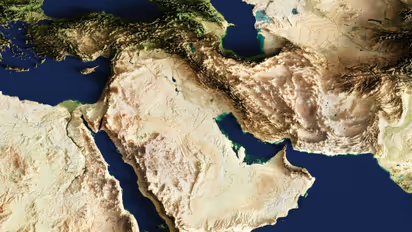
At a basic level, the Middle East usually refers to countries in the north-western part of Asia and parts of south-eastern Europe. These typically include Bahrain, Iran, Iraq, Israel, Jordan, Kuwait, Lebanon, Oman, Qatar, Saudi Arabia, Syria, Turkey, the United Arab Emirates and Yemen — and often Egypt as well.
But unlike continents or clearly defined regions, the Middle East does not have universally agreed borders. Some definitions include parts of North Africa; others do not. In diplomacy, academia and media, the map can shift depending on the context.
And that leads to a fundamental question: middle of what?
The man who coined the term
The phrase “Middle East” was first used in 1902 by American naval strategist Alfred Thayer Mahan.
While analysing the strategic interests of the British Empire, he described the area between India and the Persian Gulf as the “Middle East”. At the time, Britain was the world’s dominant naval power, and control of sea routes — especially those linked to India — was crucial.
Mahan’s idea quickly caught on among military planners and diplomats.
But the concept was not purely geographical. It was shaped by how Europe viewed the world.
A world mapped from London
In the early 20th century, global geography was often described from a European perspective.
- The “Near East” referred to the Balkans and territories of the Ottoman Empire.
- The “Far East” referred to East Asia — places like China and Japan.
- The lands in between came to be known as the “Middle East.”
In other words, the term was relative to Europe’s location. What was “middle” depended on where you stood — and at the time, global power was centred in London and other European capitals.
This was the language of imperial geopolitics.
Oil, empire, and strategic routes
As the British Empire expanded in the late 19th and early 20th centuries, the region gained immense strategic value.
The discovery of oil in Persia (modern-day Iran) in 1908 changed everything. Soon, the area stretching from the eastern Mediterranean to the Persian Gulf became vital to global energy supplies and naval power.
Control of maritime chokepoints such as the Strait of Hormuz — through which a significant share of the world’s oil flows — turned the region into one of the most strategically important parts of the globe.
The label “Middle East” gradually spread through diplomatic cables, military planning documents and newspapers.
After World War I, the name stuck
When World War I ended, the Ottoman Empire collapsed, and new nation-states began to emerge across the region. Borders were redrawn, often by European powers.
Yet the terminology remained.
Over time, governments, scholars and journalists adopted the term so widely that it became almost impossible to replace. Even today, organisations like the United Nations and global media outlets still use it regularly.
But the ambiguity never disappeared.
Is Egypt part of the Middle East or North Africa? Should Turkey be counted as European or Middle Eastern? Depending on who you ask, the answer changes.
Wars that made the term global
The phrase gained even more prominence during major conflicts in the region.
Events such as the Gulf War in 1991 and the Iraq War in 2003 pushed the term into everyday global conversation. As energy politics, military alliances and insurgencies dominated headlines, the “Middle East” became shorthand for one of the world’s most strategically sensitive regions.
Over time, the term also began to carry certain stereotypes — war zones, oil politics and instability — even though the region is far more complex.
A region far more diverse than the label suggests
In reality, the area commonly described as the Middle East spans cultures, languages and histories that differ widely.
Persian, Arab and Turkish societies have distinct traditions. Languages vary from Arabic and Persian to Turkish and Hebrew. Religions include Islam, Christianity, Judaism and many other traditions that have shaped the region for centuries.
Stretching from the Mediterranean Sea to the Persian Gulf, it is one of the cradles of human civilisation — home to ancient empires, trade routes and some of the world’s oldest cities.
That diversity is one reason why some scholars argue the term oversimplifies a complex region.
Alternatives to the term
In recent decades, some academics and policymakers have tried to move away from the Euro-centric language of the past.
Terms like West Asia and North Africa are increasingly used in research and regional discussions. These names are meant to reflect geography rather than colonial viewpoints.
However, the phrase “Middle East” remains deeply entrenched in global diplomacy, security alliances and international media. Changing it would require a shift in how institutions and governments communicate about the region.
The war today shows why the region matters
The current conflict illustrates how interconnected the region has become.
Explosions were also reported in Manama and Doha as Iranian attacks continued. Oil prices surged past $85 a barrel amid disruptions linked to the Strait of Hormuz, highlighting how quickly a regional conflict can impact global markets.
Meanwhile, the International Atomic Energy Agency confirmed that Iran’s Natanz nuclear site had suffered "recent damage", though it added that "No radiological consequence expected."
Israel, for its part, has moved forces toward southern Lebanon, aiming to create a buffer zone along the border as tensions escalate.
The war has also reached infrastructure and diplomacy. Drone strikes hit facilities linked to Amazon in the Gulf, while Iran appealed to the United Nations Security Council, saying:
"The United Nations Security Council has a duty... if it wishes, it can certainly act, because there is no obstacle to its action except its own will."
A name shaped by power
Ultimately, the story behind the term “Middle East” reveals something larger than geography.
Names on the world map are rarely neutral. They reflect the political power, perspectives and priorities of those who first used them.
The phrase emerged from imperial strategy, naval routes and the global dominance of European empires. Yet more than a century later, it still shapes how the world understands one of its most important regions.
And as the latest war unfolds across cities from Tehran to the Gulf, the term continues to frame the story — even as its origins remind us that geography, history and power are often inseparable.