Can the US president declare 'War' on another country? Here's what we know
Synopsis
On June 21, the US bombed Iranian nuclear sites on Trump’s orders, sparking a major legal and political storm over presidential war powers, constitutional limits, and global consequences
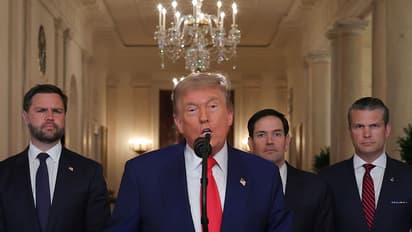
On Saturday, June 21, in a major and sudden escalation, United States launched operation 'Midnight Hammer' to take out three of Iran's nuclear facilities including the most fortified one at Fordow. Donald Trump along with his VP JD Vance announced Sunday morning, that they carried out a 'very successful' attack on three nuclear sites which included Natanz and Esfahan as well.
But with passage of time, it has become clear that Donald Trump acted all by his own and did not have formal Congressional approval for the operation.
Here in this article we find out the legality of Donald Trump's decision - whether it is constitutional for the American President to declare war on another country or does he need approval from US congress.
The strikes have no doubt managed to ignite a constitutional debate and political storm in Washington over whether present Trump was within his legal authority or it was an executive overreach on his part. While some members of the Grand old party has been hailing his move as a much needed decisive action, few are calling it unconstitutional. Democrats are also calling out Trump, many has called the action 'unconstitutional' and 'unauthorized'.
Democrat senator from Vermont, Bernie Sanders while reacting to the news called it 'alarming' and 'grossly unconstitutional'.
So who in America holds the Power to declare war?
The key constitutional question that needs to be answers in this regard is: Who holds the power to initiate a war in the United States? The US constitution mandates a strict separation of power for the executive, legislative and the judiciary unlike India. Though the President of America in his capacity is also the 'Commander-in-chief' of the armed forces (As stated in Article II), it gives the power to declare war to Congress (As stated in Article 1).
According to Article I, section 8, clause 11 of the US constitution, Congress is authorized 'to declare war, grant letters of Marque and Reprisal, and make rules concerning Captures on Land and Water." Though this constitutionality remains at the bone of contention between the congress and successive presidents, we should keep in mind that the United States has not formally entered a war since World War II. Though it has been engaged in long military operations in the middle-east, Afghanistan, Vietnam and other places.
Progressive Democrats such as Representatives Alexandria Ocasio-Cortez and Ro Khanna criticized Trump for bypassing Congress. Khanna emphasized the need for a War Powers Resolution to prevent what he described as another endless war, while Ocasio-Cortez reportedly described the move as grounds for impeachment.
Republican representative from Georgia, Marjorie Taylor Greene, a Trump and MAGA supporter was vocally opposed to a military action. She said she was 'sick of sunding foreign aid and foreign countries and foreign everything'. She went on to add that though she supports nuclear armed Israel's right to defend themselves, she also reserves the right to say no to funding or fighting Israel's war.
Past Precedents
Past presidents including Democrat presidents like Bill Clinton and Barack Obama have taken limited military action without taking prior Congressional approval by citing imminent threats or existing authorizations. Bill Clinton struck Kosovo, Barack Obama intervened in Libya and Trump himself order to strike general Qassem Soleimani in 2020. These serve as examples, where presidents have bypassed congress and taken military actions.
A Constitutional Crossroad
Trump’s decision to order strikes on Iran has reignited a pivotal debate about the limits of presidential authority in matters of war. It poses a fundamental question for American democracy: can a President bypass Congress in initiating acts of war, or must there be legislative oversight?
This could prove to be a defining moment—not just for Trump’s presidency, but for the broader constitutional framework governing US military power. Whether his actions are ultimately upheld or repudiated, they have already set the stage for renewed efforts to clarify, limit, or possibly redefine presidential war-making authority in an age of evolving global threats.