Inequality is being unseen, unheard: Poonam Sharma at UNHRC session
Synopsis
RSKS India's Poonam Sharma addressed the UNHRC, calling for dignity and equality in economic, social, and cultural rights. She highlighted that inequality is about being unseen and proposed an 'Equality by Design' approach with three key proposals.
Compelling Call for Dignity and Equality
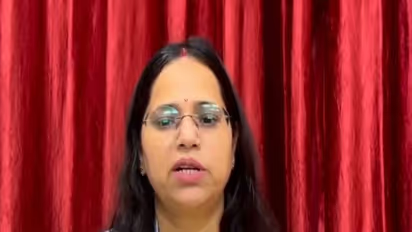
At the 63rd Session of the United Nations Human Rights Council (UNHRC-63), Poonam Sharma, Director of Rajasthan Samgrah Kalyan Sansthan (RSKS India), delivered a compelling call to place dignity, participation and equality at the heart of economic, social and cultural rights. Addressing the Panel on Promoting and Protecting Economic, Social and Cultural Rights within the Context of Addressing Inequalities, Sharma stressed that inequality today is not limited to income or material deprivation. It is also about people who remain unseen, unheard or unable to access rights already promised to them.
“Inequality today is not only about who has less; it is also about who remains unseen, unheard and unable to claim rights already promised to them,” she said. She highlighted how conflict, climate stress, discrimination, debt and technological change are widening existing divides and creating new forms of exclusion.
India's Inclusive Development Model
Invoking India’s ancient principle, “Sarve Bhavantu Sukhinah” May all be happy and live in well-being, Sharma emphasized that progress cannot be meaningful if people are left behind. She highlighted India’s positive experience of connecting development with dignity through education, livelihoods, social protection, cultural preservation and participatory approaches, particularly for tribal communities, minorities and other marginalized groups.
India’s experience demonstrates that inclusion becomes stronger when communities are not treated merely as beneficiaries, but as partners in development. When people participate in identifying needs, shaping solutions and implementing programmes, development becomes more responsive, sustainable and inclusive. Sharma presented this approach as a constructive Indian contribution to the global dialogue on economic, social and cultural rights.
An 'Equality by Design' Approach
Sharma called for an “Equality by Design” approach, where governments and institutions consider equality from the beginning while designing laws, budgets, technologies, public services and development programmes.
Three Practical Proposals
Sharma presented three practical proposals before the international community: 1. Local Equality Audits: to identify who is being excluded from development and public services before inequality becomes deeply entrenched. 2. Community-Led ESCR Innovation Labs: platforms where communities, civil society and institutions can jointly design and test practical solutions for economic, social and cultural rights. 3. A Global OHCHR Knowledge Platform: a mechanism to connect successful practices, grassroots innovations and lessons across countries and regions.
Call for Stronger Partnerships
Sharma also drew attention to financial and liquidity constraints affecting OHCHR’s work on economic, social and cultural rights. She called for stronger partnerships, regional cooperation, innovation and greater knowledge-sharing among States, the United Nations, civil society, academic institutions and local communities so that limited resources do not result in weaker human-rights protection.
Concluding her intervention, Sharma posed a powerful question to the global community, “Can we build equality into every decision before exclusion occurs?” (ANI)