Indian MPs at UN push for financial equity, support for Global South
Synopsis
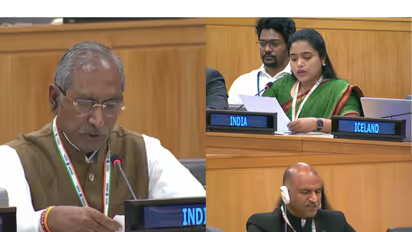
A 15-member Indian MP delegation at the UN pushed for equitable finance and timely member dues. They highlighted India's domestic successes as models and raised concerns over delayed reimbursements to troop-contributing countries.
A 15-member delegation of Indian Members of Parliament initiated an official tour of the United Nations Headquarters, pushing for equitable financial structures, timely payment of member dues, and expanded support for developing nations. The delegation began its official program in New York by paying floral tributes at the Mahatma Gandhi bust inside the UN Headquarters, signalling the start of a series of engagements across key United Nations committees.
Indian MPs Address UNGA Second Committee
Delivering India’s official statement at the General Debate of the UN General Assembly Second Committee, MP C P Joshi centred his address on economic inclusion and global financial equity. He emphasised that developing nations require "affordable, predictable financing and greater representation" in global financial institutions to bridge development gaps. Drawing on India's domestic successes, Joshi highlighted "India’s experience in digital public infrastructure, financial inclusion and domestic resource mobilisation" as actionable models for the Global South. He further pointed to India’s active development partnerships through mechanisms like "the India–UN Development Partnership Fund, IBSA Fund, ISA and CDRI," while insisting that international efforts must prioritise "carrying forward the SDGs’ unfinished work beyond 2030, respecting national ownership and strengthening the UN’s development pillar."
#IndiaAtUN Hon’ble MP Shri @cpjoshiBJP delivered India’s statement at the General Debate of the #UNGA81 Second Committee. He highlighted: ➡️ Affordable, predictable financing and greater representation for developing countries in international financial institutions. ➡️ India’s experience in digital public infrastructure, financial inclusion and domestic resource mobilisation. ➡️ Partnerships with the Global South through the India–UN Development Partnership Fund, IBSA Fund, ISA and CDRI. ➡️ Carrying forward the SDGs’ unfinished work beyond 2030, respecting national ownership and strengthening the UN’s development pillar. @PMOIndia @MEAIndia @PIB_India @IndianDiplomacy @DDNewslive — India at UN, NY (@IndiaUNNewYork) October 5, 2026
Concerns Raised at UN Budgetary Committee
In the UN Administrative and Budgetary Committee (Fifth Committee) session focused on the "Scale of Assessments for the apportionment of the expenses of the United Nations," MP Banshilal Gurjar raised critical concerns over financial equity and the burden placed on troop-contributing nations. Pointing to India's own record, he noted the "UN’s consistent recognition of India in its ‘Honour Roll’ for timely and full payment of its assessed contributions to the UN regular budget." However, Gurjar voiced strong "concern over the delayed reimbursements to troop- and police-contributing countries (TCC/PCCs), most of whom are developing countries, and who have essentially become de facto financiers of UN peacekeeping." To prevent unfair fiscal pressures, he "reaffirmed the principle of ‘capacity to pay’ in the scale of assessments," warning that "developing countries must not be burdened disproportionately" and emphasising that "any review of the current scale methodology must keep its core elements intact, which is non-negotiable." Gurjar supported a waiver request from Article 19 of the UN Charter for São Tomé and Príncipe while stressing that all member states must honor their dues "in full, on time, and without preconditions."
#IndiaAtUN Hon’ble MP @blgurjarbjp delivered 🇮🇳’s statement at the @UN Administrative and Budgetary Committee-Fifth Committee’s first formal meeting on the agenda item: Scale of Assessments for the apportionment of the expenses of the United Nations. ➡️ Highlighted UN’s consistent recognition of India in its ‘Honour Roll’ for timely and full payment of its assessed contributions to the UN regular budget. ➡️ Expressed concern over the delayed reimbursements to troop- and police-contributing countries (TCC/PCCs), most of whom are developing countries, and who have essentially become de facto financiers of UN peacekeeping. ➡️ Supported the Committee on Contribution’s recommendation on waiver request of São Tomé and Príncipe from Article 19 of the UN Charter. ➡️ Reaffirmed the principle of ‘capacity to pay’ in the scale of assessments for the apportionment of UN expenses; developing countries must not be burdened disproportionately. Any review of the current scale methodology must keep its core elements intact, which is non-negotiable. ➡️ Emphasized all Member States to pay their assessed contributions in full, on time, and without preconditions. @MEAIndia @IndianDiplomacy @PMOIndia @DDNewslive @PIB_India — India at UN, NY (@IndiaUNNewYork) October 5, 2026
Call for Accountability and Reform
Also addressing the Fifth Committee during its initial meeting on the "Organisation of Work," MP Gumma Thanuja Rani focused on institutional accountability and safeguarding funding for sustainable development. She emphasised "the need to continue with the reform agenda during the 81st session," maintaining that the "prerogatives of the UN Committee for Programme and Coordination (CPC) and Advisory Committee on Administrative and Budgetary Questions (ACABQ) are intrinsic to the work of the Fifth Committee." Reinforcing the call for financial accountability, Rani urged all member states to submit "their assessed contributions in full, on time, and without preconditions." She called on the Assembly to "ensure adequate financial resources for the UN’s development pillar, including leveraging the UN80 Initiative to strengthen the development pillar," while underscoring "the importance of consensual outcomes" in steering the committee's work forward.
#IndiaAtUN Hon’ble MP @MP_Araku delivered 🇮🇳’s statement at the @UN Administrative and Budgetary Committee-Fifth Committee’s first formal meeting on the agenda item: Organization of Work. ➡️ Highlighted the need to continue with the reform agenda during the 81st session. ➡️… pic.twitter.com/FkkG3iD9SD — India at UN, NY (@IndiaUNNewYork) October 5, 2026
Delegation Briefed on India's UN Engagements
Later in the day, India's Permanent Representative to the United Nations, Harish Parvathaneni, briefed the delegation of parliamentarians on India's wide-ranging engagements with the UN, the Permanent Mission wrote in a post on X. The members also interacted with UN ASG and Regional Director for Asia and Pacific Kanni Wignaraja. The Mission wrote in a post on X that the parliamentarians "discussed UNDP’s work in India, exchanged views on India–@UNDP cooperation, and explored the role of parliamentarians in advancing sustainable development and accelerating SDG implementation."
The 15-member parliamentary group will continue its delegation meetings and committee engagements throughout their visit to UN Headquarters. (ANI)
(Except for the headline, this story has not been edited by Asianet Newsable English staff and is published from a syndicated feed.)