India, Uzbekistan deepen ties, ink deal for Aral Sea rehabilitation
Synopsis
India & Uzbekistan elevated ties to a Comprehensive Strategic Partnership. India will provide a USD 1M grant for the Aral Sea's ecological rehabilitation, and both nations will deepen cooperation in pharmaceuticals, healthcare, and education.
India and Uzbekistan have agreed to deepen cooperation in environmental rehabilitation, pharmaceuticals, healthcare and human resource development, with New Delhi set to provide USD 1 million for greening and ecological rehabilitation of the Aral Sea region under its Grant-in-Aid framework.
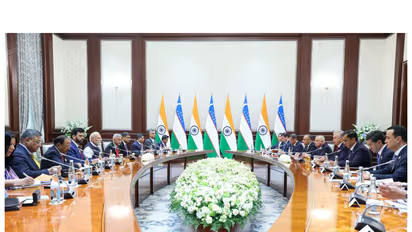
The agreement was announced in the Joint Statement issued during Prime Minister Narendra Modi's state visit to Uzbekistan from August 29 to August 30, during which he held talks with Uzbek President Shavkat Mirziyoyev and the two countries elevated their bilateral ties to a Comprehensive Strategic Partnership.
Environmental Cooperation and Greening Initiatives
Highlighting their shared commitment to a greener future, the two sides said they would cooperate in the greening and ecological rehabilitation of the Aral Sea region. "Uzbekistan and India share the aspiration of leaving a greener and healthier planet for future generations, as reflected in Uzbekistan's 'Yashil Makon' and India's 'Ek Ped Maa Ke Naam' initiatives," the Joint Statement said.
It added that the rehabilitation efforts, worth USD 1 million, including necessary technical support, would be undertaken under India's Grant-in-Aid framework. The environmental cooperation comes after PM Modi and President Mirziyoyev jointly planted a tree in the Presidential Palace garden under India's 'Ek Ped Maa Ke Naam' initiative and Uzbekistan's 'Yashil Makon' green efforts.
Expanding Healthcare and Pharmaceutical Cooperation
The two countries also agreed to expand cooperation in healthcare and pharmaceuticals, with a particular focus on medical innovation, research and investment. The leaders agreed to strengthen public health systems, including through cooperation in biomedical research and medical innovation, by leveraging each other's strengths to develop new treatments and therapies through advanced scientific research.
Tashkent Pharma Park as a Key Platform
The Joint Statement highlighted the potential of the Tashkent Pharma Park Innovative Scientific and Industrial Pharmaceutical Cluster as a platform for implementing joint projects, attracting investment in modern pharmaceutical manufacturing, localising production, facilitating technology transfer and developing a skilled workforce. "The Leaders highly appreciated the growing cooperation in the pharmaceutical sector and underscored the significant potential of the Tashkent Pharma Park Innovative Scientific and Industrial Pharmaceutical Cluster as an effective platform for implementing joint projects, attracting investment in modern pharmaceutical manufacturing, localising production, facilitating technology transfer, and developing a highly skilled workforce," it said.
India and Uzbekistan also backed the establishment of new medical centres, laboratories, research institutions and joint pharmaceutical manufacturing enterprises in Uzbekistan in cooperation with Indian companies. "The Leaders expressed their support for the establishment in Uzbekistan, in cooperation with Indian companies, of new medical centres and laboratories, as well as research institutions and joint pharmaceutical manufacturing enterprises," the statement said.
Focus on Human Resource Development and Education
The two sides also placed emphasis on human resource development and capacity building, particularly in medicine, pharmaceuticals, chemistry, nanotechnology and biotechnology. According to the Joint Statement, more than 2,700 Uzbek nationals have participated in India's Indian Technical and Economic Cooperation (ITEC) programme, while more than 400 Uzbek students have been selected under Indian Council for Cultural Relations (ICCR) scholarships, including scholarships under AYUSH.
Uzbekistan also welcomed India's announcement of the Lal Bahadur Shastri Scholarship for Hindi Language in Uzbekistan. "The Leaders reaffirmed their readiness to further promote cooperation in human resource development under the ITEC Programme," the statement said. The two countries also welcomed the continued expansion of India studies in Uzbekistan and supported greater Uzbek studies in India. They agreed to strengthen academic cooperation through joint research programmes and other educational initiatives.
Strengthening Cultural and Heritage Ties
On cultural ties, the leaders reaffirmed their commitment to expanding cooperation through cultural days, festivals, exhibitions and tours by artistic ensembles, besides strengthening direct links between cultural institutions. They welcomed the signing of the Cultural Exchange Programme for 2026-2030 and cooperation between Uzbekistan and India in the field of archives.
Heritage Site Preservation
The leaders also agreed to deepen cooperation in the preservation, study, restoration and promotion of World Heritage sites, including through digitalisation, the creation of three-dimensional models of archaeological artefacts and the use of advanced technologies for conservation. In this regard, they welcomed the Letter of Intent on the conservation and restoration of the ancient Buddhist sites of Fayaz Tepa and Karatepa in Uzbekistan.
Collaboration in Sports and Traditional Medicine
The two sides also agreed to strengthen sports cooperation through exchanges of experience in athlete preparation and coach training in disciplines including badminton, archery and chess. Yoga and traditional medicine also featured in the expanded cooperation agenda. The leaders welcomed cooperation between the Yoga Federation of Uzbekistan and India's Ministry of AYUSH on instructor training and Uzbekistan's participation in international Yogasana competitions. They also welcomed the conclusion of an MoU on cooperation in traditional medicines.
A Comprehensive Strategic Partnership
The latest agreements form part of a broader effort to translate the upgraded Comprehensive Strategic Partnership into practical cooperation across sectors including trade, investment, transport connectivity, digital transformation, energy transition, critical minerals, food security, healthcare, pharmaceuticals and education.
The two leaders held talks in a "warm, friendly and constructive atmosphere" and conducted a comprehensive review of the current state and future prospects of bilateral relations, besides exchanging views on regional and international issues of mutual interest.
India and Uzbekistan established diplomatic relations on March 18, 1992, with the signing of a protocol in Tashkent. The two countries elevated their relationship to a Strategic Partnership in 2011. Prime Minister Modi's State Visit to Uzbekistan from August 29 to 30 marks another significant step in strengthening the longstanding ties between the two countries, with the latest agreements expanding cooperation from environmental sustainability and healthcare to education, culture, sports and traditional medicine.
(Except for the headline, this story has not been edited by Asianetnews Editorial staff and is published from a syndicated feed.)