India reiterates call for UN reforms, says it's frozen in 1940s
Synopsis
India has again called for UN reforms, arguing its 1940s structure is outdated. Ambassador Harish Parvathaneni urged for UNSC expansion and transparency, comparing the current UN to running AI on a 1945 computer to handle modern global issues.
India on Tuesday reiterated its call for reforms at the United Nations, stressing the need to enhance the organisation's productivity and effectiveness, and highlighting that it cannot address contemporary global challenges while remaining frozen in an architecture designed in the 1940s.
India's Suggestions for a Reformed UN
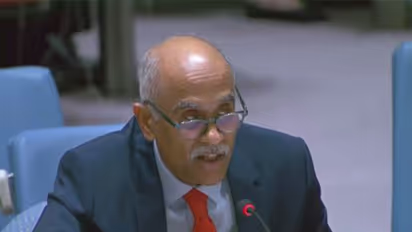
The remarks were made by Ambassador Harish Parvathaneni at the UN Security Council Open Debate on 'Upholding the Purposes and Principles of the UN Charter and Strengthening the UN-centered International System'. He presented India's suggestions to reinforce a UN-centered international system and said that these include strengthening the General Assembly of the body; undertaking meaningful reforms, expanding the UNSC to reflect contemporary geopolitical realities, and making its functioning more transparent and accountable.
"The wider UN membership is an important stakeholder on all Security Council matters. Denying access to historical and contemporary documents and maintaining the rules of procedure at a provisional status are not tenable in this age. The working methods must be refashioned appropriately in tune with our times", he said.
Ambassador Parvathaneni further stated, "The UN Security Council must be a living instrument, not a fossil. More than any other member state, the permanent members must deliberate on this matter."
An Outdated Architecture
The Ambassador highlighted how the present-day geopolitical developments have strained multilateralism, thus growing concerns towards the legitimacy, efficacy and relevance of the United Nations. He noted that while the UN Charter had mandated a review conference in 1955, no such review was ever undertaken.
He said that aside from limited institutional changes in the 1960s and 1970s, the Council's core power structure has remained virtually untouched for eight decades. Calling the current arrangement outdated, Parvathaneni compared the UN's architecture to "running advanced AI technologies on a 1945 computer," arguing that an institution designed for the realities of the mid-20th century cannot effectively respond to the complexities of the 21st.
Calling Out 'Double Standards'
He said the lack of progress in intergovernmental negotiations on Security Council reform reflected entrenched resistance to change, but warned that refusing to adapt would only weaken the UN's authority, credibility and effectiveness. India also flagged what it called a persistent problem of "double standards" within the international system, saying global institutions suffer not only from inconsistent application of principles but also from a widening gap between words and action.
Stronger multilateralism, he said, cannot be built through power politics alone but through cooperation, compromise and a genuine commitment to collective global good. "Brute force and power do not deliver stronger multilateralism or global public good. The spirit of cooperation and ability to make compromises for greater global good must be demonstrated and acted upon", he said in his remarks. (ANI)