How Warming In Tibet Can Supercharge California's Winter Storms Thousands Of Miles Away?
Synopsis
A new study shows how early-winter warming over the Tibetan Plateau can disrupt jet streams, amplifying atmospheric rivers that bring heavy rain and snow to California.
California’s record-breaking precipitation in the winters of 2016–2017 and 2022–2023 caused widespread flooding and damage. These events stood out because they occurred during La Niña conditions, which are typically associated with drier winters in the region.
Atmospheric scientists have now identified a surprising connection: unusually warm land temperatures over the Tibetan Plateau in early winter can set off atmospheric changes that strengthen storms thousands of miles away on the U.S. Pacific Coast.
Tibetan Plateau’s Role In Extreme Weather
Researchers analyzed observations and found a statistically significant relationship between early-winter warming on the Tibetan Plateau and late-winter precipitation in California.
Climate-model experiments confirmed the link. When models relied only on sea-surface temperatures, they failed to reproduce the warming over the plateau or the extreme precipitation in California. But when Tibetan Plateau land temperatures were included, the models captured both.
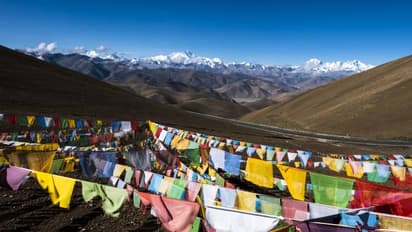
The plateau’s vast size and elevation, averaging 14,800 feet, make it a powerful driver of atmospheric changes. Warming alters temperature differences between the plateau and surrounding regions, disturbing the jet stream. This disturbance travels eastward as a Tibetan Plateau-Rocky Mountain Wave train, eventually destabilizing over the Pacific and creating conditions that strengthen atmospheric rivers.

Atmospheric Rivers And California’s Floods
Atmospheric rivers are long, narrow corridors that transport immense amounts of water vapor. When they reach the West Coast, they deliver intense rain and snow.
Previous studies have shown that atmospheric rivers drive California’s largest precipitation events. The new findings suggest that Tibetan Plateau warming amplifies these storms, explaining why extreme rainfall occurred even during La Niña winters.
Forecast systems have traditionally focused on ocean conditions, particularly the El Niño–Southern Oscillation. The study shows that land conditions thousands of miles away can also provide critical clues.
Monitoring Tibetan Plateau temperatures in early winter, alongside ocean and atmospheric data, could improve forecasts of extreme precipitation on the West Coast. This would give communities, water managers and emergency planners more time to prepare for damaging atmospheric river seasons.
The Tibetan Plateau’s influence extends beyond California. It also affects the East Asian Monsoon, while similar patterns have been observed with Rocky Mountain spring temperatures influencing weather in the U.S. Southern Plains.