High Rents, Empty Pockets: Europe in Turmoil
Synopsis
A tragic eviction of an 87-year-old woman in Spain has highlighted a growing crisis across Europe driven by soaring living costs, unaffordable housing, and weak public services. This shared frustration has sparked widespread protests and violent riots in multiple countries, including France, Italy, and Albania.
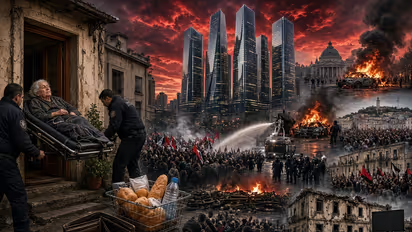
Picture an 87-year-old woman in Spain being carried out of her own home on a stretcher. Her landlord was an investment fund — a company that buys houses the way others buy shares, hoping to make a profit. It raised her rent by 230 per cent. She could not pay. She went to court and lost. Two weeks after she was evicted, she died. That single image has made people across Spain angry. They are now demanding lower rents, an end to evictions and a complete ban on such funds buying homes.
Her story is one spark among many. Serious unrest is spreading across Europe, with protests in France, Italy, Belgium, Portugal, Spain and Albania. There are warnings that Germany, Greece and Austria could follow.
Three pressures have pushed people to breaking point.
The first is the cost of daily life. Between August 2021 and August 2026, prices of food and drinks across Europe rose by 34 per cent, while salaries did not keep pace. A full month of hard work no longer covers the basics. When the grocery bill climbs, every other payment, from electricity to school fees, becomes harder. That is why protesters are asking for higher wages and stronger pensions.
The second is housing. House prices have more than doubled since 2017, and rents have shot up. For a young European, buying a home was once a natural step in life. Today it feels out of reach.
The third is weak public services. Young people in Belgium worry about rising education fees. In France, they have complained about the poor condition of their schools. In Albania, the complaint is the same. The demand is simple: proper classrooms, working services and governments that listen.
Across the continent, this shared anger shows itself in different ways. In some places it is voiced through peaceful marches. In others it has turned into open street violence.
Portugal shows the quieter face. Home prices there rose by 124 per cent between 2015 and 2024, nearly twice the European Union average. On Saturday, hundreds gathered in central Lisbon, the capital, asking for affordable housing, higher wages and better living conditions. Their message is the same everywhere: people want to be able to afford the cities they live in.
Elsewhere, frustration has turned violent. In Italy, a Saturday march in Milan over living costs descended into rioting. Crowds threw stones at police, looted shops, burnt cars and set police barricades on fire. The trouble spread to other cities, and 28 people have been arrested.
Belgium saw similar scenes this weekend. In Brussels, the capital, young protesters threw objects at police, who replied with tear gas and water cannons. Anger over living costs mixed with anger over rising education fees. The country's interior minister has said plainly that this is no longer a protest but violence.
France has seen some of the most intense confrontations. Its burning streets and clashes have dominated international headlines. Many people assumed the anger was French alone. It is not.
The most serious flashpoint is Albania. In Tirana, the capital, demonstrations have entered their seventh day. They began over education costs and poor university conditions but have grown into a wider movement against the government itself, targeting corruption, unemployment and falling standards. Buildings have been burnt and crowds have fought riot police. Their main demand is that Prime Minister Edi Rama, the head of Albania’s government, should resign. He has refused. He says a government that bargains with such demands has already collapsed, and that Albania has lived through this kind of unrest before and took years to recover.
Each country has its own politics and its own specific demands. Underneath, the feeling is the same: people are paying more, getting less, and have waited too long for things to improve. If European governments do not fix food prices, rent and wages soon, the crowds in France will not be an isolated wave. They will be the opening chapter.
(Girish Linganna is an award-winning science communicator and a Defence, Aerospace & Geopolitical Analyst. He is the Managing Director of ADD Engineering Components India Pvt. Ltd., a subsidiary of ADD Engineering GmbH, Germany.)