Greenland’s ‘Achilles Heel’ Exposed: Scientists Warn Trump’s Arctic Plans at Risk
Synopsis
Scientists have found a soft sediment layer beneath Greenland’s ice that acts like a lubricant when wet, allowing glaciers to slide faster. This weak foundation makes ice sheet less stable and could accelerate sea-level rise beyond current estimates.
Scientists have uncovered a previously unknown geological weakness beneath Greenland’s vast ice sheet -- a discovery that could accelerate ice loss, worsen global sea-level rise, and complicate strategic ambitions in the Arctic. A new study published in Geology reveals that large parts of Greenland’s ice rest not on solid bedrock, but on deep layers of soft sediment made up of sand, dirt, and clay.
This sediment layer, in some regions extending hundreds of feet deep, acts like a lubricant beneath the ice. As surface melting increases, meltwater seeps down through cracks and channels, further weakening the sediment and allowing glaciers to slide faster toward the ocean. Researchers warn that this makes Greenland’s ice sheet significantly less stable than previously assumed in climate models.
How the Discovery Was Made
The study was led by University of California, San Diego researcher Yan Yang and relied on seismic data rather than direct drilling. Scientists analysed earthquake vibrations recorded over two decades by 373 monitoring stations across Greenland. By studying how seismic waves slowed as they travelled beneath the ice, the team identified a soft layer between the ice and the underlying bedrock.
Comparisons with computer models that assumed ice resting directly on hard rock revealed consistent delays in seismic signals. These delays could only be explained by the presence of sediment. In some locations, the layer was as thin as 15 feet, while in others it reached depths of 650 feet or more.
Uneven Vulnerability Across Greenland
The sediment layer is not evenly distributed. Thick deposits are mainly found in warmer, wetter regions where glacier movement is already rapid. In colder areas, where the base of the ice remains frozen, sediments are thinner or absent. This helps explain why some Greenland glaciers are collapsing faster than others.
Yang cautioned that as climate warming continues, increased meltwater could further weaken these sediment layers, speeding up ice flow and increasing ice loss to the ocean faster than current projections suggest.
Implications for Sea-Level Rise
Greenland’s ice sheet is one of the world’s largest contributors to rising sea levels. If sediment-driven acceleration becomes more widespread, global sea-level rise could occur sooner and more rapidly than anticipated, posing serious risks to coastal cities and low-lying regions worldwide.
The findings raise concerns that existing climate models may underestimate Greenland’s vulnerability because they do not fully account for subglacial conditions.
Challenges for Arctic Resources and Strategy
Beyond climate science, the discovery has major geopolitical implications. Greenland is believed to hold vast reserves of oil, gold, copper, iron, graphite, and rare earth elements beneath its ice. However, mining and drilling operations require stable, frozen bedrock — something soft sediment cannot provide.
Studies have shown that drilling through thick sediment can clog equipment, slow progress, damage machinery, and create unsafe conditions. Increased iceberg calving caused by faster glacier movement also raises risks for offshore oil rigs and shipping lanes, driving up costs and insurance risks.
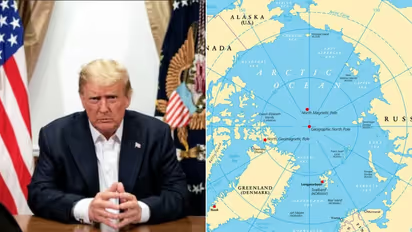
These challenges complicate long-standing US interest in Greenland. Former President Donald Trump repeatedly argued that US control of Greenland was essential to counter Russia and China in the Arctic and to secure access to strategic resources. While the US already operates military facilities on the island under agreements with Denmark, scientists warn that unstable subglacial conditions could limit long-term infrastructure development.
A Warning for the Future
The discovery highlights how hidden geological features can reshape both climate projections and geopolitical strategies. Greenland’s ice is not only melting from above — it is sliding from below, driven by a weak foundation that climate change may further destabilise.
As global temperatures rise and Arctic competition intensifies, Greenland’s newly identified “Achilles heel” underscores a sobering reality: natural forces may ultimately constrain even the most ambitious strategic plans.