Expert Predicts Impact of US-China Grand Bargain on India Strategy
Synopsis
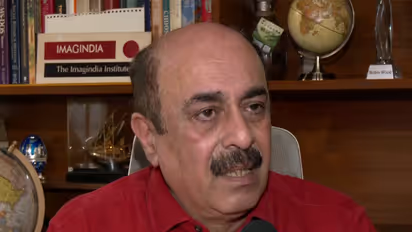
Expert Robinder Sachdeva discusses how a potential US-China grand bargain under President Trump might impact India's strategic interests, while analyzing how US midterm election outcomes could influence Washington's foreign policy landscape.
Potential G2 Formula and Its Impact on India
A possible grand bargain between the United States and China under President Donald Trump could have implications for India, particularly in the Indo-Pacific region, Foreign Affairs Expert Robinder Sachdeva said, while noting that the US midterm election results could make Trump more proactive in international relations. Speaking to ANI on the impact of the US midterm elections on Washington's foreign policy towards India and China, Sachdeva said that Trump appeared to lean towards a possible G2 formula involving a broader understanding between Washington and Beijing on trade and coexistence, which could have implications for India's strategic interests.
"Regarding China, I think he leans towards perhaps a G2 formula. That, you know, a grand bargain between the US and China on trade and coexistence- and the Western Hemisphere is ours, and let us say the Indo-Pacific region is yours. At the same time, America puts sanctions and tries to make sure that China does not catch up on technology or dual-use technology," he said.
Congressional Challenges to Foreign Policy
However, he said Trump's possible efforts towards a grand bargain with Beijing could face resistance from the US Congress, particularly Democrats, whom he described as generally hawkish towards China. "However, I think Trump's that leaning towards a G2 will now be challenged by the Congress. Because the Democrats are typically not very pro-China; rather, they're hawkish towards China. So, they will try to put some guardrails on Trump, you know, efforts--if he does--towards a grand bargain with China. And in case Trump does some grand bargain with China, then, of course, for us in India, it does have some implications," he added.
Sachdeva further said that the results would constrain Trump's domestic agenda and make the remainder of his presidency a "limping duck" one. "Broadly speaking, the midterm elections will handicap the domestic agenda of President Donald Trump. It will be, I say, a limping-duck diplomacy, because Trump will be handicapped, but Trump will continue to engage and fight out things, right? But still, on the whole, it will be a limping duck presidency for the next two years," he said.
Executive Power and International Affairs
Sachdeva said US presidents facing domestic political constraints often find greater opportunities to influence international affairs, given the executive's wider powers in matters of national security and foreign relations. "Now, typically what happens when a president of the United States has a constrained playfield within the country, he finds more release of energy and ability to influence world affairs. Because the president's powers, the executive powers, in terms of national security and foreign relations, are much greater, where he is not constrained by the US Congress," he said.
He further said Trump was unlikely to spend the next two years focusing only on domestic legislative battles and could instead turn his attention towards international affairs. "So, Trump being an energetic, active leader, and he has also said that, 'I will not spend the next two years just sitting and doing veto, veto, veto.' Okay? He will have to do something else, and he will. So, I anticipate that Trump will be even more proactive in international relations. Now, what he may do, how he may do, we cannot say. So, we can expect more of that," Sachdeva said.
Recent Trade Developments and Domestic Politics
His remarks come as the United States and China have reached a consensus to identify more favourable tariff treatment for USD 30 billion worth of non-sensitive goods in each direction, signalling progress in trade negotiations between the world's two largest economies. US Treasury Secretary Scott Bessent announced the development while speaking at the National Committee on US-China Relations Gala in New York on Tuesday. According to remarks published by the US Department of the Treasury on Wednesday, Bessent said the understanding was reached under a newly established bilateral Board of Trade.
"Under the Board of Trade, we reached consensus to identify more favourable tariff treatment for $30 billion of non-sensitive goods in each direction," Bessent said. He added that the board had also launched a working group to address trade barriers in the agricultural sector. Bessent further said China had previously agreed to import at least 25 million metric tonnes of soybeans and 10 million metric tonnes of coal from the United States over the next two years.
Hegseth Impeachment Debates
Meanwhile, US President Donald Trump criticised outgoing Congressman Thomas Massie after the US House voted against articles of impeachment against Secretary of War Pete Hegseth on Tuesday (local time). In a post on Truth Social, Trump said, "The Democrats' attempt to impeach Secretary of War Pete Hegseth has miserably FAILED! Every single Republican, except Thomas Massie, a major LOSER, voted in favour of Pete." He also cited what he called victories in Venezuela and Iran, military recruitment figures and the morale of the armed forces, adding that these had led to the "EXONERATION" of Hegseth.
However, House Minority Leader Hakeem Jeffries indicated that the matter could resurface in the new Congress. "I haven't had a conversation with anyone on the floor team about what may or may not have happened in terms of the Hegseth resolution, but this is not the end of it; it's just the beginning," he told US media, as reported by CNN. With Democrats set to take control of the House in the new Congress, the changing composition of Congress could shape the domestic political environment for Trump's administration and influence debates surrounding its foreign policy priorities. (ANI)
(Except for the headline, this story has not been edited by Asianetnews Editorial staff and is published from a syndicated feed.)