Inside Trump-Xi's 100-Minute Meeting: Tariff Cuts, Rare Earth Deal and Nuclear Buzz
Synopsis
Donald Trump hailed his meeting with Xi Jinping in Busan as a “great success”, sealing a rare earths and fentanyl tariff deal, pledging soybean buys, and announcing a potential China visit—amid nuclear testing remarks and renewed global tensions.
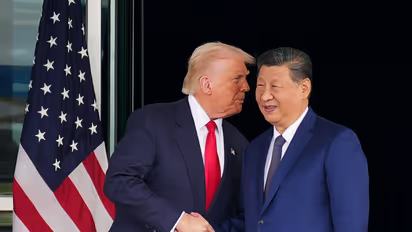
After years of frosty silence and simmering trade hostilities, US President Donald Trump and Chinese President Xi Jinping came face to face in Busan on Thursday — their first meeting since 2019. The result, Trump declared, was a “great success”.
The two leaders struck a temporary but crucial deal to trim US tariffs on China and ensure the continued flow of rare earth minerals, a sector Beijing dominates and Washington heavily relies upon. For markets rattled by uncertainty and industries crippled by supply chain disruptions, the meeting brought a cautious sigh of relief.
“I thought it was an amazing meeting,” Trump said after the talks, describing Xi as “a tremendous leader of a very powerful country.” He also announced plans to visit China in April — a move that could reset the course of a relationship that has defined global geopolitics for more than a decade.
The Deal: Rare Earths, Tariffs and Soybeans
The agreement, according to Trump, covers several key fronts — fentanyl, farm goods, and rare earths.
“On fentanyl we agreed that he was going to work very hard to stop the flow… I put a 20-percent tariff on China because of the fentanyl coming in... and based on his statements today I am going to reduce that by 10 percent,” Trump said, striking a tone of conditional optimism.
In return, China will resume what Trump called “tremendous amounts of soybean and other farm product purchases” — a clear nod to his voter base in America’s agricultural heartland.
Perhaps most significantly, the two sides signed off on a one-year extendable deal for China’s supply of rare earth elements — materials critical for everything from smartphones to electric vehicles to advanced weapon systems.
“All the rare earths has been settled, and that’s for the world,” Trump told reporters aboard Air Force One, moments before departing Busan.
For months, Beijing had been tightening controls on the export of these materials, raising fears of a global supply shock. The new deal, at least for now, eases that anxiety.
Xi’s Measured Words: “Partners and Friends”
Xi Jinping, ever the cautious statesman, struck a conciliatory tone before the meeting. “China and the US can jointly shoulder our responsibility as major countries and work together to accomplish more great and concrete things for the good of our two countries and the whole world,” he said.
“China and the US,” Xi added, “should strive to be partners and friends.”
The optics of the meeting were carefully choreographed — Trump flanked by Secretary of State Marco Rubio, Treasury Secretary Scott Bessent, and Commerce Secretary Howard Lutnick; Xi accompanied by Foreign Minister Wang Yi, Vice Premier He Lifeng, and Commerce Minister Wang Wentao.
The talks lasted around 100 minutes — intense, closed-door, and described by aides as “substantive”.
A Nuclear Shadow Over Busan
Moments before the historic handshake, Trump dropped a bombshell on Truth Social:
“Because of other countries’ testing programs, I have instructed the Department of War to start testing our Nuclear Weapons on an equal basis.”
The statement came just a day after Russian President Vladimir Putin boasted of testing a nuclear-capable underwater drone, defying US warnings.
It remains unclear whether Trump’s comments referred to actual nuclear test explosions, something the US hasn’t done since 1992, or non-explosive testing of weapons systems. Either way, the remarks added an unmistakable layer of tension to an already fraught meeting.
Trump also warned that while China is currently a “distant third” behind the US and Russia in nuclear stockpiles, it “will be even in five years.”
No Mention of Taiwan — A Calculated Omission
Speculation had swirled that Xi might press Trump on Taiwan, especially as Beijing ramps up military and diplomatic pressure on the self-governed island. Yet, according to Trump, the topic “never came up.”
“That was not discussed actually,” he said flatly.
The omission was notable — perhaps a deliberate attempt to keep the focus on economic cooperation rather than ideological divides.
However, Trump did say the two sides agreed to “work together” on Ukraine, a rare point of alignment amid rising global fragmentation.
Gifts, Crowns and a Golden Gesture
The Busan meeting was the grand finale of Trump’s Asia tour — a whirlwind of pageantry and political theatre.
In Japan, new Prime Minister Sanae Takaichi reportedly told Trump she would nominate him for the Nobel Peace Prize, presenting him with a gold-plated golf ball and a putter.
In South Korea, he was showered with praise and presented with a replica of an ancient golden crown, a symbolic gesture of friendship and respect.
“This has been an incredible trip,” Trump said, beaming as he boarded Air Force One, waving and pumping his fist.
Looking Ahead: A Fragile Truce
The Busan summit was part diplomacy, part theatre — but its implications could be real. By addressing both the fentanyl crisis and the rare earths chokehold, Trump and Xi may have just bought the world a year of relative stability.
Still, beneath the smiles and photo-ops lies a deeper unease. The spectre of nuclear rivalry, unresolved questions over Taiwan, and America’s own domestic politics all hang over what Trump called a “great success.”
For now, though, the world’s two most powerful men have managed what once seemed impossible — a handshake in Busan, and a deal that might just keep the global machine running a little longer.