Trump's Hormuz Blockade: World's Costliest Toll War
Synopsis
The Strait of Hormuz is a narrow stretch of water — just 33 kilometres wide at its thinnest — sitting between Iran and Oman. Nearly 20% of the world's entire oil supply passes through this single passage every day.
Imagine you are driving on a highway and suddenly someone puts up a toll booth — but the person collecting the toll is not the government, not any legal authority, but your enemy. And now your own country's ally tells you: do not pay that toll. If you pay, we will come after you too. This is exactly what is happening right now in one of the most important waterways on earth — the Strait of Hormuz.
Let us understand this from the very beginning, simply and clearly.
The Strait of Hormuz is a narrow stretch of water — just 33 kilometres wide at its thinnest — sitting between Iran and Oman. Nearly 20% of the world's entire oil supply passes through this single passage every day. Saudi oil, Iraqi oil, UAE oil — all of it flows through here to reach India, China, Japan, Europe, and beyond. If this passage is blocked or disturbed, the entire world feels the pain at the petrol pump, in grocery prices, and in electricity bills.
Now here is what happened. On February 28, America and Israel began a war against Iran. People feared Iran would shut Hormuz entirely. But instead, Iran did something clever — it did not fully close the strait, but it started threatening tankers, reducing ship movement, and quietly collecting fees from certain vessels to allow them safe passage. Think of it as an illegal toll booth run by Iran in the middle of international waters.
On April 11, two Chinese government-owned tankers carrying Iraqi and Saudi oil, along with another ship, were reportedly allowed to cross — after paying Iran this passage fee. Iran was essentially saying: you want to pass through my waters, you pay me.
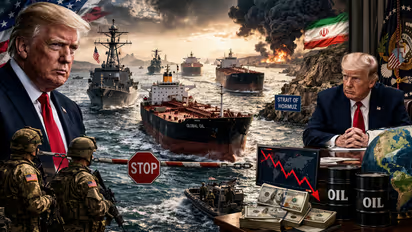
Donald Trump saw this and said: enough. On April 13, America imposed its own blockade — officially stopping any ship going to or from Iranian ports. And then came the critical warning that changed everything for countries like India: America declared that any country, any ship, any company that pays Iran this toll fee will face consequences from the United States as well.
India immediately denied paying any such fee. But the message was loud and clear to the entire world — you cannot pay Iran and then expect America to look the other way.
Trump's reasoning is straightforward. Iran is earning money from this illegal toll while simultaneously threatening global shipping. That income funds Iran's military, its nuclear programme, and its proxies across the Middle East. Cut that income, and you cut Iran's power. Starve the economy, force the leadership to beg for negotiations.
A retired American admiral confirmed that enforcing this blockade is militarily very possible. America does not need to stop every single ship. Stop two or three, seize them — and every other captain in the world will immediately rethink whether the journey is worth the risk. America has done this before with Venezuela-linked tankers.
But here is the dangerous part that everyone is worried about.
This blockade does not just hurt Iran. It hurts everyone. The strait is already partially disrupted due to the ongoing war. Oil shipments are already delayed. Now with America's blockade added on top, global oil supply tightens further. Experts warn that oil prices could approach $150 per barrel by the end of April. That directly means costlier petrol, costlier cooking gas, costlier food — for ordinary families in India and everywhere else.
There is also a deeper, more serious concern — international law. The Strait of Hormuz is an international waterway. Ships of all nations have the legal right to pass through it freely. This is called the right of innocent passage — a fundamental principle that the entire global trading system depends on. When Iran starts collecting illegal tolls, it violates this law. But when America now unilaterally decides to blockade and inspect ships of all nations — including those of France, Turkey, China, and India, all of which are not parties to this conflict — it also puts enormous pressure on this very same principle of free navigation.
One expert summed it up perfectly: this is another serious blow to the idea that the world follows a rules-based system. First Iran broke the rules. Now America is bending them to fight back. And when two giant powers both start treating international law as optional, smaller countries are the ones who suffer the most.
Iran's leadership, meanwhile, believes it has already won the first round. It survived the war, kept its nuclear material, and still controls Hormuz. It believes it can outlast Trump again — just as it survived his maximum pressure campaign in 2020, when oil exports crashed but the country kept standing.
As one expert said with brutal honesty: a blockade only works if it lasts long enough. You cannot squeeze a country for one week and expect them to surrender.
The toll booth is still standing. The question is — who blinks first?