CyRo: Bengaluru Robot Achieves 'Holy Grail' of Picking Up New Objects
Synopsis
Bengaluru-based CynLr has developed CyRo, a robot with 'baby-like intuitiveness' that can pick up unseen objects. This breakthrough addresses a major limitation in robotics and has applications in automotive, semiconductor, and warehouse automation.
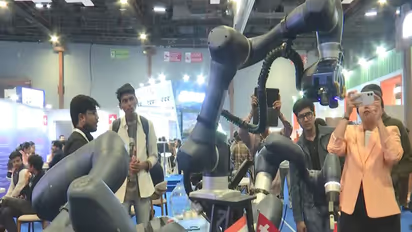
In a quiet corner of the AI Impact Summit pavilion, a robot with two arms and a pair of eyes is performing a task that has long been the "holy grail" of robotics: picking up objects it has never seen before.
Known as CyRo, this stationary robot is designed to imitate the upper torso of a human. It brings a "baby-like intuitiveness" to a field that has traditionally been stiff, over-programmed and limited by data. CyRo is the brainchild of CynLr (short for Cybernetics Laboratory), a Bengaluru-based fundamental intelligence company co-founded by Nikhil Ramaswamy and Gokul NA. The company is headquartered in Whitefield, Bengaluru. It maintains a global footprint with a design and research centre in Lausanne, Switzerland, and a sales office in the US. Together, they are building the intuitive aspects of object handling that current AI systems lack, particularly when dealing with transparent, metallic or completely unknown items.
The Challenge in Modern Robotics
Speaking at the summit, Co-founder Gokul Namakkal Arulsanmugam explained that today's robots struggle with basic tasks, like fitting a bolt into a screw hole without slipping. "That's how limited the robotics technology is," Gokul noted. He added that this limitation is why mobile phone assembly, automotive lines and semiconductor fab labs still rely heavily on manual labour. In a car with 10,000 parts, most are still hand-assembled because machines cannot adapt to "alien" situations.
A New Approach: 'Baby-Like Intuition'
"A human baby will be able to go and pick an object without knowing what they are," Gokul said, contrasting human instinct with rigid AI. "Unless and until you build that intuitiveness into a robot, they are not trainable, they are not AI-friendly." CynLr's approach is to build the capabilities of the human brain into the robotic arm. This allows CyRo to handle objects in unfamiliar situations, such as varying lighting or reflections on water, without prior training.
The magic of CyRo lies in its vision system. Unlike typical AI that requires millions of data points and months of training, CyRo learns on the fly. When a random object is placed on its tray, the robot doesn't need to recognise the item. It simply understands what is changing in the scene. "It gets curious about the object in front of it, goes and grabs them," Gokul explained. Within 10 to 15 seconds, the system figures out how to grasp the object. It instantaneously adjusts its force for hard or soft items and senses if a part is slipping.
Industry Adoption and Pilot Programs
This breakthrough has already caught the eye of global industry leaders. CynLr is currently engaged in a two-year pilot with Audi to integrate this technology into their prototype manufacturing lines. They have also signed the world's third-largest semiconductor equipment manufacturer and are in talks with luxury car brands.
Future Potential and the Vision for 'Software Defined Factories'
Beyond automotive and semiconductors, the technology holds massive potential for warehouse automation and research labs where human contamination must be avoided. While CyRo is currently a stationary platform (joined by its mobile counterpart, Synoid), the underlying technology could eventually transition into surgical robotics. Gokul clarified that a "medical grade" version would require independent investment. For now, the focus remains on a six-year journey that survived the havoc of COVID-19 to pursue a larger vision: Software Defined Factories. The ultimate pitch for CynLr is to allow manufacturers to change an entire factory's output, moving from one car model to another or handling multiple platforms on the same line, with a simple software update. By replacing rigid physical setups with intuitive, adaptive hardware, CynLr is ensuring that the factories of the future are just as curious and capable as the humans they assist. (ANI)