Climate Change Could Help World's Fastest Animal Expand Its UK Territory By 74% By 2080
Synopsis
Climate change could reshape Britain's bird population by 2080, with peregrine falcons and several other birds of prey gaining new habitats. However, some species may struggle as their preferred landscapes shrink
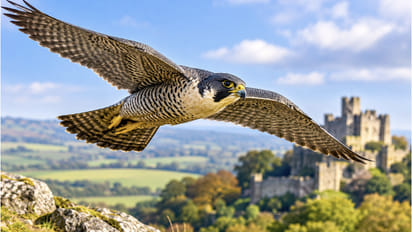
Peregrine falcons, known as the fastest animals on Earth, could significantly expand their presence across Britain as climate change transforms natural habitats. According to a new study published in Frontiers in Ecology and Evolution, the species could see an increase of up to 74% in suitable habitat by 2080.
The research examined how a high-emissions climate scenario could affect the landscapes supporting 16 different birds of prey in the UK. The findings suggest that changing environmental conditions will not necessarily affect every species in the same way.
Peregrine falcons are particularly well-equipped to adapt because they can survive in diverse environments. From deserts and tropical regions to densely populated cities, these birds have demonstrated an ability to make use of different landscapes. They have even been spotted nesting on tall urban structures, including skyscrapers.
Golden Eagles, Barn Owls Among Birds That Could Benefit
Peregrine falcons are not the only birds of prey that could find more suitable habitats in Britain as the climate changes. Golden eagles, barn owls and marsh harriers are also expected to benefit from shifting environmental conditions, according to the research.
Other adaptable species, including sparrowhawks and tawny owls, are also expected to continue doing relatively well. Their ability to occupy different types of habitats could give them an advantage as temperatures and landscapes change.
Connor Panter, a researcher at the University of Nottingham's School of Geography and one of the study's authors, highlighted the importance of looking beyond the assumption that climate change will negatively affect every species.
The research suggests that some wildlife populations could find new opportunities as their surroundings change, even while other species face growing environmental pressures.
Short-Eared Owls And Goshawks Could Face Habitat Loss
While some birds of prey may benefit, the changing climate could create serious challenges for species that depend on specific environmental conditions.
Short-eared owls, for instance, rely heavily on heather moorlands, which are expected to decline in extent under the projected climate scenario. Goshawks could also face difficulties as large forest habitats, essential for their survival, experience changes.
Hen harriers present an interesting case in the study. Although they are largely associated with upland environments in Britain, modelling suggests that suitable habitats for them could increase. However, researchers are uncertain whether these birds would successfully move into newly suitable lowland areas.
The findings could help conservationists identify regions where wildlife protection efforts should be prioritised. Understanding which species are likely to gain or lose suitable habitats could help authorities develop more effective strategies to protect Britain's birds of prey in the decades ahead.