China reaffirms commitment to Mideast peace after US-Iran breakthrough
Synopsis
China reaffirms its commitment to Middle East stability after being credited by US President Trump for bringing Iran to the negotiating table. The breakthrough led to a ceasefire and the reopening of the Strait of Hormuz.
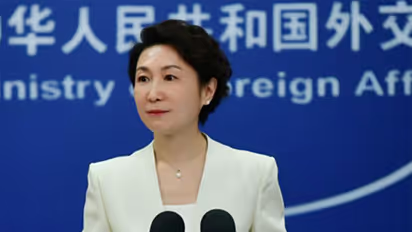
The Chinese government has reaffirmed its commitment to regional stability following acknowledgements of its role in facilitating diplomatic breakthroughs in the Middle East, as reported by China Daily. Chinese Foreign Ministry spokesperson Mao Ning stated that Beijing remains dedicated to fostering a peaceful resolution to ongoing tensions in the region.
The spokesperson's comments came as a direct response to international developments involving the United States and Iran. According to the report, Mao Ning addressed the media after US President Donald Trump credited Beijing with influencing the diplomatic shift, specifically noting that "China had helped bring Iran to the negotiating table."
Beijing Details Proactive Diplomatic Stance
In her remarks, the spokesperson emphasised the persistent efforts of the Chinese administration to mediate between conflicting parties. Mao Ning said China has been "actively working to promote peace and a ceasefire," highlighting the nation's proactive diplomatic stance. Expanding on Beijing's future involvement, she further noted that the country "will continue to play a constructive role in helping restore peace and stability in the Gulf and the broader Middle East."
The Ceasefire Agreement and China's Crucial Role
This diplomatic assertion follows President Trump's statement on Tuesday, where he expressed his belief that China had successfully convinced Iran to enter negotiations. According to The Times of Israel, this breakthrough came after the US President announced a 14-day suspension of military strikes against the Islamic Republic, a pause in the "bombing of Iran" granted in exchange for the "reopening of the Strait of Hormuz" by Tehran.
Last-Minute Intervention Averts Further Conflict
The critical nature of Beijing's involvement was further highlighted by a report in The New York Times. Citing three Iranian officials, the report indicated that the decision to accept the Pakistan-mediated truce followed a last-minute intervention from China, which reportedly urged Iranian leadership "to show flexibility and defuse tensions" due to mounting anxieties over the regional conflict's global economic fallout. The Times of Israel further reported that officials claimed the cessation of hostilities received approval from Supreme Leader Mojtaba Khamenei. The younger Khamenei was reportedly "wounded at the start of the US-Israeli bombing campaign" and has remained out of the public eye since his appointment to succeed his father, Ali Khamenei, who was "killed in the opening strike" of the war.
Beijing's Strategic and Economic Leverage
Beijing's influence stems from its dual role in the region as a primary strategic ally of Tehran and the leading purchaser of Iranian crude oil, the majority of which is transported through the Strait of Hormuz. Despite these ties, China also possesses deep economic interests within Gulf nations and has frequently "criticised Iran's attacks on them" throughout the course of the hostilities involving Israel and the United States.
High-Stakes US-China Summit Planned
In a move highlighting the growing significance of Chinese diplomacy, President Trump is anticipated to visit Beijing in mid-May for a high-stakes summit with President Xi Jinping. The diplomatic mission was initially planned for early April, but was delayed by the US President, who stated at the time that his presence was required in Washington "to oversee the Iran war."
Background of the Escalating Conflict
The sudden announcement of the ceasefire was made late at night, a mere 90 minutes before a final ultimatum for Iran to clear the Strait of Hormuz. Previously, the US President had warned of the total destruction of Iran's "bridges and power plants" if the blockage continued, cautioning as the deadline approached that "a whole civilisation will die tonight."
The conflict had escalated rapidly after February 28, when the US and Israel initiated a massive air campaign intended to topple the regime and dismantle its "ballistic missile and nuclear programmes." In response, Iran carried out widespread drone and missile strikes and implemented a blockade on the Strait of Hormuz.
The impact of the hostilities has been felt globally, as the strategic waterway typically facilitates the movement of approximately 20 per cent of the world's petroleum. Traffic has recently seen a 90 per cent decline in commercial movement, triggering a global surge in energy costs and adding significant urgency to the current diplomatic efforts to maintain the temporary truce. (ANI)
(Except for the headline, this story has not been edited by Asianet Newsable English staff and is published from a syndicated feed.)