Belgian Farmer Goes 26 Years Without Irrigation, Uses No-Till Farming To Keep Soil Moist
Synopsis
A Belgian farmer has not irrigated his crops for 26 years. He relies on soil management techniques that help the ground absorb and retain rainwater.
Water becomes one of the biggest concerns for farmers during heat waves. Crops need moisture to survive, while drought and rising temperatures put pressure on water supplies. A Belgian farmer's unusual approach to soil management is now getting attention online.
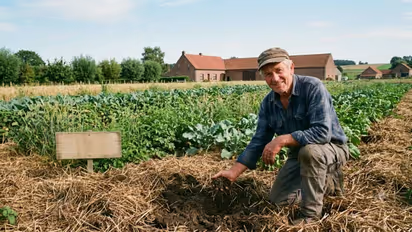
West-Flemish farmer Diederik Steyaert says he has not irrigated his crops for 26 years. He relies on rainfall and farming methods designed to help his soil absorb and retain water. The claim was highlighted by Belgian content creator Louis De Jaeger in an Instagram post that has received around 30,000 likes and hundreds of comments.
Farmer does not plough his fields and allows grass to decompose for years
The most striking part of the post is a simple check of the soil. After the dry-looking surface was disturbed, moisture was found only a few centimetres below the top layer. The caption says: "Just five to ten centimetres down, the soil was already moist. Only the very top layer was dry." For many people, the sight challenges the idea that a dry field must immediately need additional water.
Steyaert's approach focuses on what happens to rain after it reaches the ground. Rather than allowing water to run off or disappear, his farming practices help the soil capture and store it.
One of the main practices highlighted in the post is that Steyaert does not plough his land. Reducing soil disturbance is associated with conservation and regenerative farming. Keeping the soil structure more intact helps water move into the ground and may reduce erosion.
Steyaert also continues to add organic material to his fields. Organic matter improves soil structure and helps the ground retain moisture. Healthy soil contains spaces that allow rainfall to enter while also holding water for plants to use later. The exact amount of water a field can retain depends on its soil type, climate, crop and other conditions, so the results will not necessarily be the same on every farm.
Another unusual part of Steyaert's method involves grass. According to the Instagram post, he piles up grass and leaves it for one to two years. Rainfall enters the pile and the plant material gradually breaks down. Eventually, the grass becomes dark, decomposed material that can be returned to the soil. The post describes the material this way: "No manure, just pure grass, low in nitrogen and rich in carbon."
The idea is to build organic material in the soil rather than simply removing plant matter. Adding organic matter helps improve soil structure and its ability to hold moisture. For farmers dealing with hotter summers or irregular rainfall, this can be an important part of long-term water management.
The Instagram post also highlights a striking figure about soil organic matter. It says: "Every 1% of organic matter lets the soil hold around 160,000 litres of water per hectare." The post then suggests that richer soil can hold close to a million litres per hectare. Steyaert reportedly farms around 11 hectares, leading the post to estimate that his land could buffer roughly 11 million litres of water.
These numbers should not be viewed as a universal measurement for every type of soil. Water-holding capacity varies considerably depending on soil composition and other factors. Still, the underlying point is that improving soil health can increase the amount of rainfall that remains available to plants.
Steyaert also takes a different approach to plants that are usually considered weeds. The Instagram post says: "What most people call weeds, he treats as storage capacity for water." Plant roots affect soil structure, while vegetation provides cover that protects the ground from direct heat and rainfall. Keeping living plants on the soil helps reduce exposure and contributes organic material over time. This does not mean every weed should be left uncontrolled. Farmers still need to manage plants that compete with crops for nutrients, sunlight and water.
The jungle plot
The farmer also reportedly has a plot that he calls the "jungle." According to the post, every 10 years he allows one field to lie fallow and lets plants grow naturally. Instead of keeping the plot completely controlled, the land gets a period in which different vegetation can develop. The approach reflects the broader idea behind regenerative agriculture: improving the condition of the soil instead of focusing only on the immediate crop.
Steyaert's example does not mean that irrigation is unnecessary for every farm. Local rainfall, soil type, crop selection and temperature all affect how much water plants need. Farmers in very dry regions may still require irrigation even with strong soil management practices. However, his farm highlights another way of thinking about drought resilience.
Instead of asking only how much water can be added to a field, farmers can also ask how much rainwater the soil can capture and keep. The Instagram post sums up the idea simply: "This is what healthy soil actually does. It drinks when it rains and holds on for the dry months."
As heat waves and unpredictable rainfall become bigger challenges for agriculture, the ability of soil to retain water could become an increasingly important part of farming.