Beijing's Bad Bet: What the Jiwani Bombing Says About CPEC's Real Balance Sheet
Synopsis
The Jiwani bombing has renewed scrutiny of the China-Pakistan Economic Corridor (CPEC), with the attack raising fresh questions about Gwadar's security, investment risks and the long-term viability of China's flagship infrastructure project in Pakistan.
Every time Gwadar makes headlines for the wrong reasons, the same reassurance gets recycled: this is a temporary setback, the fundamentals remain strong, patience will be rewarded. Beijing in particular has leaned on a version of this line for years, framing the relationship with Islamabad as an all-weather partnership that no attack will be permitted to derail.
Friday's suicide bombing of a Pakistan Coast Guard camp in the Panwan area of Jiwani — squarely inside Gwadar's own district — is a useful moment to ask how many "temporary setbacks" a single project can absorb before that reassurance starts sounding less like confidence and more like denial.
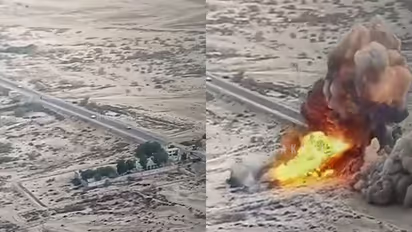
The Balochistan Liberation Army says a truck bomb reduced the fortified camp to rubble and that more than 30 personnel were killed as its fighters swept through afterward. Pakistan has offered no official count, and its past pattern in similar incidents has been to attribute such attacks to "foreign elements" — typically pointing at Afghanistan or Iran — rather than address the domestic grievances that groups like the BLA say are driving the campaign.
Whatever the final casualty number turns out to be, the operation itself — a coordinated vehicle-bomb-and-assault against a facility built specifically to protect this corridor — is the real headline.
Reading CPEC as an Investment, Not a Slogan
Treat CPEC the way any investor would treat a $62 billion commitment: by looking at delivery against promise. On that basis it has underperformed badly, no matter how the official messaging is framed.
Islamabad and Beijing both continue to describe the corridor as fundamentally on track, pointing to a new 2026 transit order that formally routes Iran-bound third-country cargo through Gwadar as proof the port finally has a functioning commercial mission. That framing conveniently answers a longstanding criticism — that Gwadar had geopolitical symbolism but no real throughput — without addressing why it took roughly a decade to arrive at that answer.
Of the roughly 90 projects originally announced under CPEC, only about 38 have been completed as of this year, and a third of the total were never even launched. Gwadar was supposed to be the flagship of this portfolio, the piece that would prove the rest of the model worked. Instead, years into the project, its list of completed work is short: a master plan, a modest infrastructure package, a small technical institute. A single transit order, however useful, does not erase that record. It's the profile of a project that has been extended, deferred, and quietly re-scoped so many times that the delays have become part of the pitch.
The Insurgency Has Out-Escalated the Garrison
What should alarm Chinese planners specifically is the pace of the insurgency's adaptation relative to Pakistan's response.
The Gwadar Port Authority complex and the Turbat naval base have both already been stormed directly. A Coast Guard patrol boat was attacked near Jiwani earlier this year — the first confirmed hit on a maritime security vessel in the area — and the group followed up almost immediately by announcing a standing naval unit, not a one-time stunt. Add in a drone capability introduced months earlier, and Friday's truck bombing of a static land installation, and you have an insurgency that has now demonstrated proficiency across every domain a port security plan is built to cover: land, sea, air, and fortified structures.
Pakistan's Special Security Division was created explicitly to prevent this kind of layered threat, and officials have repeatedly assured Chinese counterparts that security for CPEC assets is being strengthened after each incident. The recurrence of these attacks — port authority complex, naval base, patrol boat, and now a coast guard camp — suggests those assurances have consistently outpaced the actual capability delivered on the ground.
The Quiet Verdict of the Insurance Market
Nobody announces a shipping route change with a press release, but the mechanism is straightforward and well understood: insurers price in risk, premiums climb, and cargo quietly migrates to ports where premiums don't. A facility whose own security camp gets bombed is not a facility that gets favorable terms from underwriters. Multiply that dynamic across a decade of recurring attacks — port authority complex, naval base, patrol boat, now a coast guard camp — and the cumulative effect on Gwadar's commercial viability is likely far larger than any single incident, however severe.
A Resentment That Predates and Outlasts Any One Attack
It is worth remembering that none of this security architecture exists in a vacuum. It was built around a province that has consistently objected to CPEC on its own terms, viewing the project as an extraction scheme run by outsiders through their coastline. The heavier the security presence gets, the more that grievance compounds — and the insurgency's expanding capabilities suggest the compounding has, if anything, accelerated rather than plateaued. Friday's bombing did not happen despite two decades of security investment in Gwadar. In a real sense, it happened because of the conditions that investment created and never resolved.
None of this means Gwadar's promoters are lying when they point to the new transit order or reaffirm the partnership's resilience — those developments are real. It means those claims describe intent and potential, while Friday's bombing describes what the port's security has actually delivered so far. Investors, insurers, and Balochistan's residents are the ones left to reconcile the gap between the two.