Why Is Bangladesh Boiling Again? & Why India Is Watching Closely | Explained
Synopsis
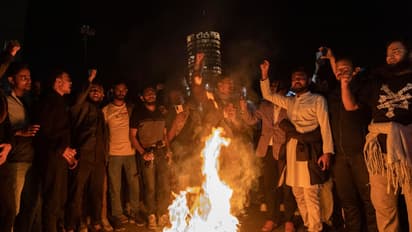
Bangladesh experienced fresh unrest following the death of radical leader Sharif Osman Hadi, leading to violent protests in Dhaka. Demonstrators attacked and vandalized The Daily Prothom Alo and The Daily Star offices.
Violent protests broke out in several cities in Bangladesh overnight after the death of radical leader Sharif Osman Hadi. A polarising figure known for his strong anti-India rhetoric, Hadi, 32, gained prominence during Bangladesh's 2024 student uprising that led to the ouster of former premier Sheikh Hasina.
Hadi was shot in the head by masked assailants in central Dhaka while formally launching his election campaign. He succumbed to his injuries six days later in a Singapore hospital. His killing has reopened political fault lines at a moment when Bangladesh is bracing for a pivotal national election and attempting to recalibrate its strained relationship with New Delhi.
Authorities said Hadi was attacked while travelling in a rickshaw near Box Culvert Road in the Motijheel area. He was shot close to his left ear, suffered severe blood loss and remained in critical condition before being airlifted abroad for treatment.

Police initially said it was unclear who carried out the attack or what the motive was. The confirmation of his death by interim chief adviser Muhammad Yunus triggered immediate unrest across Dhaka and other cities, as protesters vandalised buildings, torched newspaper offices and targeted institutions of the political establishment.
Who was Hadi? Why his death could reshape Bangladesh’s future
Violence comes at a sensitive juncture for Dhaka. Bangladesh is scheduled to hold elections in February next year, more than a year and a half after the dramatic ouster of Sheikh Hasina, who is currently living in exile in India.
Hadi was a complex and polarising figure. Emerging from the July Uprising, he rose to prominence as the convenor and spokesperson of Inquilab Mancha, a platform that positioned itself against all forms of political domination. A University of Dhaka alumnus, Hadi was a critic not just of the Awami League but of Bangladesh’s entrenched political culture as a whole.
Rejecting established elites, he projected himself as the voice of a generational rupture — a defiant challenge to the old order. By announcing his independent candidacy for the Dhaka-8 seat, Hadi sought to counter what he described as the growing threat posed by new political forces ahead of the election.
Reacting to his death, Inqilab Moncho, the party Hadi belonged to, claimed that he had been "martyred" in the so-called "struggle against Indian hegemony," the statement said, as per BD News.
Bangladesh is currently governed by an interim administration led by Nobel laureate Muhammad Yunus, which has faced mounting protests over delayed reforms and warnings of renewed agitation from Sheikh Hasina’s Awami League, now barred from contesting the polls.
Nearly 128 million voters are eligible to cast their ballots across more than 42,000 polling stations spanning 300 parliamentary seats. The election will be held alongside a referendum on the ‘July Charter’, a reform blueprint born out of last year’s unrest. The charter calls for limits on executive power, stronger judicial and electoral independence, and safeguards to prevent the misuse of law enforcement agencies.
Who killed Hadi? Why the narrative matters
In the immediate aftermath of the shooting, local reports claimed without evidence that the attackers were Indians or had escaped with Indian assistance. These narratives have been widely viewed as deliberate attempts to stoke public anger against New Delhi ahead of the election.
According to Prothom Alo, police have identified three suspects, all allegedly linked to organisations associated with the Awami League. The shooter has been named as Faisal Karim Masud, also known as Rahul, a former leader of the now-banned Chhatra League, who allegedly fired from the back of a motorcycle driven by Alamgir Sheikh.
Another individual, Rubel, said to be linked to the Swechchhasebak League, is accused of conducting surveillance prior to the attack. Investigators believe the murder was meticulously planned over several months with the explicit aim of triggering large-scale instability.
Photographs showing the three suspects together at political events attended by Hadi have circulated widely on social media, intensifying public scrutiny and suspicion.
Earlier on December 14, India’s ministry of external affairs rejected Dhaka’s claim that Indian territory “was being used for activities inimical to the interests of the friendly people of Bangladesh.” The MEA reiterated its long-standing position on Bangladesh’s democratic process.
“We have consistently reiterated our position in favour of free, fair, inclusive and credible elections being held in Bangladesh in a peaceful atmosphere,” the statement read.
Diplomatic fallout and why Delhi is watching closely
On Wednesday, India summoned Bangladesh’s high commissioner in New Delhi to express grave concern over the deteriorating security situation, particularly threats aimed at Indian diplomatic missions. Visa services in Dhaka were suspended amid fears for staff safety, and New Delhi urged the interim government to honour its diplomatic obligations.
For India, the stakes extend far beyond immediate security concerns. A parliamentary committee has described the current phase as India’s most severe strategic challenge in Bangladesh since 1971, pointing to rising extremism, attacks on minorities and the risk of Dhaka drifting away from its traditional alignment with New Delhi.
The erosion of Awami League dominance, the surge of youth-driven nationalism and the re-emergence of Islamist forces have compounded India’s unease.
“India faces its greatest strategic challenge in Bangladesh since the Liberation war of 1971. While the challenge in 1971 was existential, a humanitarian and a birth of a new nation, the latter was of a graver, a generational discontinuity, a shift of political order, and a potential strategic realignment away from India,” the report said quoting an expert.
The panel advised the government to "continue to uphold its principled and humanitarian approach", consistent with India’s values and international responsibilities, while ensuring such situations are "managed with due sensitivity".
It also flagged the declining political dominance of Sheikh Hasina’s Awami League, citing low voter turnout in the January 2024 elections as evidence of eroding legitimacy and public trust.
On Hasina’s presence in India, the committee stated, "The Committee note that the stay of former Prime Minister of Bangladesh, Sheikh Hasina, in the country and India's approach in this regard is guided by its civilisational ethos and humanitarian tradition of offering refuge to individuals facing circumstances of grave distress or existential threat," while urging caution in managing the politically sensitive issue.
The Hasina question
The future of former Bangladeshi prime minister Sheikh Hasina has become a defining test for India–Bangladesh relations. In November, Dhaka formally sought the extradition of the 78-year-old Awami League leader, who was sentenced to death in absentia by a special tribunal over her government’s crackdown on the 2024 student-led uprising.
Hasina has remained in India since August 5, 2024, when mass protests forced her resignation and ended her party’s prolonged rule. What began as opposition to a job quota system favouring families of 1971 war veterans rapidly escalated into the bloodiest political violence Bangladesh has witnessed in decades.
A subsequent UN inquiry estimated that up to 1,400 people were killed as security forces responded with lethal force. An interim government under Muhammad Yunus later assumed control.
While India has acknowledged the tribunal’s verdict, it has maintained that it will continue to “engage constructively” with all stakeholders to support peace, democracy and stability. Dhaka, however, insists extradition is a legal obligation under bilateral treaties, warning that sheltering convicted individuals would be considered “unfriendly”.
Hasina has dismissed the proceedings as “rigged”, arguing they are intended to erase the Awami League from Bangladesh’s political landscape.