Australia's space partnership with India a key focus at Bengaluru expo
Synopsis
Australian High Commissioner Philip Green highlighted the growing Australia-India space partnership at the Bengaluru Space Expo, detailing strategic alignment, crucial support for India's Gaganyaan mission, and commercial collaboration opportunities.
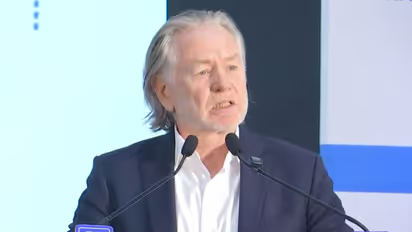
Australian High Commissioner to India Philip Green delivered an address at the 9th Bengaluru Space Expo 2026 on Monday, highlighting the expanding bilateral space partnership between Canberra and New Delhi.
Comparing contributions from various international partners on the platform, Green noted, "Now I'm conscious that the other ambassadors on this stage represent nations that are the real heavyweights of space. The ambassador of Italy brings the legacy of Galileo and Marconi in his suitcase. And my friend Ambassador Gore brings, you know it, NASA, the Apollo space programme and its moon landing that so captivated people of my generation." He further observed, "Sergio also brings a musical tradition related to space. Think Fly Me to the Moon and Forbidden Planet. Australia doesn't make these blockbuster claims, but let me explain to you why you might choose to visit the Australian pavilion and engage with the Australian companies who've made the journey from Adelaide, Brisbane, Perth, Sydney, Melbourne and Canberra to be with you today."
Three Pillars of Australia-India Space Cooperation
Outlining primary areas for cooperation, Green presented three key reasons for delegates to connect with the Australian delegation, pointing first to governmental alignment, stating, "First, because Australia's and India's governments are aligned in their focus on space. I had the privilege to accompany Prime Minister Modiji on his visit to Australia last month, and beyond the bear hugs and the rock star appearance at Marvel Stadium, there was a lot that was relevant to space."
1. Governmental and Strategic Alignment
Detailing the strategic framework, he stated, "We celebrated the reality that in a complicated and contested world, Australia and India are strategically aligned as never before, both bilaterally and through the Quad. Reflecting the bilateral alignment, our Prime Minister's announced a new strategic partnership. They called it PACT, the Partnership for Cyber Critical Technologies and Supply Chains, which seeks to harness technologies that will shape our future and drive our growth." He added, "The PACT agreement makes clear that space is no longer a peripheral field of interest but a core arena for bilateral technology collaboration, industry integration and regional security. Here at BSX is our first opportunity since the inking of PACT to put it into practice. Reason number one, to seek out the Australian pavilion and delegates."
2. Critical Support for Gaganyaan Mission
Focusing on the second reason, Green emphasised Australia's direct involvement in India's space endeavours, noting, "Reason number two relates to Australia's direct support for India's landmark Garganyong programme. As announced during the Melbourne Summit, Australia has formally commissioned a dedicated space tracking terminal on the Caucus Keeling Islands in the eastern Indian Ocean. If you don't know where they are, they are about at a midpoint between where we are here in Bengaluru and Perth, as the crow would fly."
Describing operational support, he mentioned, "When Indian astronauts orbit Earth aboard Garganyong, Australia will be holding the ground line. Located strategically in the Indian Ocean, our tracking station provides mission-critical telemetry, tracking and coverage of ISRO's uncrewed and crewed flights. This support will extend to rescue and recovery operations for controlled landings in Australian waters off the coast of Western Australia." He concluded on this point by stating, "This collaboration underscores that Australia is a trusted partner in ISRO's human spaceflight mission, signifying an expansion of our space cooperation and demonstrating that Australia is actually now an indispensable part of the Garganyong project."
3. A Thriving Commercial Space Sector
Detailing the third incentive, Green pointed to commercial participation, noting, "The third reason to seek out the Australian contingent here at BSX relates to the great Australian companies that are joining you here in Bengaluru. There are 30 in our delegation with a wide range of competencies that spans the full mission lifecycle, from world-class research led by our leading universities, upstream satellite design and manufacturing, propulsion, launch and re-entry, and finally downstream in Earth observation, analytics and in-space research." He added, "Collectively, our companies represent a space sector that takes ideas from the laboratory to orbit and beyond. Now, it perhaps shouldn't surprise you that Australia brings top-class science to events like this. After all, we are the nation that invented Wi-Fi, Google Maps and the quantum clock in space."
Highlighting unique geographic and demographic traits, the High Commissioner stated, "First, in terms of territory and population, we are the un-India. We have a territory that is two and a half times bigger than India's, with one-fiftieth the population. That means vast open land masses and the quietest skies on Earth. It also means that we have to be good at doing things remotely, with tools like robotics and automation." Providing examples, he noted, "For instance, our mining giant, Rio, runs the largest fleet of remote vehicles anywhere in the world, directing trucks in the Pilbara in north-western Western Australia from control stations in Perth, 1,300 kilometres away. Because we are a big landmass and we don't have many people, we have to know about doing things at distance and with machines."
Addressing regional advantages, Green remarked, "Second, we have, for India, some very relevant geography. Our position in the East Indian Ocean means that we are ideally located to support India's space journey. Our satellites track Indian spacecraft and our naval and border command vessels support their splashdown. Australia has unique access to launch profiles, including both equatorial and polar orbits."
On commercial collaboration, he observed, "Third, our companies are motivated to work closely with their Indian partners. Like you, our private space journey is relatively recent and is fast-moving. Our space industry is growing at a rate nearly triple that of Australia's overall economic growth. And unlike the giants in this room, our industry is big enough to be consequential for India, but small enough to want to work closely with you." He stated, "As I have seen it personally, the Australian space industry is growing up with the Indian space industry and learning together. Our companies are backed by our government. My government is investing nearly 1,500 crore in the space sector specifically and crowding in additional private sector investment."
Noting cultural ties within the industry, Green mentioned, "And there's one other thing which you might notice if you visit the Australian Pavilion. Many businesses in the Australian space sector are led by people of Indian origin. That's not surprising to me. There's now more than a million Indian origin Australians in my country, and they are asymmetrically represented in our business, in our science, and they have a keen sense of how to do business here in India."
An Ideal Match for Space Collaboration
Concluding his remarks, the High Commissioner summarised the mutual strengths of both nations, stating, "Let me conclude by identifying the one defining character of the Australian and Indian space industries. Our industries are complementary. We have the things you don't and you have the things we don't. So partnership is natural and relatively simple. We have niche technological strengths, the advantages of being in India and of relevant geography, and a culture of innovation forged in our extensive academic and scientific ecosystem." He wrapped up by encouraging delegates, "India has end-to-end manufacturing capabilities, cost efficiencies, and world-class engineering talent at scale. It's an ideal match between two space vehicles. So come and dock in to the Australian companies here at BSX and let's fly to the moon together based on strategic alignment, complementary capabilities, and a government-to-government framework that is closer than ever." (ANI)
(Except for the headline, this story has not been edited by Asianet Newsable English staff and is published from a syndicated feed.)