As Iran's Military Facilities Burn, India's Swadeshi FF Bot Offers Blueprint For Airbase Survival
Synopsis
US B-52 bombers targeting an ammunition depot and airbase in Isfahan caused vast explosions — what engineers call "cookoff," the phenomenon where heat from one detonation triggers the next, and the next, until the chain of secondary blasts has done more structural damage than the original strike.
New Delhi: When missiles struck fuel depots near Tehran in early March, the fires that followed did not stop at the perimeter fence. Strikes on fuel depots near Tehran caused a river of fire to pour out along the streets, engulfing the city in thick black smoke and triggering toxic, acidic black rain across surrounding neighbourhoods. Residents were ordered indoors. The Iranian capital's air turned hazardous for days. And that was a civilian fuel depot.
When the same logic applies to a military airbase — where aviation fuel sits beside liquid oxygen storage, munitions bays adjoin maintenance hangars, and radar installations share ground with chemical stores — the consequences compound at a speed and scale that conventional emergency response cannot match.
US B-52 bombers targeting an ammunition depot and airbase in Isfahan caused vast explosions — what engineers call "cookoff," the phenomenon where heat from one detonation triggers the next, and the next, until the chain of secondary blasts has done more structural damage than the original strike.
Across Iranian military sites, strikes damaged or destroyed communications infrastructure, fuel depots, maintenance facilities and aircraft hangars in combinations that left bases operationally dead even where runways remained physically intact.
The runway is only one part of what makes an airbase function. Destroy the fuel farm, the munitions store, the radar suite or the power infrastructure feeding all three, and the aircraft on that runway are grounded just as effectively as if the tarmac itself had been cratered.
This is the threat environment that air forces everywhere are now being forced to reckon with — and one that the Indian Air Force had already begun preparing for.
At Vayu Shakti 2026, India's premier airpower demonstration held at Pokhran the IAF showcased something beyond its now-familiar arsenal of Rafales, Su-30MKIs and precision-guided munitions.
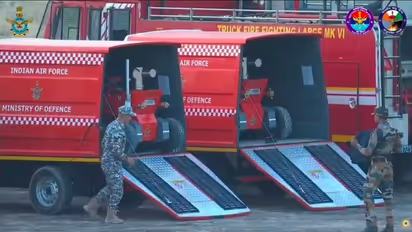
Alongside the firepower display, the FF Bot, an indigenously developed firefighting robot built by Swadeshi Empresa Pvt Ltd under the iDEX framework, was put through its operational paces. Defence officials described its demonstration as directly relevant to base-survival contingencies — the scenarios in which an airbase must absorb a strike, contain the damage and keep flying.
For the first time, Vayu Shakti was executed along a defined operational storyline, transforming into a simulated live combat theatre that seamlessly integrated offensive strikes, air defence, special forces missions and humanitarian assistance — and within that full-spectrum framing, the FF Bot's role as a damage-control asset was a deliberate and considered inclusion.
The robot itself addresses a specific operational gap. Airbases handling aviation fuel, liquid oxygen, air-to-air and air-to-ground munitions, and sensitive electronics present layered ignition risks that intensify sharply in a post-strike environment.
Human firefighting crews cannot safely operate in areas where secondary detonations remain an active threat.
The FF Bot is engineered for exactly that window. Its heat-resistant frame and remote operation allow it to enter fuel storage zones, munitions-adjacent corridors and structurally compromised hangars without putting personnel at risk.
Thermal imaging gives it visibility through smoke that defeats optical cameras. A 360-degree turning radius makes it functional in the confined geometries of military infrastructure. It suppresses fires using water or foam, detects hotspots, and streams live visuals back to commanders — providing both an active suppression capability and real-time damage assessment from inside the most dangerous areas of a base.
The system was developed through direct engagement with military users under the iDEX scheme, which has enabled more than 300 companies to receive cumulative orders exceeding Rs 1,500 crore. Each iteration of the FF Bot incorporated field feedback from defence fire-safety teams, producing hardware shaped by operational reality rather than theoretical specification.
Officials noted it cleared every performance benchmark set for base-level firefighting equipment — and did so with a margin.
The timing of its Vayu Shakti debut, as it turns out, could not have been more pointed. The question of how an airbase survives the fire that follows the first strike is no longer a planning hypothetical.