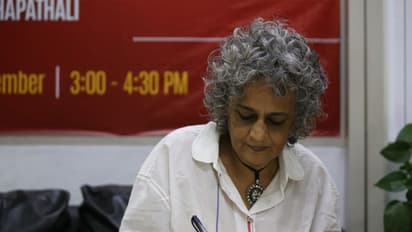
Arundhati Roy signs copies of 'Mother Mary Comes to Me' in Kathmandu
Synopsis
Acclaimed Indian author Arundhati Roy signed copies of her latest book, "Mother Mary Comes to Me," for fans in Kathmandu. The event celebrated her work, which also recently cleared a legal hurdle in India's Supreme Court over its cover art.
Acclaimed Indian writer Arundhati Roy signed copies of her "Mother Mary Comes to Me" for Nepali readers in Kathmandu on Sunday as part of her signing tour. The signing ceremony, held at EKTA Books in the capital, Kathmandu, featured the Indian writer, who has also been awarded the Booker Prize. Dozens of Nepali readers had a brief interaction with her, clicked pictures and got her to sign the recently released publication which has also been named one of the best books of the year by The New York Times Book Review.
Praise from Nepali Readers and Academics
"Arundhati Roy is the winner of the Booker Prize. She wrote the 'God of Small Things' and that is how I got introduced to her writing. What I love about her is that she writes soulfully, instinctively, and she writes about emotions that linger in the air and the unsaid. Her writing really captures the essence of the small things," Pushpa Bhandari, a graduate student in English literature, told ANI during the signing ceremony.
Roy's first novel has sold over six million copies since its first publication in 1997, the same year she won the Booker Prize.
"My (graduate) thesis was on her book, the 'God of Small Things' can't be translated into a movie, and she said so herself that translating her book would be a very cruel attempt because some words can't be transformed into a visual form, and people shouldn't simply adapt it. I love her audacity, I love how she claims her writing, and it's completely hers; it's never replicable," Bhandari added.
The latest publication by the Bengali writer, "Mother Mary Comes to Me" is the story of her mother, Mary Roy, whom she writes as "my shelter and my storm." Her second novel, which comes after a 20-year gap during which she wrote essays that earned her both reverence and vilification, is also her first memoir.
"Arundhati Roy is the greatest writer of our time. I feel like she is not only the text, but she is the context for so many texts. She questions the authority, she connects it with the root of every people, and she writes it so simply that it can be an example for many students,s like how a writing can be," Sushil Paudel, English Literature academician in Kathmandu told ANI.
Book Cover Controversy Resolved by Supreme Court
Roy's latest publication continued to face legal hurdles in India due to its cover until Friday, when the Supreme Court dismissed a plea seeking a ban on the book. The petition had alleged that the cover picture depicts the author smoking cigarette/beedi in violation of a central legislation.
A bench of CJI Surya Kant and Justice Joymalya Bagchi reasoned that the use of the said picture in the book cover is in no way intended to promote smoking and that the Disclaimer in the back of the book clarifies that.
"The book, the photograph, the publisher or the author, none of these persons have anything to do with promoting cigarettes. She is a renowned author. Even the publisher is renowned. It is not an advertisement for cigarettes," the Court observed.
The Court rejected the appeal and upheld the decision passed by the Kerala High Court.
Petitioner's Appeal Dismissed
"The picture in the book does not constitute any violation of Section 5 of the Cigarettes and Other Tobacco Products (Prohibition of Advertisement and Regulation of Trade and Commerce, Production, Supply and Distribution) Act, 2003. We don't see any reason to interfere with the impugned order passed by the High Court," the Court noted.
The petitioner moved the Supreme Court, challenging the Kerala High Court's decision to reject his plea seeking a ban on the promotion, sale, distribution, etc, of Roy's book, as its cover image depicted the author smoking without a proper health warning.
During Friday's hearing in the Supreme Court, the counsel for the petitioner argued that the disclaimer to the cover picture is on the back side of the book and does not justify the author's smoking image sufficiently. However, the Supreme Court upheld the High Court's reasoning in dismissing the plea, which held that the image does not intend to promote cigarette smoking for commercial purposes.
The top court verbally observed that the said book cover is not being used for commercial purposes on hoardings or banners across cities. Instead, it only concerns people who are interested in buying and reading the renowned authors'; memoirs.
After hearing the petitioner for some time, the apex court dismissed the appeal and upheld the High Court's decision. (ANI)
(Except for the headline, this story has not been edited by Asianet Newsable English staff and is published from a syndicated feed.)