John Clarke, Michel Devoret and John Martinis Win 2025 Nobel Prize in Physics
Synopsis
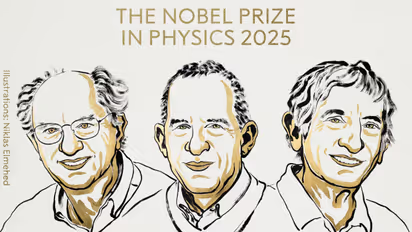
Briton John Clarke, French scientist Michel Devoret, and American John Martinis have won the 2025 Nobel Prize in Physics. They were recognised for discovering macroscopic quantum tunnelling and energy quantisation in electric circuits.
The 2025 Nobel Prize in Physics has been awarded to Briton John Clarke, French scientist Michel H. Devoret, and American John M. Martinis for groundbreaking work in quantum physics. The Nobel jury recognised the trio ‘for the discovery of macroscopic quantum mechanical tunnelling and energy quantisation in an electric circuit,’ a development that significantly advances the understanding of quantum systems in practical applications.
The significance of the discovery
This discovery is expected to have far-reaching implications in quantum technology, including the development of quantum computers and other advanced electronic systems. The laureates' work demonstrates how quantum mechanical phenomena, typically observed at microscopic scales, can manifest in macroscopic electric circuits, bridging the gap between theory and experimental applications.
Last year's Nobel Prize in Physics
Last year, the Nobel Prize in Physics was awarded to American scientist John Hopfield and British-Canadian Geoffrey Hinton for their pioneering contributions to machine learning, which helped fuel the rapid rise of artificial intelligence. Both laureates have also voiced concerns about the societal impact and ethical implications of AI.
The Nobel Prize ceremony
As per tradition, the Nobel Prize in Physiology or Medicine is awarded by the Royal Swedish Academy of Sciences. The prize includes a monetary award of 11 million Swedish kronor (approximately $1.2 million USD), to be shared equally among the laureates. The official award ceremony will take place on December 10, 2025, in Stockholm, coinciding with the anniversary of Alfred Nobel's death.
Nobel Prize in Physiology or Medicine
The 2025 Nobel Prize in Physiology or Medicine was jointly awarded to Mary E. Brunkow, Fred Ramsdell, and Shimon Sakaguchi for their groundbreaking discoveries concerning peripheral immune tolerance. Their research elucidated how the immune system prevents attacking the body's own tissues, a critical mechanism in maintaining health and preventing autoimmune diseases. The Nobel Assembly at the Karolinska Institutet in Stockholm announced the award on Monday, October 6, 2025.
Previous Nobel Laureates in Medicine
The 2024 Nobel Prize in Physiology or Medicine was awarded to Victor Ambros and Gary Ruvkun for their discovery of microRNA, small RNA molecules that regulate gene expression and play a role in various biological processes. Their work has significantly advanced our understanding of gene regulation and its implications in health and disease.
Upcoming Nobel Prize Announcements
Following the announcement of the Nobel Prize in Physiology or Medicine and the Nobel Prize in Physics, the Nobel Prize in Chemistry will follow on Wednesday, October 8, 2025. The Nobel Peace Prize is set to be announced on Friday, October 10, 2025, with the Nobel Memorial Prize in Economic Sciences concluding the series on Monday, October 13, 2025.
(With inputs from agencies)