200,000 Walruses Crowd Alaska's Shores As Melting Arctic Ice Threatens Their Habitat - WATCH
Synopsis
More than 200,000 Pacific walruses have gathered on Alaska's shores as melting Arctic sea ice disrupts their natural habitat. A new conservation agreement aims to protect nearly 50,000 acres and safeguard the animals
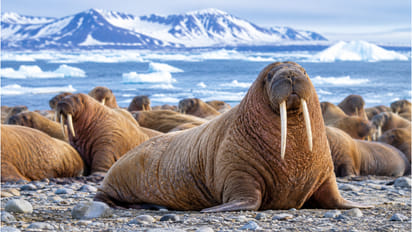
The disappearance of Arctic sea ice is forcing thousands of Pacific walruses to abandon their traditional resting grounds and gather on land near Point Lay in north-west Alaska. The region has now become home to one of the largest walrus gatherings in the world.
For decades, these marine mammals have depended on floating sea ice to rest near feeding areas, give birth and nurse their young. During winter, they occupy the Bering Sea, while females and their calves generally migrate towards the Chukchi Sea through the Bering Strait.
However, rising temperatures and the retreat of Arctic sea ice have increasingly disrupted this natural pattern. During late summer, the ice moves further away from shallow coastal waters, making it difficult for walruses to reach the seabed where they find food.
The gathering near Point Lay first became noticeable in 2007, when a few thousand females and calves began using the barrier islands. Today, approximately 200,000 walruses visit the location, making it the largest Pacific walrus haul-out site in North America.
Marine scientist Chelsea Koch of American University has cautioned that although the animals are adapting to changing conditions, land cannot replace the sea ice habitat they are gradually losing.
Why Large Walrus Gatherings Could Become Dangerous For Young Animals
While gathering on land offers walruses an alternative resting place, it also exposes them to several dangers. These animals are particularly sensitive to disturbances, and even a relatively minor disruption can trigger a stampede involving thousands of them.
Adult walruses can weigh as much as two tonnes. When large groups suddenly rush towards the water, younger animals are particularly vulnerable to being trampled or crushed. Such incidents have reportedly resulted in the deaths of hundreds and, in some cases, thousands of young walruses.
The threats do not come from predators alone. Polar bears can disturb the gatherings, while human activities such as low-flying aircraft, passing ships and tourists approaching the animals for photographs can also trigger panic.
The consequences of overcrowding were highlighted in Netflix's 2019 documentary Our Planet. It showed walruses falling from cliffs onto rocks below after climbing elevated areas to escape overcrowding on a Russian beach.
There are also concerns about industrial development near Point Lay. The location is close to Alaska's National Petroleum Reserve, where fossil fuel exploration and other resource-related projects could create additional pressure on wildlife habitats.
Alaska Secures Nearly 50,000 Acres To Protect Pacific Walruses
Amid growing concerns about the animals' changing habitat, a new conservation agreement has secured permanent protection for 47,473 acres of land near Point Lay.
The Conservation Fund, a US-based environmental non-profit organisation, announced the initiative on November 18. It purchased a permanent conservation easement from the Cully Corporation, an Alaska Native village corporation that owns the land.
The agreement aims to prevent commercial development and minimise human disturbances across the protected area. Importantly, it also ensures that local residents retain access to natural resources required for their traditional livelihoods.
The arrangement holds particular significance for the Iñupiaq community, which has maintained a centuries-old cultural and subsistence relationship with walruses.
Although the financial details of the agreement have not been disclosed, the payment to the Cully Corporation is expected to support the community's economic security and help preserve its cultural traditions.
The project took approximately 10 years to develop, with discussions involving local leaders and conservation representatives before the agreement was finalised.
Wildlife biologist Anthony Fischbach of the US Geological Survey noted that the Pacific walrus population has remained relatively stable. However, the continuing loss of Arctic sea ice is creating increasingly challenging conditions for the species.