IIT-M scholars use 'Groin Fields' technique to reclaim 50 Km of Kerala's beaches
Synopsis
Groin Field as one of the coastal protection measures had been tried successfully all over the world. It was used in India in 1960s and was completely forgotten. After the tsunami, the Kerala government wanted a master plan for 25 villages to check erosion on stretches of two km in each. The Groin Field technology succeeded in retaining sand and building of the beaches.
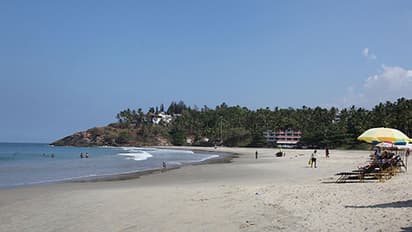
Following a request from the Kerala government to protect its receding beaches from erosion, IIT-M scholars have been able to restore close to 50 kms of the state's exquisite beach by using an age-old technique- the Groin Fields. Ever since the project was implemented in 2007, 25 eroded sites of two kilometer each around 25 villages were reclaimed.
Interestingly, the technique was last used in the 1960s. The Groin Field is unique as it can actually recover land lost in the sea, unlike sea walls which can only prevent further erosion. However, the technique needs precise calculation, which includes determining the quality of sediments and the direction of long-shore currents. Groin Field is a long narrow structure built out into the water from a beach to prevent erosion. With this, erosion activities didn't shift to nearby areas as feared earlier.
Prof V Sundar of department of ocean engineering in IIT-M, who headed the project said, "After the tsunami, the Kerala government wanted a master plan for 25 villages to check erosion on stretches of two km in each. After investigation, we proposed 'Groin Fields' which yielded positive results. It has succeeded in retaining sand and building of the beaches. Thus, we reclaimed the lost beaches."
He further added, "Groin Field as one of the coastal protection measures had been tried successfully all over the world. It was used in India in 1960s and was completely forgotten. It was not a new idea from IIT-M, but the department carefully designed with scientific process to make a difference."
Currently, the team is using the technique in another project in North Chennai. On the eve of the World Ocean Day, the head of the project said, "Just because India has a long coastline there is no place for complacency as there is an urgent need to conserve beaches and their socio-economic aspects. Conserving the coastline has national and global implications."
The team is also working on 'river mouth training' to let rivers freely flow into oceans. Explaining the technique Sundar said, "A critical phenomenon observed at places like Kozhikode and Ettikkulam among others along the Kerala coast is the choking of river mouths due to longshore drifts. Construction of training walls, at the mouth of the river, ensured that the river will drain freely into the sea."