Saudi Arabia’s 350-metre-high ‘sky stadium’: Kingdom's bold 2034 World Cup dream explained
Synopsis
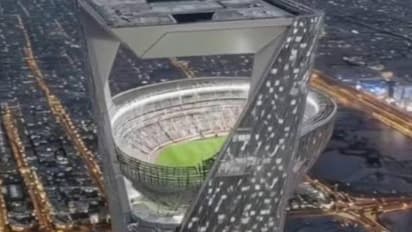
Reports indicate Saudi Arabia plans to construct the world's first "sky stadium" in NEOM, a 350-meter-high venue designed for the 2034 FIFA World Cup. This 46,000-seat, renewable-energy-powered marvel is a cornerstone of the Kingdom's Vision 2030.
Social media is shaking with excitement after reports emerged that Saudi Arabia will construct the world's first "sky stadium" - an engineering and architectural marvel set to rise 350 meters above the desert in NEOM's futuristic city, The Line.
The proposed NEOM Sky Stadium will seat around 46,000 spectators and draw power entirely from renewable energy sources such as wind and solar. Construction is expected to begin in 2027 and conclude by 2032, perfectly in sync with the Kingdom's preparations for the 2034 FIFA World Cup, which Saudi Arabia will host as the sole bidder officially confirmed by FIFA.
A Visionary Leap in Sports Infrastructure
The "sky stadium" has yet to be mentioned in Saudi Arabia's legacy media, though it follows an unprecedented wave of sports infrastructure developments across the Kingdom. According to Arab News, Saudi Arabia aims to build 15 stadiums under its World Cup plan, including the colossal King Salman International Stadium in Riyadh, which will house 92,760 fans upon completion in 2029 - making it the largest venue in the country.
Meanwhile, Construction Review revealed that the NEOM stadium will be integrated into The Line, the linear smart city being developed as part of the vast NEOM project. The publication described it as the "world's first sky stadium," suspended more than a thousand feet above the earth, combining cutting-edge architecture with sustainability principles.
Endorsed by FIFA, Powered by Possibility
FIFA's preliminary endorsement of the project emphasizes its potential to redefine environmentally conscious sports venues. Yet, the project is not without challenges. Its ambitious elevation and location demand inventive engineering solutions for access, ventilation, and structural stability.
Despite ongoing questions surrounding NEOM's broader timeline - now projected beyond 2039 - the sky stadium remains a top priority due to its connection to the World Cup. Its strategic placement near educational and wellness districts is also expected to foster a vibrant sports-oriented community.
A Symbol of Vision 2030
The concept has inspired both awe and skepticism online. Many praise it as a "groundbreaking leap" in global sports innovation, while others question the practicality of suspending a full stadium hundreds of meters in the air. Yet, for many Saudis, the project symbolizes their nation's broader vision of transformation.
"My favourite language is the language of possibility, because to us, anything is possible," a young Saudi voice told the FIFA Congress last week - echoing the nation's newfound confidence on the world stage.
A little over a decade ago, few imagined Saudi Arabia as a serious candidate to host football's most prestigious tournament. Today, with FIFA confirming its 2034 World Cup hosting rights, the Kingdom stands at the heart of global sport, aligning perfectly with its Vision 2030 plan to diversify the economy and establish itself as a global entertainment hub.
From Desert Arenas to Global Icons
Since 2021, Saudi Arabia has emerged as a sports powerhouse, hosting Formula 1 races in Jeddah, heavyweight boxing bouts featuring Tyson Fury and Anthony Joshua, and elite tennis exhibitions with greats like Novak Djokovic and Rafael Nadal. Football megastars including Cristiano Ronaldo, Karim Benzema, and Neymar have already turned the Saudi Pro League into an international spectacle.
Hosting the World Cup, however, is another level altogether. Qatar 2022 raised expectations by attracting 3.4 million fans and more than 5 billion global viewers. Saudi Arabia now aims to exceed that benchmark with visionary designs and massive investments.
Bold Stadium Designs Across the Kingdom
Besides the sky stadium, Saudi Arabia is readying an array of jaw-dropping venues. The King Salman International Stadium in Riyadh will host the tournament's opening and final matches from its dramatic clifftop setting. On the Red Sea coast, the Qiddiya Coast Stadium will feature rippling curves inspired by the movement of a crowd's Mexican wave.
Each venue promises to combine technology, culture, and sustainability, with the NEOM Sky Stadium standing as the crown jewel. Accessed via high-speed lifts and autonomous vehicles, it will offer fans an unmatched aerial perspective of the game - literally and figuratively raising the bar for sporting experiences.
As a spokesperson for the bid said, "We don't just want to host; we want to pioneer a new way of watching football."
One Nation, One World Cup
The 2034 edition will be historic for another reason - it will be the first single-nation World Cup to feature the expanded 48-team format. The upcoming 2026 tournament will be shared by the US, Mexico, and Canada, while 2030 will span six countries across three continents. In contrast, Saudi Arabia plans to unite all fans in one destination, capitalizing on its geographical location - with 60% of the world's population within an eight-hour flight.
Infrastructure Ready for the Future
Saudi Arabia's preparations include expanding its transport networks, airports, and urban transit systems, including the Riyadh Metro and new high-speed rail connections. The Kingdom will also add 185,000 hotel rooms to accommodate millions of visiting fans.
Although official World Cup dates remain unconfirmed, experts predict a winter schedule, potentially in January, avoiding the sweltering summer and religious overlaps with Ramadan.
If Saudi Arabia's plans unfold as promised, the 2034 tournament could deliver the most futuristic and climate-conscious World Cup in history - with the world's first stadium in the sky as its defining symbol.