Sanjay Bangar's daughter Anaya gets nod to play in Australia's WBBL
Synopsis
Anaya Bangar, daughter of Sanjay Bangar, who underwent gender-affirming surgery, has been offered a pathway by Cricket Australia to play elite-level cricket, including the WBBL, from March 2027, subject to its policy requirements.
Anaya Bangar is preparing to return to competitive cricket in Australia, with Cricket Australia (CA) offering her a route to pursue elite-level cricket, including the Women's Big Bash League (WBBL), subject to its policy requirements.
Anaya, daughter of former Indian cricketer and coach Sanjay Bangar, underwent a gender-affirming surgery earlier this year in March. She has been offered a pathway into competitive cricket as per CA's 'Inclusion of Transgender and Gender Diverse Players in Elite Cricket Policy'. Untill March 2027, when she will face a test to determine her serum testosterone concentration, she will be eligible to play community cricket in "any state or territory of Australia". If she meets the policy requirements, she will be eligible for elite-level cricket in the country from March 2027 onwards.
Cricket Australia's Policy Requirements
An expert panel comprising of Jacqui Partridge (CA, Head of Integrity), Emily Yates (CA, Integrity Partner, Legal), Peter Roach (CA Head of Scheduling, Operations and Domestic Cricket), Dr Peter Harcourt (CA, Anti-Doping Medical Officer) and Dr Pip Inge (CA Team Doctor) (relevant expert) considered her case and confirmed that subject to compliance with the policy, she will be eligible for elite cricket in the country from March 2027.
"Under Cricket Australia's Policy, a player seeking to participate in the female category of Elite Cricket must establish that their serum testosterone concentration has been below 10 nmol/L continuously for a period of no less than 12 months," said an email to Anaya from CA. "Based on the medical information provided, this requirement will be satisfied in March 2027. Accordingly, your eligibility for Elite Cricket from that date is conditional upon you providing a blood test upon your arrival in Australia confirming that your serum testosterone concentration remains below 10 nmol/L and that you continue to satisfy the Policy's eligibility requirements. Until March 2027, you remain eligible to participate in Premier Cricket competitions in any State or Territory of Australia. As Premier Cricket is classified as Community Cricket rather than Elite Cricket under the Policy, your participation in those competitions is not affected by this determination," added the email.
View this post on Instagram A post shared by Anaya Bangar (@anayabangar)
'A Pathway Back to the Sport': Anaya Bangar
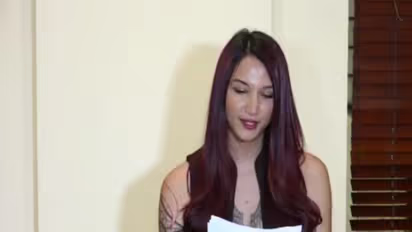
Speaking about the development to the media, Anaya told reporters that the occasion feels really important to her after years away from competitive cricket, and the process has not been "an automatic or informal" one. She said that CA has a framework "designed to balance fairness, competitive integrity and inclusion in women's sport" and her case has been considered through it.
"Everyone, thank you for being here. Today is an important day for me because after several years away from competitive cricket, I can finally speak about a pathway back to the sport that has been such a significant part of my life. I am preparing to return to women's cricket in Australia with the aim of pursuing elite cricket from March 2027. This has not been an automatic or an informal process. Cricket Australia has a framework designed to balance fairness, competitive integrity and inclusion in women's sport and my case has been considered through that framework," she said.
"My understanding is that Cricket Australia's review considered a comprehensive body of information relating to my circumstances, including my medical history, surgical history, hormone and testosterone levels, my cricketing background and playing footage as well, and the scientific and athletic performance work undertaken with Manchester Metropolitan University's Institute of Sport," she added.
Anaya also confirmed that after her gender-affirming surgery, she no longer has testes, her previous primary source of testosterone, and as per a recent blood test, her total testosterone is 0.6 nanomoles, within the female reference range.
"I appreciate the thoroughness of that process. For me, it was important that this was assessed through an established sporting framework rather than simply being a question of public opinion. I've also undergone gender-affirming surgery, and I no longer have testes, which means my previous primary source of testosterone is no longer present. My most recent blood test in July recorded total testosterone at 0.6 nanomoles. That is within the female reference range reported by the laboratory," she said.
"My understanding from Cricket Australia's clearance is that my eligibility for elite women's cricket from March 2027 remains subject to the applicable policy requirements, including a blood test assessment at the same time. If that March 2027 test confirms that I continue to meet the required testosterone criteria, I will be eligible to pursue selection for elite women's cricket, including the Women's Big Bash League pathway," she added.
'Eligibility is Not Selection'
Anaya said that the eligibility is "not selection" and CA has just given her a pathway, not a place in the team, which she seeks to earn through her performances.
"I want to make another point very clearly. Eligibility is not selection. Cricket Australia has given me a pathway, which does not mean that I have been given a place in a team. I still have to train, compete, perform and earn that opportunity. That's exactly how I want it. I don't expect my history or my identity to earn me a place on a cricket team. I want my cricket to earn me a place on a cricket team," she said.
A Journey of Inclusion and Fairness
Anaya acknowledged the high standard of women's cricket and the scrutiny, questions and opinions that come with it, and also the "legitimate considerations about fairness and competitive integrity" in women's sport. She also expressed happiness that during her transition, when she at one point felt that cricket might no longer be meant for her, CA has given her a pathway to try it again.
"At the same time, I believe inclusion and fairness do not have to be treated as mutually exclusive principles. Good sporting policy should be capable of considering both. This is why I respect the process Cricket Australia has followed in considering my case. For me personally, this is about more than a policy decision. I began playing cricket because I love the sport. I competed because I wanted to become better. And when I transitioned, one of the most difficult possibilities I had to confront was that cricket might no longer have a place for me. I spent years trying to find a way back. Today, I finally have a pathway to try," she said.
Anaya also expressed hope that her case could contribute to more informed conversations about transgender athletes in sports and how questions around such athletes could be approached more responsibly.
"I am not claiming that I have made a team. I am saying that I have been given the opportunity to compete for one and I intend to work for it. I hope that my journey can also contribute to a more informed conversation around transgender athletes in women's sport and how sporting organisations can approach these questions responsibly with evidence, individual assessment, fairness and respect. But ultimately, I want the conversation to come back to where it started for me," she signed off.
(ANI)
(Except for the headline, this story has not been edited by Asianet Newsable English staff and is published from a syndicated feed.)