Gambhir slams Guwahati pitch despite India's record chase vs West Indies
Synopsis
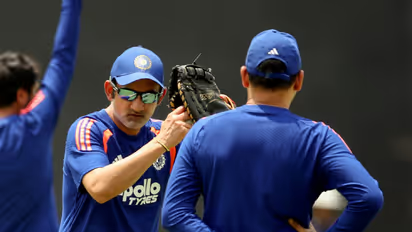
India head coach Gautam Gambhir criticised the Guwahati pitch after a record 406-run chase against the West Indies. He called for a better contest between bat and ball, stating that such batting-friendly conditions are 'not fair' on bowlers.
Gambhir calls for 'more contest between bat and ball'
"Look, if I have to be absolutely honest, I feel I think there has to be a bit of more contest between bat and ball, because I think you talk about cricket - but this is not cricket, this is only batting," Gambhir told Star Sports after the game, according to Cricinfo. "Because imagine a young bowler bowling on this wicket, and the opposition getting 400 and then we go on to chase 400. Obviously, for the records it's outstanding, for the crowd it's outstanding, for the broadcaster it's outstanding, but if you ask me as a genuine cricket fan and as a coach, because I have to have sympathy for the bowlers as well," said Gambhir."When you bowl on this kind of a wicket, it's not fair for the bowlers. So we've got to give something to the bowlers so there's at least something which the bowlers can work with," he added.
Record-breaking chase seals series for India
The comments came after a remarkable batting contest in which both teams crossed 400. West Indies posted 405 for seven after centuries from John Campbell, Shai Hope and Amir Jangoo, only for India to chase down the target with six-and-a-half overs to spare. Shubman Gill produced a record-breaking 223 not out off 133 balls, while Rohit Sharma struck 101 off 75 as India raced to 408 for two in 43.3 overs.Gill and Rohit put on 255 for the opening wicket, India's second-highest opening partnership in men's ODIs, before Rohit departed after completing his century. Virat Kohli, who had scored a century in the first ODI, made 29 off 19 balls before falling, but Gill remained unbeaten, and Ruturaj Gaikwad's 31 off 37 helped India complete the chase. It was only the second successful chase of a target of 400 or more in ODI history, after South Africa's famous 438-run chase against Australia in 2006.
'You need some sympathy for the bowlers'
Gambhir, however, said the bowling figures should not be viewed in isolation when assessing bowlers in such conditions."The first thing is that you need some sympathy and a bit of margin for the bowlers," he told Star Sports, according to Cricinfo. "Often you can't be hard on bowlers, because sometimes bowling figures are such that they haven't bowled as poorly as their figures suggest. Because the margin is very small. Plus, I think you can only bowl in good areas because besides that, with five fielders inside, two new balls, and the kind of power-hitting there is now, bowlers don't really have many options."
"That is why, as a coach, as a support staff, the first thing you look at is, were they able to execute their bowling or their plans properly? If they were able to do that, then you shouldn't be hard on them. If you get too hard just looking at their analysis, then we will never be able to develop bowlers. Imagine Auqib \[Nabi\] playing his first game... somewhere you need to give them a bit of support and keep a bit of an extra cushion or extra options for them. But unfortunately, today there wasn't much for any bowler," he added.
Testing young bowlers for 2027 World Cup
India handed a debut to Auqib Nabi despite holding a 1-0 lead, and Gambhir said exposing young bowlers to pressure situations was part of India's preparation for the 2027 ODI World Cup."We could have given Auqib a chance in the next match too when it's a dead rubber, but in a dead rubber, you don't have that pressure which comes with the pressure of winning a series. And we all know that the World Cup is all about pressure. Cricket isn't going to change like that, only the pressure will be different because the World Cup comes once in four years, so we want to put bowlers under pressure," said the India head coach.
"For example, Gurnoor [Brar]. Having Gurnoor bowl in the first 10 overs, bowling at the death, I know people will talk about his analysis, but the more he bowls in tough conditions, in tough situations, the better it is for Indian cricket. Because you can have him bowl in the middle overs and get good analysis or good stats for him, make him bowl defensively, but the more we expose them at such times, the better it is for Indian cricket," he added.
Limited time to finalise World Cup squad
With the 2027 World Cup less than a year away, Gambhir also stressed the limited number of ODIs India have left to assess their options."You said that there is one year, but in that one year, three months will go into the IPL, three months will go into the India-Australia series," he said. "So after this series, we have barely 20 ODIs, and 20 ODIs aren't really that many ODIs, which includes three against Sri Lanka, three against Zimbabwe. I believe there isn't much time. So whatever we plan, whatever options we prepare, we will have to do it as quickly as possible," said Gambhir.
"So before that, whatever our options are after the IPL, whatever squad is ready in our probably bigger, broader picture, we will only play them after the IPL. So right now is the time for us to try different options. Just like Auqib got an opportunity today, we will similarly try, at least until the Zimbabwe series, to give other people an opportunity and see what they can offer us in this format," he concluded.
India's record chase ensured they took an unassailable 2-0 lead in the three-match series, but Gambhir's focus after the game was on ensuring future ODI contests provide a greater role for the bowlers as India continue preparations for the World Cup. India will face West Indies in the third ODI at the PCA International Cricket Stadium in New Chandigarh on Saturday. (ANI)
(Except for the headline, this story has not been edited by Asianet Newsable English staff and is published from a syndicated feed.)