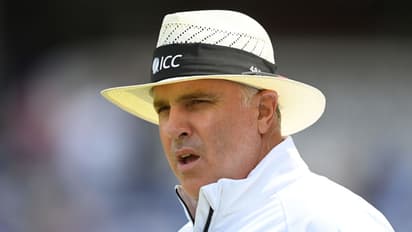
WI vs AUS: TV umpire Adrian Holdstock faces heat over controversial DRS calls in Barbados Test
Synopsis
Controversial DRS calls by third umpire Adrian Holdstock have marred the first WI vs AUS Test, with decisions like Chase’s LBW and Hope’s catch sparking outrage. Fans accuse Holdstock of bias and say he's undermining the credibility of the DRS.
The ongoing first Test between the West Indies and Australia at Barbados’ Kensington Oval has been marred by a series of controversial Decision Review System (DRS) calls, and the centre of the controversy is third umpire or TV umpire Adrian Holdstock.
The first match of the Frank Worrell Trophy 2025 is currently hanging in the balance, with Australia taking an 82-run lead. The visitors assumed their second innings batting after bundling out West Indies for 190 and posted a total of 92/4, with Travis Head and Beau Webster batting on 13 and 19, respectively, at the close of play on Day 2.
Australia were bowled out for 180 in the first innings, with Travis Head being the top-scorer with 59 off 78 balls, and West Indies responded with 190, thanks to gritty batting by skipper Roston Chase (44) and Shai Hope (48), and vital contribution by Alzarri Joseph (23) in the lower-order.
The hosts clawed their way back into the contest with early breakthroughs, including the wickets of Usman Khawaja (15), Cameron Green (15), and Josh Inglis (12), setting up a tense battle heading into Day 3 of the Barbados Test.
DRS controversies put the first Test in spotlight
The series opener of the Frank Worrell Trophy 2025 has caught the attention of the fans and experts alike, not just for the gripping contest between West Indies and Australia but also for a series of DRS controversies that sparked debate over the use of technology by the third umpire.
West Indies were the ones who suffered the most from wrong DRS calls by Adrian Holdstock, who is officiating the ongoing Test series as the third umpire. From fine Snicko spikes to disputed low catches, the Caribbean side, led by Roston Chase, repeatedly found themselves on the wrong end of marginal decisions by the third umpire, despite technology seemingly suggesting otherwise.
Day 2 of the opening Test of the three-match series witnessed a couple of controversial DRS calls by the third umpire Holdstock, including Roston Chase’s LBW dismissal, where Ultredge clearly showed a spike, yet he was ruled out.
The ongoing first match of the series between West Indies and Australia, despite offering a gripping contest as the momentum swings, has become a talking point for all the wrong reasons, with third-umpire Adrian Holdstock’s questionable DRS decisions overshadowing the on-field action and drawing widespread criticism.
Controversial DRS calls by Adrian Holdstock
1. Roston Chase - LBW dismissal
Roston Chase was given out for LBW by the on-field umpire, and decided to opt for DRS. In the Real-time Snicko (RTS), a slight spike appeared just as the ball passed the bat, indicating an inside edge before the ball hit his pad. However, the TV umpire Holdstock felt that the ball was too far from the bat before hitting the pad; thus, he upheld the original decision of the on-field umpire. Chase was dismissed despite seeming evidence of bat involvement.
2. Shai Hope - Caught Behind by Alex Carey
The middle-order West Indies batter Shai Hope was given out after Alex Carey took a clean, one-handed diving catch behind the stumps. However, the on-field umpires decided to check with Adrian Holdstock whether the ball caught by Carey touched the ground before entering the gloves. Despite the replays showing that there was a possible gap between the ground and Carey’s gloves, the third umpire deemed no conclusive evidence to overturn the on-field soft signal of ‘out’ and thus, Hope was dismissed on a low-percentage call.
3. Travis Head - Edge out not reviewed
One of the controversial DRS calls is that Adrian Hotstock is not taking Travis Head’s potential edge in the first innings. The West Indies skipper Roston Chase decided to opt for a review after keeper Shai Hope believed that the ball had under-edged the bat before being caught. Mitchell Starc felt it was out. However, the third umpire did not consider the edge, upholding the on‑field umpire’s ‘not out’ decision.
4. Cameron Green - LBW appeal
Cameron Green faced a heated LBW appeal on Day 2 of the series opener when replays showed that a tinny spike and a slight deviation from the bat suggesting contact, but third umpire Adrian Hotsock ruled ‘not out’, ruling that the evidence was inconclusive. The ball-tracking showed all three reds, but Holdstock believed the spike on UltraEdge was not definitive enough to confirm bat involvement, upholding the on-field umpire’s original decision.
Adrian Holdstock faces backlash on social media
With repeated controversial DRS calls in the first Test between the West Indies and Australia, the third umpire, Adrian Holdstock, has been criticised for inconsistent interpretations of the technology and seemingly favouring Australia with marginal calls, sparking outrage among fans on social media.
Taking to their X handles (formerly Twitter), many called out Holdstock for undermining the credibility of the Decision Review System, while mentioning that the West Indies have been ‘robbed’ of fair opportunities due to wrong decisions by the TV umpire. Some have suggested the West Indies walk off from the series until Adrian Holdstock stepped down from officiating the series as the third umpire.
It remains to be seen whether the International Cricket Council will address the growing criticism and take any action against Adrian Hotstock on his controversial DRS calls, which sparked debate over the lack of transparency and accountability of third-umpire decisions in international cricket.
‘A couple more have gone against the West Indies’
Australian pacer Mitchell Starc weighed in on four DRS controversies across three innings of the first Test, stating there had been some ‘interesting ones’. He admitted that a few wrong DRS calls went against the West Indies.
“There’s been some interesting ones,” Starc said.
“A couple more have gone against the West Indies than us, so one for us, obviously, looked like there was a gap between the bat and the ball. Cost us 40-odd runs, but then a contentious one to then get the wicket.
“So as players, you can only ask a question, we don’t use the technology to make that decision, we can ask a question,” he added.