Zuckerberg’s Metaverse Was Supposed To Change Everything — Instead, Meta Seems To Be Pulling The Plug After Burning Billions

Synopsis
As AI spending explodes across Big Tech, Meta is aggressively pivoting toward AI, raising questions about whether Zuckerberg has quietly shifted from the metaverse to a more attainable vision.
- Meta’s metaverse rollout struggled from the start, hampered by poor adoption.
- Reality Labs has become a significant financial drag, posting massive operating losses that now look increasingly unsustainable as AI capex demands rise.
- The company is prioritizing AI leadership over reviving its metaverse vision.
Has Mark Zuckerberg’s metaverse dream come crashing down? It has been four years since the billionaire took the leap of faith toward the concept, reasoning that it was the successor to the mobile internet.
If rumors are anything to go by, Meta Platforms, Inc. (META) is mulling cutting 30% of the budget earmarked for the metaverse.
Big Vision That Didn’t Quite Take Off
Announcing the fancy concept at the Meta Connect 2021 conference, the company defined it as a “set of interconnected digital spaces that lets you do things you can’t do in the physical world.” Zuckerberg was so enamored with it that he wanted to abandon the company’s identity as a social-media platform and rebrand it as Meta, which had previously been known as the flagship Facebook app.
The metaverse heavily drew on Augmented Reality (AR), a technology that lets users augment their physical environment with digital elements, and Virtual Reality (VR), which gives users an immersive experience of a virtual world. During the metaverse’s unveiling, the company announced its flagship product, the Horizon Homes, a homebase in the metaverse, where you can invite friends, hang out with them and play games together by putting on your Quest VR headset.
As opposed to Meta’s internal target to hit 500,000 monthly active users for its Horizon Worlds, a social platform optimized for the metaverse, by the end of 2022, it could only hit 200,000 by October, forcing Meta to revise down its estimate, according to Statista.
Monthly Active Users Of Horizon Worlds (2022)
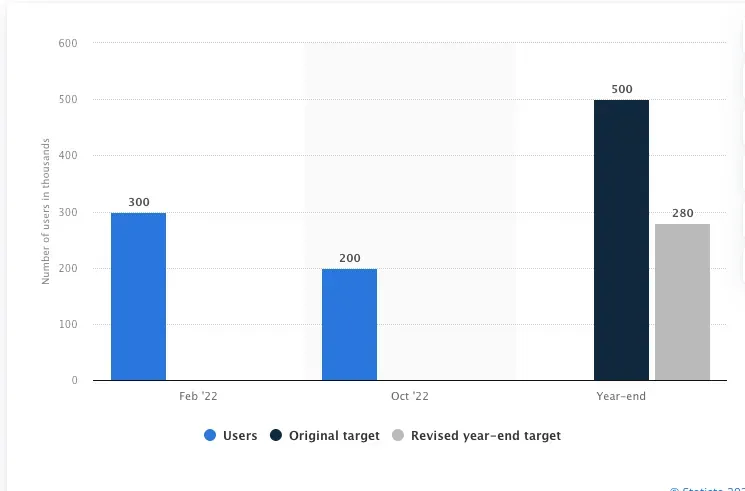
Source: Statista<
Poor user adoption, expensive hardware requirements, not-so-good user experiences, and a lack of compelling content all served as handicaps.
AI - The Metaverse Killer?
Metaverse, which was housed in the company’s Reality Labs business, didn’t quite take off as Zuckerberg expected. A year from its launch, another buzzword bulldozed its way into the tech world, smothering Zuckerberg’s new fad. But the metaverse had its inherent pitfalls, keeping the technology from taking off in a big way. When asked about Meta’s metaverse at the 2022 WSJ TechLive conference, Microsoft Gaming Head Phil said it’s a “poorly built video game.”
The launch of OpenAI’s large language model (LLM), ChatGPT, in late 2022, set off the artificial intelligence (AI) revolution, spawning an ecosystem of players, both builders and consumers, around it.
According to Wedbush’s Daniel Ives, the AI revolution is here to stay despite all doomsday talks. In a recent note, the analyst called AI the fourth industrial revolution and said the “tech cap-ex supercycle” will drive it over the next few years. He sees big-tech capital expenditure on technology at $500 billion to $600 billion in 2026.
Meta’s stock has begun to turn the corner after the ravages seen since it hit a peak in mid-August as the broader market shook off AI bubble fears and set its eyes on a potential rate cut in December.
Reality Labs’ Dismal Showing
Reality Labs, Meta’s research arm for AR/VR hardware and software, emerged from the company’s push into immersive technologies and was built around Oculus VR, which Meta acquired in 2014 for $2 billion in cash and stock. Oculus is the progenitor of today’s Quest headsets. Although there’s no single moment that clearly marks the division’s formal creation, Meta celebrated its 10th anniversary last year, with the Oculus acquisition widely regarded as its starting point.

Source: Meta<
For the first nine months of 2025, the division has generated $1.06 billion in revenue and incurred $12.76 billion in operating losses.
Meta Seeks Redemption?
As Meta’s capex needs surge, the company can’t afford to keep pouring money into a hole. Several prominent voices on Wall Street have already accused it of propping up profits with questionable accounting choices.
To stay competitive in the AI race, Meta may need to adopt a more disciplined approach — one that could force Zuckerberg to let go of his once-cherished vision. Signs suggest he may already have moved on, given the breakneck speed of Meta’s AI push, from forming a Superintelligence group to building massive data centers and aggressively recruiting top AI researchers. Even with these concerted efforts, whether Meta can close the gap with its megacap peers in foundation models — and deploy AI features profitably across its core businesses — remains an open question.
For updates and corrections, email newsroom[at]stocktwits[dot]com.<
Stay updated with all the latest Business NewsShare Market NewsIPOsGold PriceDA Hike8th Pay CommissionAsianet News Official App