STT Bombshell on F&O in Budget 2026: Experts Explain Who Gains, Who Loses
Synopsis
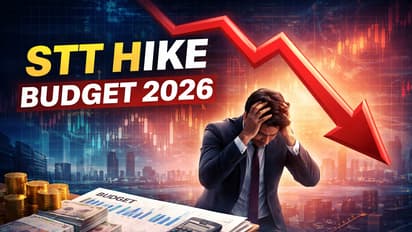
Union Budget 2026 hikes STT on futures and options to curb speculation and protect retail investors. Markets turn volatile as experts, NSE chief and brokerages react to the move.
In a decisive move to curb speculative trading in derivatives, Finance Minister Nirmala Sitharaman on Sunday proposed a sharp hike in the Securities Transaction Tax (STT) on futures and options (F&O) trades in the Union Budget 2026-27. The move, aimed at protecting retail investors and reducing systemic risk, has triggered mixed reactions from market participants, brokerages and regulators.
What Has Changed in STT
Presenting her ninth consecutive Budget, Sitharaman announced that the STT on futures contracts will be increased to 0.05 per cent from the existing 0.02 per cent.
On options, the tax burden has also been raised:
- STT on options premium: 0.15 per cent (from 0.1 per cent)
- STT on exercise of options: 0.15 per cent (from 0.125 per cent)
“I propose to raise the STT on Futures to 0.05 percent from present 0.02 percent. STT on options premium and exercise of options are both proposed to be raised to 0.15 percent from the present rate of 0.1 percent and 0.125 percent respectively,” the finance minister said.
The increase comes on top of last year’s hike and is widely seen as a signal that the government wants to rein in excessive derivative trading rather than maximise tax revenue.
Buybacks to Be Taxed as Capital Gains
Alongside the STT hike, Sitharaman also proposed a key change in the taxation of corporate buybacks.
“In the interest of minority shareholders, I propose to tax buyback for all types of shareholders as Capital Gains. However, to disincentivize misuse of tax arbitrage, promoters will pay an additional buyback tax,” she said.
According to the proposal:
- Corporate promoters will face an effective tax of 22 per cent
- Non-corporate promoters will pay an effective tax of 30 per cent
The move is intended to curb tax arbitrage while protecting minority investors.
Why the Government Is Tightening the Screws on F&O
The government and market regulator SEBI have repeatedly flagged concerns over rampant speculative trading in derivatives, especially among retail investors.
A SEBI study revealed that around 93 per cent of individual traders in equity F&O incur losses, and more than 75 per cent of loss-making traders continue trading despite repeated losses.
Revenue Secretary Arvind Shrivastava said the hike is meant to directly address this issue.
“The government's intention is to discourage speculative tendencies, and the increase in rate is essentially in that direction. So, it is meant to essentially handle the systemic risk in derivative markets,” he said.
Shrivastava added that even after the hike, STT rates remain modest when compared to the sheer scale of derivative transactions.
Immediate Market Reaction and Volatility
The announcement triggered sharp volatility in the equity markets. The Sensex plunged 2,370 points, while the Nifty slipped nearly 3 per cent, briefly falling below the 80,000 and 25,000 marks respectively, before staging a partial recovery later in the session.
Market participants attributed the sell-off largely to concerns over higher transaction costs in derivatives and the potential impact on trading volumes.
Brokerages Flag Short-Term Pain
Brokerages broadly agreed that the move could act as a near-term dampener, particularly for capital market intermediaries.
“The proposed increased STT in F&O is a dampener for capital market entities in the short term, but may augur well in the long term,” said Dhiraj Relli, Managing Director and CEO of HDFC Securities.
Kotak Securities MD and CEO Shripal Shah said the hike will significantly raise trading costs.
“This could cool derivative activity and lead to a reduction in volumes. The intent appears to be volume moderation rather than revenue maximisation, as any potential revenue gain could be offset by lower derivative volumes,” he said.
SAMCO Securities warned that higher transaction costs could lead to a cascading impact across the ecosystem.
“Higher transaction costs are likely to reduce trading volumes, dampen short-term momentum, and lower profitability for active market participants,” the brokerage said.
Impact on FPIs and Market Structure
Some experts cautioned that foreign portfolio investors (FPIs), particularly high-frequency and derivative-focused funds, may be hit in the near term.
“The increase in STT, particularly in futures and options, is likely to act as a marginal negative for FPI flows,” said Aakash Shah, Technical Research Analyst at Choice Equity Broking.
However, others believe the move could ultimately strengthen the market.
“The treatment of buybacks as capital gains provides a meaningful offset and reinforces long-term investor confidence,” said Shrikant Chouhan, Head of Equity Research at Kotak Securities.
NSE CEO: Markets Will Absorb the Change
Seeking to calm concerns, Ashish Chauhan, Managing Director and CEO of the National Stock Exchange (NSE), said the markets will gradually adjust to the higher STT.
“Overall, the market tends to absorb such changes in its own way and gradually adjusts. Going forward, the asset quality of stock brokers and exchange-listed entities will not be significantly impacted,” Chauhan said.
He added that India’s strong economic growth would continue to attract investors and that the STT hike is unlikely to affect NSE’s proposed IPO.
“The stock markets will absorb the changes in STT and gradually adjust, with no significant impact on the asset quality of stock brokers or exchange-listed entities,” he reiterated.
NSE IPO Timeline and Budget Takeaways
Chauhan also revealed that NSE’s long-awaited IPO could be rolled out in the next 7 to 8 months, with the Draft Red Herring Prospectus (DRHP) expected in 3 to 4 months, following SEBI’s recent approval.
Calling the Budget growth-oriented yet fiscally conservative, he highlighted key achievements, including:
- Reduction in fiscal deficit from 4.4 per cent to 4.3 per cent
- A roadmap to bring the debt-to-GDP ratio to around 50 per cent
- Focus on infrastructure projects such as the Mumbai-Pune high-speed railway
Long-Term View: Stability Over Speculation
While short-term discomfort is evident, several market veterans believe the STT hike could encourage healthier market behaviour.
“The tweak in STT fits squarely within the philosophy of promoting investment, hedging and efficient price discovery, rather than excessive leverage-driven trading,” said Narinder Wadhwa, MD & CEO of SKI Capital Services.
Summing up the government’s intent, Chauhan said the Budget “deepens financial markets through calibrated measures — higher STT on derivatives to curb excess speculation”.
As India’s markets mature, policymakers appear determined to prioritise stability and investor protection, even if it comes at the cost of short-term volatility.
Stay updated with all the latest Business NewsShare Market NewsIPOsGold PriceDA Hike8th Pay CommissionAsianet News Official App