Stocktwits Space Race Weekly: SPCX Holds Pole Position As ASTS, RKLB, PL, RDW, FLY Lose Altitude
Synopsis
Planet launched Google’s Suncatcher prototype to test TPUs in orbit, and Redwire explored orbital computing and robotics.
- Starship reached orbit and deployed 26 Starlink V3 satellites, but an engine shutdown shortened the mission to roughly three hours.
- Rocket Lab booked 20 additional Synspective launches and ARK bought about $16.5 million in shares.
- AST shipped BlueBirds 14-16, while the carrier satellite JV preserved existing agreements and filings revealed a new commercial chief’s 200,000-RSU grant.
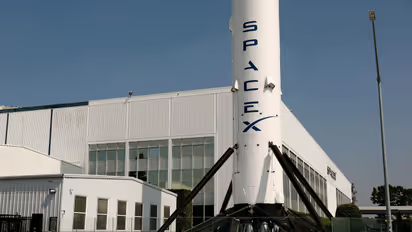
SpaceX (SPCX) lost the least ground in this week’s space-stock race as Starship reached orbit and Elon Musk pitched a new Nvidia AI milestone, while rivals’ contracts, satellite shipments and computing projects failed to prevent broader declines.
SPCX fell 0.4% over the past week, while RKLB declined 5%, FLY lost 6%, PL dropped 7%, ASTS shed 8% and RDW slid 9%.

SPCX Fires Up Starship And Its AI Ambitions
Starship Flight 14 reached orbit on Monday and deployed 26 Starlink V3 satellites. Musk later said all were “deployed and operating nominally.” An upper-stage engine shutdown shortened the planned 10-hour mission to three hours, keeping recovery and reuse firmly on investors’ watchlists.
Thursday’s slate included NASA’s Crew-13 launch aboard Dragon Grace, Transporter-18 and Falcon Heavy’s NROL-97 mission, putting SpaceX on track for three orbital launches in about 13 hours.
Musk also said he was “cautiously optimistic” SpaceX could run its version of Nvidia’s VR72 system near 250 kilowatts of average power, with peaks approximately 10% higher. “This is a big deal if it pans out and would apply to our ground-based systems too,” he said, crediting close collaboration with Nvidia.
Mach33 founder Aaron Burnett estimated that the target was 10% to 25% above typical third-party reported averages, while flagging the heat-management challenge. “If anyone can pull it off it’s the joint Nvidia and SpaceX teams,” he said.
The push comes alongside compute agreements providing $920 million monthly from Google and $1.25 billion monthly from Anthropic, subject to contractual terms. UBS projects $7.6 billion in third-quarter AI revenue, but also $19.3 billion in capital spending and $13.2 billion in cash burn.
SPCX sentiment on Stocktwits swung to ‘bullish’ from ‘bearish’ a week earlier amid ‘high’ message volume.
RKLB Lands Record Deal, ARK Buys The Dip
Rocket Lab landed its largest commercial Electron agreement: 20 additional Synspective launches scheduled from 2028 through 2031. The deal lifts Synspective’s total bookings to 47 and Rocket Lab’s launch backlog above 100 missions.
ARK bought 233,482 RKLB shares on Thursday worth about $16.5 million at the close. Citi initiated coverage with a ‘Buy’ rating and a $105 target, calling the company a “core holding for space bulls.” Neutron’s maiden flight, targeted no earlier than the fourth quarter, and the proposed Iridium acquisition are the current longer-term catalysts.
RKLB sentiment on Stocktwits slipped to ‘bearish’ from ‘bullish’ a week earlier amid ‘high’ message volume.
ASTS Moves BlueBirds And Builds Commercial Muscle
Meanwhile, AST shipped BlueBirds 14, 15 and 16 to Cape Canaveral and CEO Abel Avellan met FCC Chairman Brendan Carr as the company sought more spectrum for direct-to-device service.
AT&T, T-Mobile and Verizon then formalized a technology-neutral satellite joint venture Thursday. Existing agreements remain intact, preserving AT&T’s and Verizon’s relationships with AST while T-Mobile continues working with Starlink.
AT&T CEO John Stankey previously said the carrier would “continue on that path” with AST. The satellite company also said its agreements were “not affected” by the proposed JV.
Fresh filings also identified Wayne Thorsen as executive vice president and chief commercial officer and disclosed a 200,000-RSU grant vesting over three years. The underlying shares were worth about $11.4 million at Thursday’s close.
ASTS sentiment on Stocktwits turned ‘bullish’ from ‘bearish’ a week earlier amid ‘high’ message volume.
PL Sends Google’s AI Ambitions Into Orbit
Transporter-18 launched Planet’s Google Project Suncatcher prototype, Tanager-2 and 18 SuperDoves on Thursday. Planet confirmed initial contact with the prototype, Tanager-2, and two SuperDoves, with the remaining 16 awaiting deployment from a transfer vehicle.
Suncatcher will test how Google’s TPUs withstand orbital radiation and heat, a first step toward exploring space-based AI computing. Tanager-2 expands Planet’s hyperspectral imaging capabilities for emissions monitoring, agriculture, water quality and mineral identification.
PL sentiment on Stocktwits remained ‘bearish’ over the past week amid ‘extremely low’ message volume.
RDW And FLY Chase Space AI As Retail Cools
Redwire signed an MOU with Sophia Space to explore orbital computing, combining Sophia’s TILE architecture with Redwire’s power, cooling and spacecraft expertise. Honda also separately proposed pairing its robotic hand with Redwire’s STAARK arm to automate research aboard commercial space stations.
Meanwhile, Firefly signed a commercial agreement to carry Starcloud’s computing payload aboard Elytra on a lunar mission targeted no earlier than 2028. The demonstration will process data in lunar orbit before transmitting it to Earth, showing “how data can be captured, processed, and delivered from lunar orbit,” Firefly executive Ray Allensworth said.
On Stocktwits, retail enthusiasm cooled sharply for RDW and FLY over the past week. RDW sentiment swung from ‘extremely bullish’ to ‘bearish’, while FLY slipped from ‘extremely bullish’ to ‘neutral’, both amid ‘high’ message volume.
For updates and corrections, email newsroom[at]stocktwits[dot]com.<
Stay updated with all the latest Business NewsShare Market NewsIPOsGold PriceDA Hike8th Pay CommissionAsianet News Official App