RKLB Is Among Nasdaq’s Top 5 Losers So Far This Month, Yet Analysts See 90% Upside — Can Neutron Justify Its SpaceX Premium?

Synopsis
RKLB trades at 26.6x forward EV/sales, about 89% above SpaceX, while Redwire has the lowest valuation multiples.
- RKLB has fallen nearly 23% in October, sharply underperforming the Nasdaq Composite, S&P 500, and Dow.
- Planet leads peers with 121% analyst upside, followed by RKLB, ASTS at 82%, RDW at 67%, and SPCX at 50%.
- Neutron hardware production is advancing after composite defects delayed its debut into 2027, with qualification testing still ahead.
Shares of Rocket Lab (RKLB) have shed nearly 23% so far in October, yet analysts see a 90% upside as the company advances its delayed Neutron rocket. The selloff has widened its potential return without erasing a demanding valuation: Rocket Lab still trades at almost twice SpaceX’s forward sales multiple.
RKLB’s Losses Outrun Broader Market
RKLB stock’s October decline compares with a 0.6% loss for the Nasdaq Composite and gains of 1.4% and 3.8% for the S&P 500 and Dow, respectively.
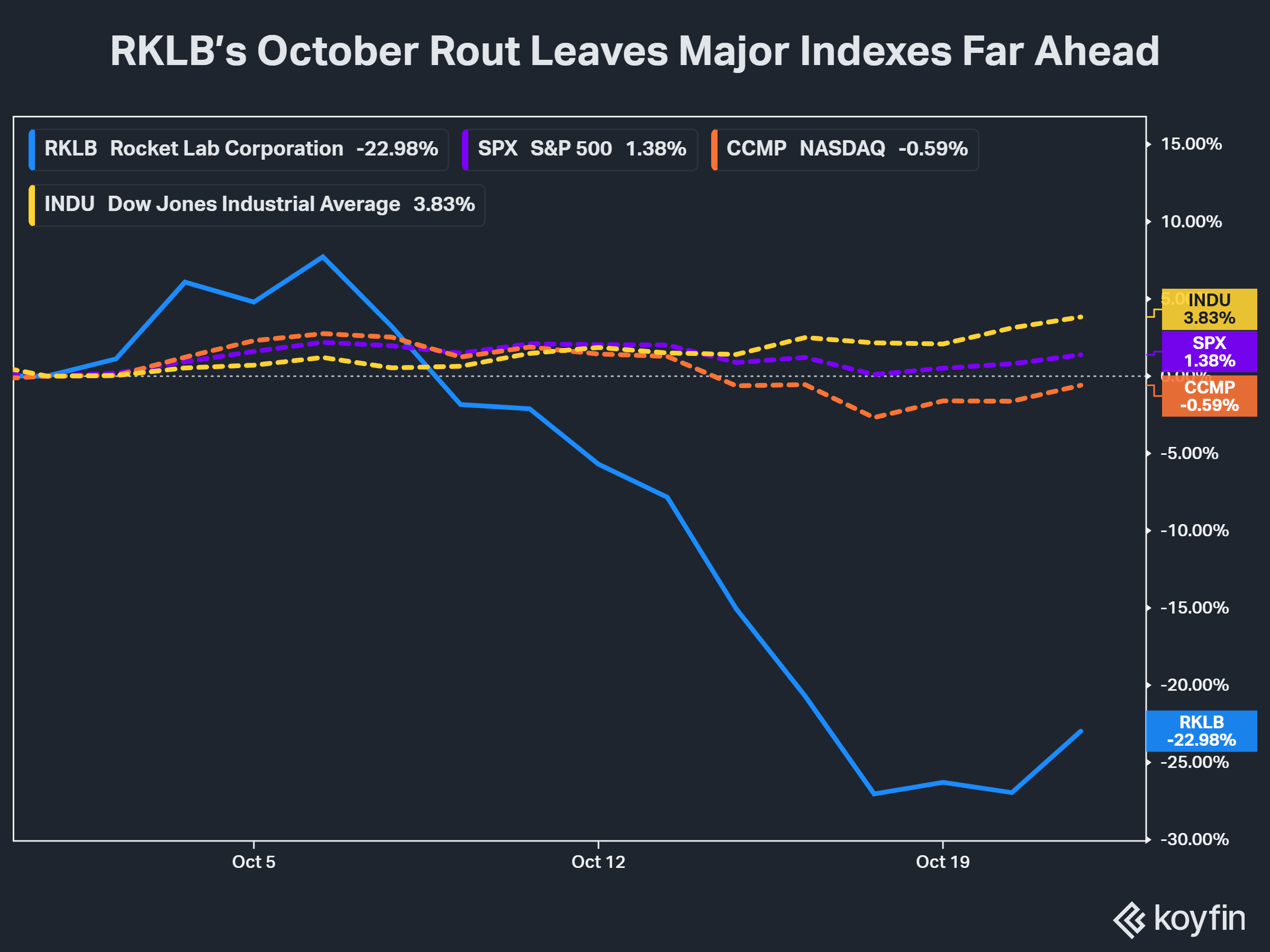
Other Nasdaq-100 laggards include CoreWeave, down 29% so far this month, Nebius, down 27%, Seagate, down 24%, and Intel, down 23%.
CoreWeave has faced scrutiny of its debt-funded AI expansion as inflation revived rate-hike fears, with its October 2031 bond yield briefly exceeding 16%. Nebius suffered spillover from the same concerns as Gartner warned that cost pressures and limited differentiation could force more than 80% of specialized AI cloud providers to cease independent operations by 2030.
Seagate faced pricing concerns after reports said that Toshiba planned to double AI data-center hard-drive capacity by fiscal 2027. Intel faced uncertainty over potential Terafab business after Musk confirmed discussions with TSMC, followed by an October 14 explosion at its Kiryat Gat facility.
Wall Street Sees A Rocket Lab Comeback
Rocket Lab’s analyst backing looks strong alongside space-sector peers SpaceX, AST SpaceMobile, Planet Labs, and Redwire, but it does not offer the biggest potential payoff. According to Koyfin, RKLB’s average 12-month target of $102.15 implies 90% upside, trailing Planet’s 121%, while exceeding AST SpaceMobile’s 82%, Redwire’s 67%, and SpaceX’s 50%.
| Stock | Average 12-month target | Target range | Upside |
| Planet Labs (PL) | $30.27 | $17-$50 | 121% |
| Rocket Lab (RKLB) | $102.15 | $64-$150 | 91% |
| AST SpaceMobile (ASTS) | $74.28 | $42.50-$108 | 82% |
| Redwire (RDW) | $14.28 | $8-$20 | 67% |
| SpaceX (SPCX) | $238.55 | $70-$500 | 50% |
Rocket Lab leads the group in bullish analyst backing, with five ‘Strong Buy’ ratings, 13 ‘Buy’ ratings, and four ‘Hold’ ratings across 22 analysts. About 82% recommend buying the stock, and none recommend selling, according to Koyfin.
SpaceX comes close at 79%, with eight ‘Strong Buy’ ratings, 22 ‘Buy’ ratings, five ‘Hold’ ratings, and three ‘Sell’ ratings across 38 analysts. But its $70-$500 target range reveals a wide divide over what the shares are worth.
Meanwhile, Planet has one ‘Strong Buy,’ six ‘Buy,’ and five ‘Hold’ ratings across 12 analysts. Redwire has six ‘Buy’ ratings, four ‘Hold’ ratings, and one ‘Strong Sell’ across 11 analysts. AST SpaceMobile draws the least bullish consensus: just four of its 13 analysts rate it ‘Buy,’ while seven recommend ‘Hold,’ one ‘Sell,’ and one ‘Strong Sell.’
Neutron Faces A High Bar In RKLB’s Valuation
Rocket Lab’s selloff has left a sizable valuation premium intact. At 26.6 times forward enterprise value to sales, RKLB trades about 89% above SpaceX, nearly three times Planet Labs’ multiple, and more than eight times Redwire’s.
| Stock | Trailing EV/sales | Forward EV/sales | Price/book |
| Rocket Lab (RKLB) | 38.8x | 26.6x | 9.2x |
| SpaceX (SPCX) | 91.2x | 14.1x | 16.5x |
| Planet Labs (PL) | 12.2x | 9.4x | 8.8x |
| Redwire (RDW) | 3.9x | 3.2x | 1.3x |
SpaceX commands higher multiples of trailing sales and book value, but its much lower forward-sales multiple points to expectations for a sharp revenue ramp.
Redwire offers the lowest multiples across all three measures, while Planet pairs a lower sales valuation with the greatest analyst-implied upside. Planet looks considerably more expensive against forecast EBITDA, however, trading at 297.4 times compared with SpaceX’s 23.5 times. SpaceX also trades at 52 times forward earnings.
For Rocket Lab, investors are paying a substantial premium for forecast sales, making Neutron’s progression from factory milestones to successful launches and commercial revenue important.
RDW leads the group with a 13% year-to-date gain, while SPCX is down just 1%. RKLB has fallen 23%, followed by PL’s 30% decline and ASTS’s steeper 44% loss.

Neutron Moves Forward, But A Launch Date Must Wait
Rocket Lab is advancing Neutron after manufacturing defects pushed its debut into 2027. The Stage 2 tank assembly has been rotated horizontally ahead of shipment to Wallops Island for fluid-system testing and Archimedes vacuum engine installation.
A replacement Stage 1 forward dome is also in production after voids appeared in thicker carbon-composite sections introduced following an earlier tank failure and a switch to automated manufacturing.
“They don't necessarily mean that the dome would fail in flight but our practice is to proceed only when we believe the system has the appropriate margins. Possible success isn't our standard,” CEO Sir Peter Beck said last week.
Manufacturing fixes produced Rocket Lab’s highest-quality aft dome to date. Management expects replacement forward-dome production and inspection before Q1 2027, followed by first-stage assembly and pressure testing during that quarter if work proceeds as planned. A firmer launch target would follow. “In the meantime I'd rather show you real-time progress than give you a date that I might have to walk back,” Beck said.
Rocket Lab is also accelerating upgrades for later flights, while building its second and third Neutron vehicles.
SpaceX’s Starship Push Could Make Room For Neutron
On the other hand, SpaceX’s shift toward Starship could create room for Neutron. Some spacecraft companies have reportedly been told Falcon 9 is fully booked until 2028 or 2029. Musk has tied its phaseout to reliable Starship flights several times a week, although government missions could keep Falcon operating into the early 2030s.
“They are all in dire need of getting access to launch,” ARK analyst Daniel Maguire said of satellite operators. Neutron’s 13,000-kilogram capacity is close to Falcon 9’s 17,000 kilograms in a partially reusable configuration. ARK sees an “enormous opportunity” for Rocket Lab and Stoke Space, provided their rockets deliver.
Rocket Lab already has a growing business behind the opportunity. Second-quarter revenue rose 62% to a record $234 million, while backlog climbed 137% to $2.36 billion. Third-quarter guidance called for revenue of $250-million-$265 million and an adjusted EBITDA loss of $17 million-$23 million.
Electron, HASTE, and Space Systems generate revenue ahead of Neutron’s debut. The proposed $8 billion enterprise-value Iridium acquisition would add an operating satellite communications network, with completion targeted for mid-2027.
Peers are building momentum too. Planet launched Pelican-12 and secured a NASA task order for Tanager hyperspectral data, while Redwire announced $13.8 million in additional Stalker drone orders for National Guard training.
Retail traders showed a clear preference for SPCX on Stocktwits, where sentiment was ‘extremely bullish’ amid ‘extremely high’ message volume. RKLB, ASTS, PL, and RDW drew a cooler reaction, with sentiment ‘bearish’ and message volume ‘normal’ across all four.
For updates and corrections, email newsroom[at]stocktwits[dot]com.<
Stay updated with all the latest Business NewsShare Market NewsIPOsGold PriceDA Hike8th Pay CommissionAsianet News Official App