Iran Attacks: IEA Chief Warns Hormuz Shipping Risks Are Here To Stay Despite Recovery In Gulf Oil Exports
Synopsis
Fatih Birol says confidence in the Strait of Hormuz has been severely damaged, even as Gulf crude shipments recover to 82% of pre-war levels.
- Birol said he sees “no credible path back” to pre-war conditions in the Strait of Hormuz.
- Gulf crude exports recovered to 15 million barrels per day in October, according to the IEA.
- The IEA chief expects the energy crisis to accelerate investment in domestic renewable energy, nuclear power, electricity grids and battery storage.
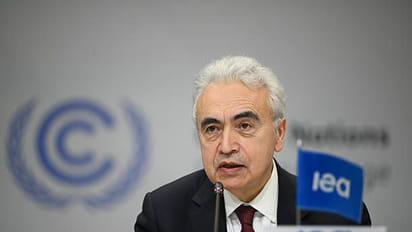
International Energy Agency (IEA) Executive Director Fatih Birol warned Wednesday that the war in Iran has fundamentally changed perceptions of the Strait of Hormuz as a reliable energy corridor, casting doubt on a return to pre-war conditions despite Gulf oil exports recovering.
“I don’t see any credible pathway back to the situation that existed in February 2026,” Birol wrote in an essay for The Economist's ‘The World Ahead 2027’, according to CNBC.
The IEA chief said the disruption of shipping through the strait had severely damaged confidence in the waterway, which could face further interruptions.
“Shipping flows through the Strait of Hormuz have been blocked once, with a hugely disruptive effect on oil and gas markets. It can happen again. Confidence in the Strait as a safe and reliable corridor for energy and other goods has been crushed,” he said.
Iran War Raises Fresh Concerns Over Hormuz
Birol's comments came as Iran launched fresh attacks against Kuwait and Bahrain early Wednesday, widening its strikes across the Gulf while continuing to target ships attempting to transit the Strait of Hormuz.
Iran said it targeted Kuwait's Ali Al Salem Air Base, which hosts U.S. forces, while Kuwait reported incoming drone attacks without confirming damage. Bahrain also reported attacks, following renewed U.S. strikes on Iran's Qeshm Island on Tuesday.
The latest escalation follows the war that began on February 28, during which repeated attacks disrupted oil infrastructure and maritime traffic across the region. Before the conflict, approximately 20 million barrels of crude oil and petroleum products passed through the strait daily, according to the IEA.
Gulf Oil Exports Recover, But Risks Remain
Despite continuing hostilities, Gulf crude exports recovered to 15 million barrels per day in October, equivalent to 82% of pre-war volumes, the IEA said in its November oil market report.
The recovery has helped ease pressure on oil markets, although attacks on tankers and regional infrastructure continue to threaten shipments.
Birol said the crisis has permanently changed perceptions of the waterway's reliability, citing Saudi Arabia and the United Arab Emirates' efforts to develop pipeline routes that bypass the strait.
What Birol Expects For Global Energy Markets
Birol expects the disruption to accelerate countries' efforts to strengthen domestic energy security through solar, wind and nuclear power. He also emphasized the need for stronger electricity grids, battery storage and emergency oil reserves to reduce vulnerability to future supply shocks.
“Uncertainty is now the rule, not the exception,” Birol said, cautioning energy policymakers against replacing existing dependencies with new ones.
CNN reported Monday that U.S. intelligence had uncovered possible Iranian plans involving a “dirty bomb” targeting Washington, D.C. President Donald Trump and other officials downplayed any imminent threat, although Trump warned at a summit in Manila that Iran would “pay a price the likes of which no country has ever paid before” if such plans existed.
Crude Futures Edge Lower
Oil futures traded lower Wednesday despite renewed tensions in the Middle East. U.S. West Texas Intermediate (WTI) crude futures maturing in December fell 0.85% to $85.30 per barrel, while international benchmark Brent crude futures for January fell 0.35% to $92.81 per barrel.
At the time of this writing, oil-linked exchange-traded funds, including the United States Oil Fund (USO) and the ProShares Ultra Bloomberg Crude Oil (UCO), were also in the red in Wednesday’s premarket. On Stocktwits, sentiment around both remained in the ‘bearish’ territory.
See Also: Investors ‘Overwhelmingly Bullish’ On Anthropic’s AI Position, Says William Blair — Sees Valuation Below Peers
For updates and corrections, email newsroom[at]stocktwits[dot]com.<
Stay updated with all the latest Business NewsShare Market NewsIPOsGold PriceDA Hike8th Pay CommissionAsianet News Official App