Fed’s Jefferson Says Higher Yields Signal Investors Are Reassessing Outlook — Next Rate Move ‘May Take More Time’
Synopsis
The Fed vice chair sees inflation risks tilted higher while growth and employment remain solid, as artificial intelligence investment supports the economy but adds to some price pressures.
- Jefferson expects unemployment to remain near 4.1% through year-end but is monitoring potential AI-related job losses.
- Lower-income consumers are showing greater price sensitivity and softer demand despite resilient overall spending.
- Short-term inflation expectations remain elevated, while most longer-term measures are consistent with 2% inflation.
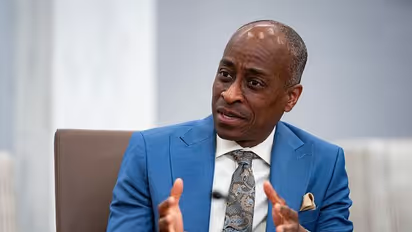
Federal Reserve Vice Chair Philip Jefferson said Treasury yields have risen further since the central bank’s September meeting, signalling that investors are reassessing the economic outlook as policymakers consider their next move.
Future policy adjustments should depend on incoming data, the evolving outlook and the balance of risks, Jefferson said in a Thursday speech. Fed officials will need to reach their own judgment, a process that “may take more time.”
The 10-year Treasury yield was around 5.25% on Friday after reaching 5.34% Thursday, its highest level in 24 years.
Jefferson supported September’s 25-basis-point rate increase to 3.75%-4%, describing it as an important step toward keeping longer-term inflation expectations anchored.
He characterized the economy as facing a “cascade of shocks,” including higher energy prices, the AI infrastructure buildout, and changes in trade policy, which policymakers must consider together.
Inflation Risks Remain Tilted Higher
Personal consumption expenditures inflation stood at 3.4% in August and has remained above the Fed’s 2% goal for more than five years. Jefferson expects inflation to stay elevated in the short run before declining toward target, but sees risks tilted to the upside.
Short-term inflation expectations are elevated, while most longer-term measures remain consistent with 2% inflation. Persistently high inflation, however, could eventually weaken households’ and businesses’ confidence that the Fed will return inflation to target, he said.
AI Supports Growth, Consumer Strains Emerge
Gross domestic product expanded at a 2.4% pace in the first half of 2026, supported by strong AI-related business investment. Jefferson expects continued resilience and an extension of the roughly six-and-a-half-year economic expansion.
He sees risks to growth as roughly balanced: Middle East tensions could weigh on activity, while a stronger-than-expected AI buildout could push growth above his baseline. AI-related demand is also contributing to higher production costs and core goods prices.
Consumer spending remains resilient, though Jefferson is hearing of greater price sensitivity and softer demand among lower-income consumers. Unemployment stood at 4.1% in August and is expected to remain near that level through year-end, while he is monitoring the possibility of AI-related job losses in certain sectors and among some groups of workers.
How Are US Markets Placed Today
At the time of this writing, Nasdaq futures were up 0.6%, Dow and S&P 500 futures rose more than 0.3%, while Russell 2000 futures gained 0.5%.
On Stocktwits, retail sentiment for the SPDR S&P 500 ETF (SPY), an exchange-traded fund that tracks the S&P 500 Index, moved to ‘bullish’ from ‘extremely bullish,’ and Invesco QQQ Trust (QQQ), which tracks the Nasdaq-100 Index, improved to ‘extremely bullish’ from ‘bullish.’
See Also: AMZN Inches Higher Premarket: Amazon Reportedly Seeks To Offload $8B Of Nvidia Chips To Investors
For updates and corrections, email newsroom[at]stocktwits[dot]com.<
Stay updated with all the latest Business NewsShare Market NewsIPOsGold PriceDA Hike8th Pay CommissionAsianet News Official App