Elon Musk Eyes SpaceX-Tesla Merger, Huang Pitches ‘Financeable’ Chips, Zuckerberg Wants More Compute: Mag 7 Voices This Week
Synopsis
The CEOs of the Magnificent Seven spent the week insisting that demand for AI computing is strong, but each had a different bottleneck to flag.
- In the SpaceX earnings call, Elon Musk said a merger with Tesla would be a good idea, but warned that it would be “overstating it” to assume the deal was certain.
- He also said that power and cooling, not chips, limit AI deployment, which led to a surge in Bloom Energy, Vertiv, and other power stocks.
- Meanwhile, Nvidia CEO Jensen Huang said he wants lenders to treat Nvidia chips as a “financeable asset,” pegged neocloud demand to be off “off the charts”, but warned that capital is scarce.
SpaceX (SPCX) and Tesla (TSLA) CEO Elon Musk was the most vocal market participant among the Magnificent Seven leaders this week with earnings of both his companies on deck.
Meta Platforms (META) CEO Mark Zuckerberg also made headlines following Meta’s results, while Nvidia (NVDA) CEO Jensen Huang took the stage at GTC Berlin.
While all three offered a bullish view of AI demand, their comments also flagged the infrastructure and financing required to keep up with it. Musk pointed to power and cooling as bigger constraints on AI deployment than chips, while Huang stated that Nvidia’s computing hardware should become a “financeable asset,” and Zuckerberg said Meta’s AI assistant Muse was only limited by a shortage of computing capacity.
The market was less forgiving. The Nasdaq Composite had its worst session since June on Thursday as concerns about AI spending and higher oil prices weighed on chip stocks.
Musk Backs SpaceX-Tesla Merger: Says Power, Not Chips, Limits AI
Musk used SpaceX’s third-quarter (Q3) earnings call on Tuesday to endorse a potential merger with Tesla, while cautioning that a deal remained uncertain.
“Do I think it would be a good idea? Yes.”
– Elon Musk, CEO, SpaceX and Tesla, on a possible merger
Musk said he felt like he was “tap dancing through a minefield,” when asked about the merger. He shared that the boards of both companies have formed special committees of independent directors, but the committees have not agreed on any terms. According to him, treating a merger as a certainty would be “overstating it.”
SpaceX’s Super Intelligence (SI) segment, which rents computing capacity and operates Grok, generated $7.6 billion in revenue, surpassing Starlink as the company’s largest business. According to Musk, the obstacle facing broad superintelligence deployment is securing enough power, cooling, and supporting infrastructure, rather than obtaining semiconductors.
“More in power and cooling and infrastructure than it is in chips.”
– Elon Musk, CEO, SpaceX and Tesla, on what constrains AI deployment
He said that SpaceX plans to add about 20 gigawatts of power and cooling capacity by the end of 2027, drawing on “many different sources of power, not just gas turbines.” Musk also flagged delays of 12 to 18 months for some gas-turbine components. He stated that the company’s plans were highly proprietary and did not identify suppliers.
Investors took notice of the infrastructure implications, with shares of Bloom Energy (BE), Vertiv (VRT), and other power companies rallying the following day. GE Vernova (GEV), Vistra (VST) and Constellation Energy (CEG) also gained Wednesday, according to Stocktwits.
On Stocktwits, retail sentiment around TSLA stock shifted to 'bearish' from 'bullish' over the past week, while chatter stayed at 'high' levels.

Tesla’s results also put autonomy and robotics in focus. Musk said the Cybercab fleet in Austin had grown tenfold since its launch about a month earlier and that robotaxis should begin contributing to the company’s financial results in 2027.
“I remain convinced that Optimus will be the biggest product on Earth.”
– Elon Musk, CEO, SpaceX and Tesla, on Optimus potential
Jensen Huang Sees AI Funding Squeeze
At GTC Berlin, Huang said Nvidia was working to persuade lenders to treat its chips as collateral, adding that computing capacity can be financed like other productive assets. According to him, compute holds value because it is fungible, productive, and durable.
“One of the things that we’re trying to do is to establish Nvidia’s compute as a financeable asset.”
– Jensen Huang, CEO, Nvidia, to CNBC on the sidelines of GTC Berlin
Huang also remained bullish on demand for neocloud providers, which offer computing capacity to companies developing and running AI models. However, he flagged financing as the key limiting factor.
“If you look at the fundamentals, the demand for the neoclouds is off the charts. Their capabilities are extraordinary, and so what is missing in the middle is the working capital to fuel that growth, to fund that growth.”
– Jensen Huang, CEO, Nvidia, to CNBC on the sidelines of GTC Berlin
According to him, capital is falling short because so many AI sectors are competing for it. He added that neoclouds need to “scale” in order to establish “regional excellence.”
Meanwhile, markets focused on the funding implications of Huang’s remarks. Wedbush said his comments on neocloud financing helped spark Thursday’s selloff.
On stage at GTC, Huang put the cost of a one-gigawatt AI factory at about $50 billion, including land, power, the building shell, computing equipment, networking, storage and cooling.
“Each gigawatt data center is $50 billion.”
– Jensen Huang, CEO, Nvidia, at GTC Berlin
He estimated that such a facility could generate roughly $40 billion in annual revenue. A three-month delay would therefore cost about $10 billion, he said, adding that this “will make anybody anxious.”
Huang also predicted that telecommunications companies would become distributed AI networks, combining their cellular infrastructure with computing capacity. T-Mobile (TMUS) completed what Nvidia and Nokia (NOK) described as the first AI-RAN call on a live commercial network last week.
“Every single telco in the future, and I predict this, every single telco in the future, with 100,000 sites representing some 100 gigawatts of distributed telco base stations and data centers, will in the future evolve into a distributed AI network.”
– Jensen Huang, CEO, Nvidia, at GTC Berlin
The comments came as Nvidia launched DSX POD, a containerized reference design for Vera Rubin AI factories that the company says can be deployed in as little as 14 days. On Stocktwits, retail sentiment around NVDA stock shifted to 'bullish' from 'neutral' over the past week, while chatter stayed at 'normal' levels.
Mark Zuckerberg Says Meta’s AI Ambitions Are Constrained By Compute Shortages
During Meta’s earnings call, Zuckerberg said more than 10 million people in the U.S. and Canada had signed up for Muse, Meta’s AI assistant. According to him, the company has not launched the service globally because it is compute-intensive.
“There is just nowhere near enough compute for all the demand.”
– Mark Zuckerberg, CEO, Meta, on Muse
Zuckerberg added that Meta expects Muse to serve billions of people and plans to begin monetizing the service sooner than it typically would for a new product. The company also announced a nonvoting Class C share and a two-for-one stock split expected in late January. The structure would allow Zuckerberg to retain control while the company continues funding its AI ambitions.
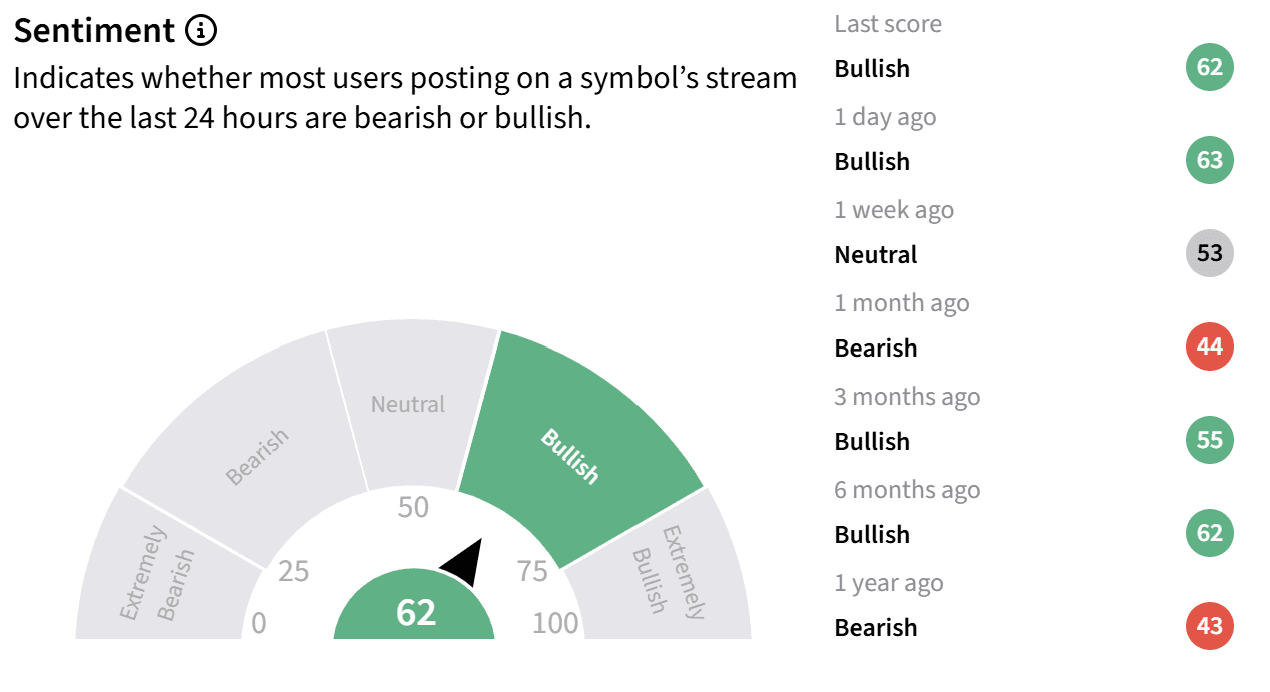
On Stocktwits, retail sentiment around META stock soared to 'extremely bullish' from 'bearish' over the past week, while chatter rose to 'high' from 'low' levels.
Satya Nadella Looks Beyond AI Hype
In an interview with Semafor this week, Nadella said that the AI industry needs to focus less on novelty and more on systems that work predictably and reliably. He stated that frontier AI labs were “magical businesses,” but added that early success does not guarantee long-term leadership in the industry.
“It’s not about the shiny object and FOMO.”
– Satya Nadella, CEO, Microsoft, to Semafor
Nadella’s annual letter, published the same day, placed AI agents at the center of Microsoft’s reorganization. He wrote that agents allow users to “macro delegate and micro steer,” and said Microsoft 365 Copilot had passed 30 million paid seats.
Sundar Pichai Prioritizes DeepMind’s Compute Needs
Alphabet (GOOG, GOOGL) CEO Sundar Pichai said this week that Google Cloud was giving up some short-term revenue so DeepMind could have first claim on computing capacity.
“Non-negotiable.”
– Sundar Pichai, CEO of Alphabet, on DeepMind’s computing needs, on the Big Technology Podcast
Pichai said meeting requests from new customers seeking computing capacity for 2027 would be extremely difficult. He did not disclose how much revenue Alphabet was forgoing to prioritize DeepMind.
OpenAI began rolling out its models on Google Cloud in private preview on Wednesday. Pichai confirmed that Apple uses Gemini models in Siri and said the partnership was “working well.”
Amazon (AMZN) was largely absent from this week’s AI discussion, with CEO Andy Jassy making no new public remarks. Apple (AAPL) CEO John Ternus also did not make any fresh public comments this week.
Read also: MU, SNDK, SKHY Stocks Bounce After Thursday’s Markdown, But Strategists Split: ‘Great Buying Opportunity’ Versus ‘The Kospi Has Peaked’
For updates and corrections, email newsroom[at]stocktwits[dot]com.<
Stay updated with all the latest Business NewsShare Market NewsIPOsGold PriceDA Hike8th Pay CommissionAsianet News Official App