Early Uber Investor Sees ‘All Car Companies’ Joining Robotaxi Gold Rush — Lucid And Baidu Take It Global
Synopsis
Lucid’s European push comes amid Uber’s commitment to deploy at least 35,000 Lucid robotaxis equipped with Nuro tech.
- Lucid and Bolt plan to deploy at least 25,000 Level 4 autonomous vehicles across major European cities using Nvidia’s Hyperion architecture.
- Baidu is conducting fully driverless Apollo Go tests in Hong Kong and plans to apply for commercial operations.
- Tesla faces a Sept. 30 deadline to explain how its steering-wheel- and pedal-free Cybercab complies with safety standards.
Early Uber investor Jason Calacanis said “all car companies” are poised to become robotaxi operators as Lucid announced a 25,000-vehicle European partnership with Bolt and Baidu advanced its fully driverless push in Hong Kong.
Bolt Taps Lucid For Massive Driverless Fleet
“All car companies are now going to become Robotaxi companies!” Calacanis said on X, pointing to Lucid’s (LCID) new partnership with European mobility platform Bolt.
Lucid and Bolt said on Thursday they will jointly develop an SAE Level 4-ready vehicle on Lucid’s upcoming Midsize platform, with Bolt aiming to deploy at least 25,000 fully autonomous vehicles across major European cities. The vehicles will use Nvidia’s (NVDA) Hyperion autonomous-driving architecture. Bolt will help define the vehicle, software, safety, and rider-experience requirements before owning and operating the fleet.
Bolt CEO Markus Villig said European autonomy requires “data, software, vehicles, and operations to work as one system built for European roads and regulation.”
Bolt operates across more than 850 cities and aims to host 100,000 autonomous vehicles on its platform by 2035. The Lucid fleet is expected to be manufactured at the EV maker’s new Saudi Arabian plant, which is scheduled to begin production early next year.
Lucid Builds A Global Robotaxi Pipeline
The Bolt agreement expands Lucid’s robotaxi ambitions beyond its existing U.S. partnership with Uber (UBER) and autonomous-driving company Nuro.
Uber has committed to deploy at least 35,000 Lucid vehicles, including Gravity SUVs and future Midsize models, equipped with Nuro’s technology. Lucid plans to supply around 100 pre-production Gravity-based robotaxis to its partners by the end of 2026, with production expected to begin in early 2027.
Napoli previously called the robotaxi opportunity “huge” and identified the Uber-Nuro program as a top priority.
Baidu Takes Apollo Go Onto Hong Kong Roads
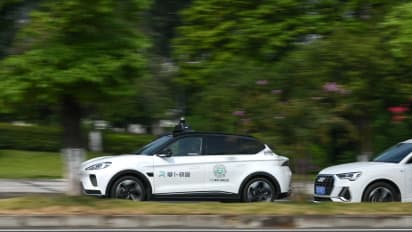
Baidu (BIDU) also highlighted its international robotaxi expansion on Thursday, sharing footage of Apollo Go vehicles conducting fully driverless tests on Hong Kong roads. The company said it plans to apply for commercial operations after building on its current trials.
“We look forward to advancing the city’s vision for driverless, scaled-up and commercialized AV operations,” Baidu said on X, adding that Hong Kong could become a “global benchmark for commercial autonomous driving in right-hand-drive markets.”
Robotaxi Gold Rush Spreads Across Auto Industry
Calacanis’ prediction comes as automakers increasingly pair with mobility platforms and autonomy developers rather than building every component internally. Uber agreed in March to invest up to $1.25 billion in Rivian (RIVN). Uber or its fleet partners plan to purchase 10,000 autonomous R2 vehicles beginning in 2028, with an option for 40,000 more from 2030.
Stellantis (STLA), Wayve and Uber signed a preliminary agreement in June to develop Level 4 robotaxis for Europe and North America. Stellantis has also partnered with Bolt and Pony.ai on an autonomous-vehicle pilot in Luxembourg. Volkswagen, Mercedes-Benz, Nissan, Hyundai and XPeng are pursuing their own programs through tech partnerships, internal development or commercial deployment plans.
Tesla’s Cybercab Faces A Regulatory Test
Tesla (TSLA), meanwhile, began the commercial deployment of a small number of Cybercabs in Austin earlier this month. The two-seat robotaxi has no steering wheel, pedals, or mirrors. CEO Elon Musk has called it “the first car that is specifically built for unsupervised full self-driving,” while Tesla has promised a “first-class experience at coach price.”
The National Highway Traffic Safety Administration (NHTSA) has given Tesla until Sept.30 to explain how Cybercab complies with safety standards without an exemption. The regulator is seeking details about its controls, operating restrictions and planned fleet expansion.
How Do Retail Traders Feel About Automakers?
On Stocktwits, retail sentiment was ‘bullish’ for LCID, ‘bearish’ for BIDU and ‘extremely bearish’ for TSLA. Message volume was ‘low’ for BIDU and TSLA, while LCID saw ‘normal’ chatter. UBER sentiment remained ‘neutral’ amid ‘normal’ message volume.
Over the past year, LCID has fallen 79%, BIDU has declined 35%, UBER has dropped 24%, and TSLA has lost 14%.
For updates and corrections, email newsroom[at]stocktwits[dot]com.<
Stay updated with all the latest Business NewsShare Market NewsIPOsGold PriceDA Hike8th Pay CommissionAsianet News Official App