Cisco CEO Shrugs Off Concerns On Revenue Guidance Dip, Says ‘Profitability Of The Business Is Incredible’
Synopsis
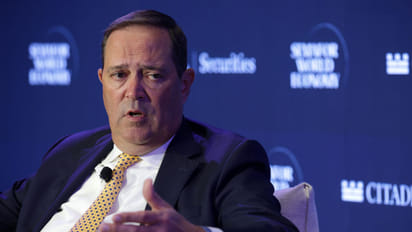
In an interview with CNBC, Cisco CEO Chuck Robbins said the sequential decline in the company’s second-quarter revenue outlook reflects a seasonal pattern, not a deterioration in demand.
- Robbins said that investors were focusing too heavily on gross margin.
- According to him, operating income and operating margin are more important measures of Cisco’s profitability.
- The CEO added that a potential Nvidia pullback from funding AI startups would have limited impact on Cisco.
Cisco Systems (CSCO) CEO Chuck Robbins said on Friday that the dip in the company's second-quarter revenue guidance is routine and that investors are focusing on the wrong margin.
“It’s a linearity thing that occurs almost every year,” Robbins said in an interview with CNBC on Friday, a day after Cisco reported its first quarter (Q1) results. He also said “the profitability of the business is incredible,” even if gross margin is lower.
The comments come as the stock reacts to guidance that came in below the latest quarter and to questions about how much hyperscaler sales will weigh on margins. CSCO stock fell over 5% in morning trade and was among the top trending tickers on Stocktwits at the time of writing.
Retail sentiment on the platform around Cisco trended in ‘extremely bullish’ territory over the past day, while chatter rose to ‘extremely high’ from ‘high’ levels.
Cisco CEO Says Second-Quarter Revenue Dip Is ‘Seasonal’
Robbins said Cisco’s fiscal calendar helps explain the sequential decline in its outlook. The company’s fiscal year ends in July, and its first quarter typically benefits from shipments tied to orders booked toward the end of the prior fiscal year. The second quarter is usually somewhat slower, he said.
“It’s seasonal… It’s been this way since you know dinosaurs walked the earth.”
Chuck Robbins, CEO, Cisco on the company’s long-standing seasonal revenue pattern
Cisco issued a second-quarter revenue guidance of $18.0 billion to $18.2 billion, which was below the first quarter’s revenue of $18.5 billion.
Cisco CEO Says Guidance Is Not A Demand Problem
Robbins said the outlook does not point to a demand problem. “I’m really apologizing for 19% growth this year,” he said, referring to the growth implied by Cisco’s raised full-year revenue outlook. The midpoint of the new range implies about 19% growth from fiscal 2026 revenue of $63.3 billion.
Cisco reported 21% growth in product orders, with networking orders up 28% and orders excluding hyperscale customers up 14%, according to the earnings call.
“I wish somebody told me five years ago my biggest problem this quarter was going to be that 21% product order growth wasn’t good enough,” Robbins said. He acknowledged that “there’s a lot of nervousness in the industry right now,” adding that investors are “naturally looking for things that could concern them.”
Robbins Says Operating Profit Matters More Than Gross Margin
Robbins said he understands why investors are watching gross margin, but stated that operating income and operating margin are more important measures of the company’s earnings power.
“I get it because it’s always been something they care about,” he said. “But operating margins and operating income drives EPS.” Cisco reported an adjusted operating margin of 37.8%.
“While the gross margins may be lower, the profitability of the business is incredible,” Robbins said. He added that “it’s just taking people time to digest this model because it’s counter to what we’ve done for 30 years.”
He linked the company’s profitability to productivity gains and a leaner workforce. “The guidance we gave yesterday will effectively add 20 billion in revenue with actually several 1000 fewer employees than we had at the beginning of 2025,” he said.
Robbins added that Cisco has also rolled out personal AI agents to its employees, with about 83,000 people using them. “I haven’t had anybody on my team ask for headcount in about a year,” he said.
Nvidia Turmoil To Have Limited Impact On Cisco
Robbins also addressed the uncertainty surrounding Nvidia (NVDA) and its role in financing AI infrastructure startups. Asked whether Nvidia pulling back on funding for startups or credit guarantees could affect Cisco, he said the impact would be limited.
“It won’t matter that much to us because we’re not that active in that space,” Robbins stated. He added that the neocloud business was “relatively immaterial to us.”
Robbins also praised Nvidia interim CEO Colette Kress, who worked with him at Cisco before joining Nvidia. “I love Colette. She’s a real operator. She’s the real deal,” he said. “I think she’s going to do just great.”
Cisco reported fiscal first-quarter results Thursday after the market close. Revenue rose 24% to $18.5 billion, while adjusted earnings were $1.40 per share. Both figures topped analyst estimates. Adjusted operating income was $7 billion, compared with expectations of $6.57 billion.
The company also raised its fiscal 2027 target for AI infrastructure revenue from hyperscalers to about $9 billion, up from its previous target of $7.5 billion.
Read also: Tom Lee Says Jensen Huang Exit Doesn’t Change His Bullish Tech Outlook: AVGO, AMD Stocks Lead Chip Rally
For updates and corrections, email newsroom[at]stocktwits[dot]com.<
Stay updated with all the latest Business NewsShare Market NewsIPOsGold PriceDA Hike8th Pay CommissionAsianet News Official App