ASTS, RKLB, SPCX, LUNR Chase An August Win: What SpaceX’s Falcon 9 Wind-Down Means For Space Stocks
Synopsis
Rocket Lab’s Neutron could capture medium-lift demand as Falcon 9 commercial capacity tightens.
- Firefly’s Alpha and Eclipse rockets are also positioned to benefit from the launch shortage.
- AST SpaceMobile could gain near-term Falcon capacity but remains exposed to third-party launch risks.
- Intuitive Machines is positioned safer as its Falcon 9 lunar missions are mostly NASA-backed.
AST SpaceMobile (ASTS), Rocket Lab (RKLB), SpaceX (SPCX) and Intuitive Machines (LUNR) enter August’s final trading days as SpaceX’s Falcon 9 wind-down creates opportunities for launch providers, while raising capacity concerns for satellite operators.
So far in August, LUNR stock has led the group with a 35% gain, followed by SPCX at 27%, FLY at 9%, ASTS at 5% and RKLB at 3%.
SpaceX Begins Falcon 9 Wind-Down
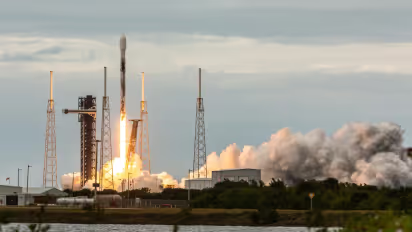
SpaceX completed its last Falcon 9 Starlink mission from Florida on Tuesday, marking a key step in transferring East Coast Starlink launches to Starship. “This morning’s @SpaceX mission from pad 40 was the last planned Falcon 9 Starlink launch from Florida,” SpaceX Vice President of Launch Kiko Dontchev said on X, calling it “the end of an era.”
Falcon 9 Starlink missions will continue from California. The rocket will also support Crew Dragon, NASA, national-security and previously contracted commercial missions, with a residual fleet potentially serving critical government customers into the early 2030s.
CEO Elon Musk said Falcon will be wound down “once Starship is flying reliably several times per week,” allowing SpaceX to redirect “super scarce” resources toward achieving several Starship launches per day. Falcon 9 is on pace for 155 missions in 2026, down from its record of 165 in 2025.
Rocket Lab And Firefly Target Falcon 9 Gap
Rocket Lab’s reusable Neutron rocket is designed for the medium-lift market dominated by Falcon 9, carrying 13 to 15 metric tons into low Earth orbit. Its first-stage tank is expected to reach the launch site in the fourth quarter, although the company has said the 2026 debut window is “narrowing,” making a 2027 launch increasingly likely. Neutron already has dedicated missions booked, including a Kepler Communications flight no earlier than 2028.
Rocket Lab’s backlog reached a record $2.36 billion in the second quarter, up 137% from a year ago with more than 90 launches under contract. Electron could also capture demand if inexpensive Falcon rideshares become scarcer.
Firefly Aerospace is pursuing the same opening. Its Alpha Block 2 rocket is targeting a fourth-quarter debut, while most of its 2027 Alpha manifest is already sold. Its Northrop Grumman-backed Eclipse medium-lift rocket, designed to carry 16 metric tons to low Earth orbit, is targeting its first flight in 2027. Firefly CEO Jason Kim has called launch capacity “the most constrained I’ve ever seen.”
KeyBanc Capital Markets said in June that the launch market could remain undersupplied for more than a decade, even if Starship succeeds, since much of its early capacity may serve SpaceX’s internal payloads. The firm had upgraded Rocket Lab and Firefly to ‘Overweight.’
ASTS, LUNR Navigate Falcon 9 Transition
AST SpaceMobile’s reliance on third-party launch providers leaves its BlueBird rollout exposed to delays and capacity constraints. After disruptions involving Blue Origin’s New Glenn affected earlier plans, SpaceX launched BlueBirds 8 through 10 in June and BlueBirds 11 through 13 earlier this month.
As of Aug.10, AST SpaceMobile had 12 commercial BlueBirds in orbit and 10 launches booked across two providers, supporting its target of launching every one to two months and deploying approximately 45 satellites by early 2027 for initial commercial service. Moving Florida Starlink missions off Falcon 9 could free pad time and scheduling capacity for AST SpaceMobile’s booked flights
Meanwhile, Intuitive Machines is less exposed because its lunar missions are mostly backed by NASA. Its IM-3 mission, carrying the Trinity Nova-C lander and Altus-1 lunar relay satellite, is targeting the second half of 2026 or a window extending into the first quarter of 2027. IM-4 is planned for 2027 and will also launch aboard Falcon 9.
How Do Retail Traders Feel About Space Stocks?
Retail traders remained cautious across the space sector. Sentiment on Stocktwits was ‘bearish’ for SPCX, ASTS, RKLB and FLY, while LUNR drew a ‘neutral’ reading. Message volume was ‘low’ across all five tickers.
Over the past year, LUNR stock led the pack with an 87% gain, followed by RKLB at 42% and ASTS at 24%. Meanwhile, SPCX declined 14%, and FLY fell 50%.
For updates and corrections, email newsroom[at]stocktwits[dot]com.<
Stay updated with all the latest Business NewsShare Market NewsIPOsGold PriceDA Hike8th Pay CommissionAsianet News Official App