Alphabet And Tesla's Blowout Capex Plans Are Shifting Investor Perceptions And Valuation Metrics

Synopsis
A regime shift driven by higher interest rates and an elevated cost of capital is creating valuation and profitability challenges for tech giants as investors pay keen attention to profitability metrics.
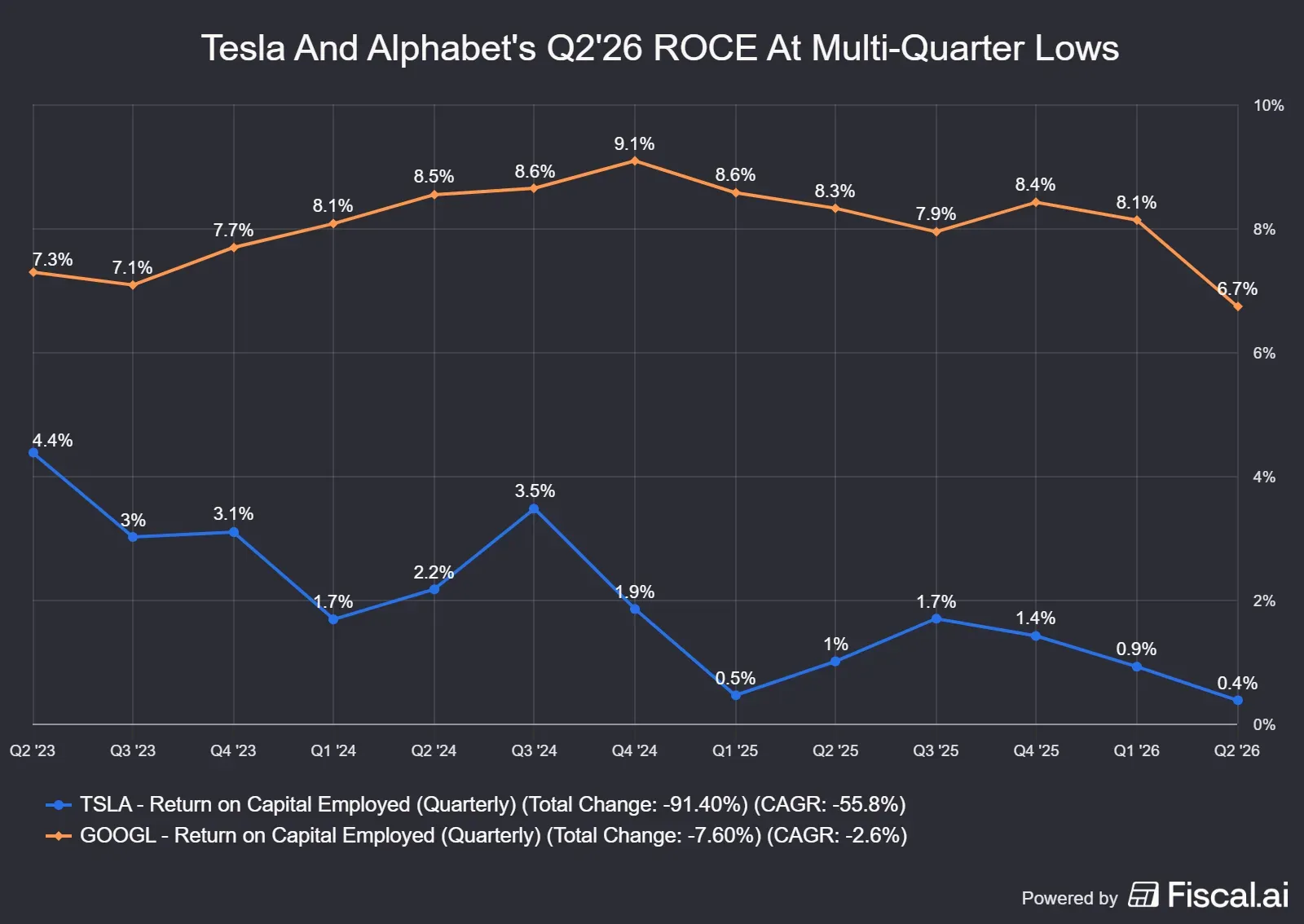
- Alphabet’s and Tesla’s Q2 '26 return on capital employed (ROCE) hit multi-quarter lows.
- The Roundhill Magnificent Seven ETF (MAGS) plunged nearly 5% on Thursday toward its worst trading day since April 2025.
- Alphabet raised its 2026 capital expenditure forecast up to $205 billion, while Tesla pledged to accelerate capital spending despite missing earnings estimates.
Wall Street seems to be increasingly penalizing hyperscalers for unchecked capital commitments, rewarding companies like Apple that have avoided massive AI infrastructure buildouts while demanding clear visibility on AI monetization.
Decades of falling interest rates, low inflation, and cheap capital created an ideal tailwind for asset-light technology models. In that era, investors benefited simply from rising financial asset valuations without requiring companies to tie up vast amounts of capital in physical infrastructure.
Projections point to an 82% chance of a Federal Reserve rate hike in September 2026, according to the CME FedWatch Tool. With soaring oil prices fuelling inflation concerns, the market dynamics that supported cheap capital may be coming under pressure.
Entering what Goldman Sachs Chief Global Equity Strategist Peter Oppenheimer calls the “post-modern cycle,” higher interest rates, elevated government debt, and geopolitical fragmentation have raised the hurdle rate for capital across all asset classes.
"In an environment of falling interest rates and a low cost of capital, investors just need to get exposure to financial assets, because a lot of the return is simply coming from rising valuations," Oppenheimer noted. "Now, with interest rates higher and the cost of capital rising, fundamental profit growth is becoming a crucial driver of performance. If you can generate a return that comfortably exceeds the higher cost of capital, that's going to be an important factor."
For instance, the 10-year US Treasury yield, which is often considered the primary baseline for corporate cost of capital, is the highest in over a year. This higher cost of capital is widening the performance gap between market winners and losers, capping broad valuation multiples, and making rigorous stock selection essential for generating sustainable returns.

Tesla’s And Alphabet’s Capex Plans Rattle Tech Investors
The risk of unchecked capital raises is evident in the shares of the world's largest technology companies, famously known as the Magnificent Seven, which suffered a brutal market selloff on Thursday, driven by growing investor skepticism over the soaring costs required to build out artificial intelligence infrastructure.
The Roundhill Magnificent Seven ETF (MAGS) plummeted nearly 5%, setting the benchmark on course for its sharpest single-day decline since April 2025. The index has now retreated 11% from its record high set in late May, wiping out over $2 trillion in market capitalization.
The decline spread across the broader megacap technology cohort ahead of next week's earnings reports. Amazon.com Inc. (AMZN) slid 5%, Meta Platforms Inc. (META) tumbled 4.7%, and Microsoft Corp. (MSFT) dropped 3.1%.
In contrast, Apple Inc. (AAPL) experienced a milder drop of 1.7%, having largely eschewed the aggressive capital spending sprees of its peers—a strategic distinction that has seen its stock gain 18% year-to-date.
For Tesla (TSLA) and Alphabet (GOOGL), the two big-tech firms that released their Q2 earnings this week, the return on capital seems to be faltering, something that investors have been worried about, leading to sell-offs as seen on Thursday.
"They require a lot of capital to generate growth, but it may be a long time before they actually make a profit," Oppenheimer pointed out. "That makes it harder to value assets."
Markets' Perception of Hyperscaler Capex Is Shifting
The market is seemingly undergoing a fundamental regime shift in how it values artificial intelligence investments. During the early phases of the generative AI boom in the two years ending 2025, capital expenditure announcements were routinely met with equity price surges. Investors viewed aggressive infrastructure commitments as an indicator of market leadership and future revenue dominance.
However, in 2026, the market's narrative has pivoted, with investors being more skeptical about when and how these bloated expenditures will provide relevant returns. The focus seems to be shifting to free cash flows, capital efficiency, and clear visibility on return on invested capital.
On one hand, AI and tech leaders continue to highlight strong demand for the hardware and software being developed through massive capital spending. On the other hand, the high costs associated with using AI products have led several companies to ask employees to reduce their AI usage.
Uber (UBER), Walmart (WMT), Meta (META), and Accenture (ACN) are examples of companies that have scaled back AI spending in some form.
For updates and corrections, email newsroom[at]stocktwits[dot]com.<
Stay updated with all the latest Business NewsShare Market NewsIPOsGold PriceDA Hike8th Pay CommissionAsianet News Official App