‘Beary’ Michael Burry Waves The Red Flag Again — But These 5 Charts Suggest The Market Isn’t Crashing Yet

Synopsis
Despite the investor’s bearish warnings, earnings growth, strong margins, resilient economic forecasts, supportive Fed policy, and sustained AI spending suggest the bull market remains intact.
- While Michael Burry warns of a prolonged downturn, market indicators do not yet signal an imminent crash.
- Earnings growth, healthy corporate margins, steady economic expansion, and a dovish Fed backdrop continue to underpin equities.
- Robust AI spending and massive tech capex are sustaining leadership in growth stocks, likely supporting the broader bull trend.
“The Big Short” investor Michael Burry has broken his two-year social media silence, reemerging in late October with a flurry of market warnings. After his firm, Scion Asset Management — which has since been deregistered — disclosed massive short positions in artificial intelligence (AI) darlings Nvidia and Palantir, Burry began calling out hyperscalers Oracle and Meta for inflating the valuable lives of data center assets. Then he took potshots at Nvidia for its stock-based compensation accounting.
The short seller has now trained his sights on the broader market, though projecting it in a less flattering light. Can his warning be taken at face value or just shrugged off as an attention-seeking gimmick?
Beary Burry
Sharing a chart on X, Burry noted that American households now have more wealth locked in stocks than in real estate. Calling it an interest chart, the fund manager said this “has happened only twice — in the late 60s and late 90s. “The last two times, the ensuing bear market lasted years.”

So Far So Good
The market has shown remarkable resilience this year, pushing through multiple headwinds and remaining firmly afloat. The year began with bouts of volatility as traders paused following the strong year-end rally in 2024. Just as momentum was building, President Donald Trump’s tariffs unsettled markets, triggering a sharp selloff in early April.
Since then, stocks have rebounded and resumed a broadly upward trajectory, punctuated by brief, intermittent pullbacks within the larger uptrend.
The SPDR S&P 500 ETF (SPY), an exchange-traded fund (ETF) that tracks the broader S&P 500 Index, has gained 16.42%, on top of the 24.5% jump in the previous year, and the nearly 26% gain in 2023. The current bull run began in October 2022.
The tech sector has led the market rally this year, as evidenced by the 19% gain by the Invesco QQQ Trust (QQQ)

Source: Koyfin<
Here are five charts showing that the market is nowhere close to falling off the cliff:
1. Earnings Growth Optimism
Corporate earnings, a primary driver of the market, hold out more promise. The year-over-year earnings growth rate of S&P 500 companies is estimated at 8.1% for the fourth quarter, according to FactSet’s latest earnings insights report. If the estimate proves correct, it will mark the 10th consecutive quarter of earnings growth.
Source: FactSet<
2. Healthy Margins Debunk Bear Thesis
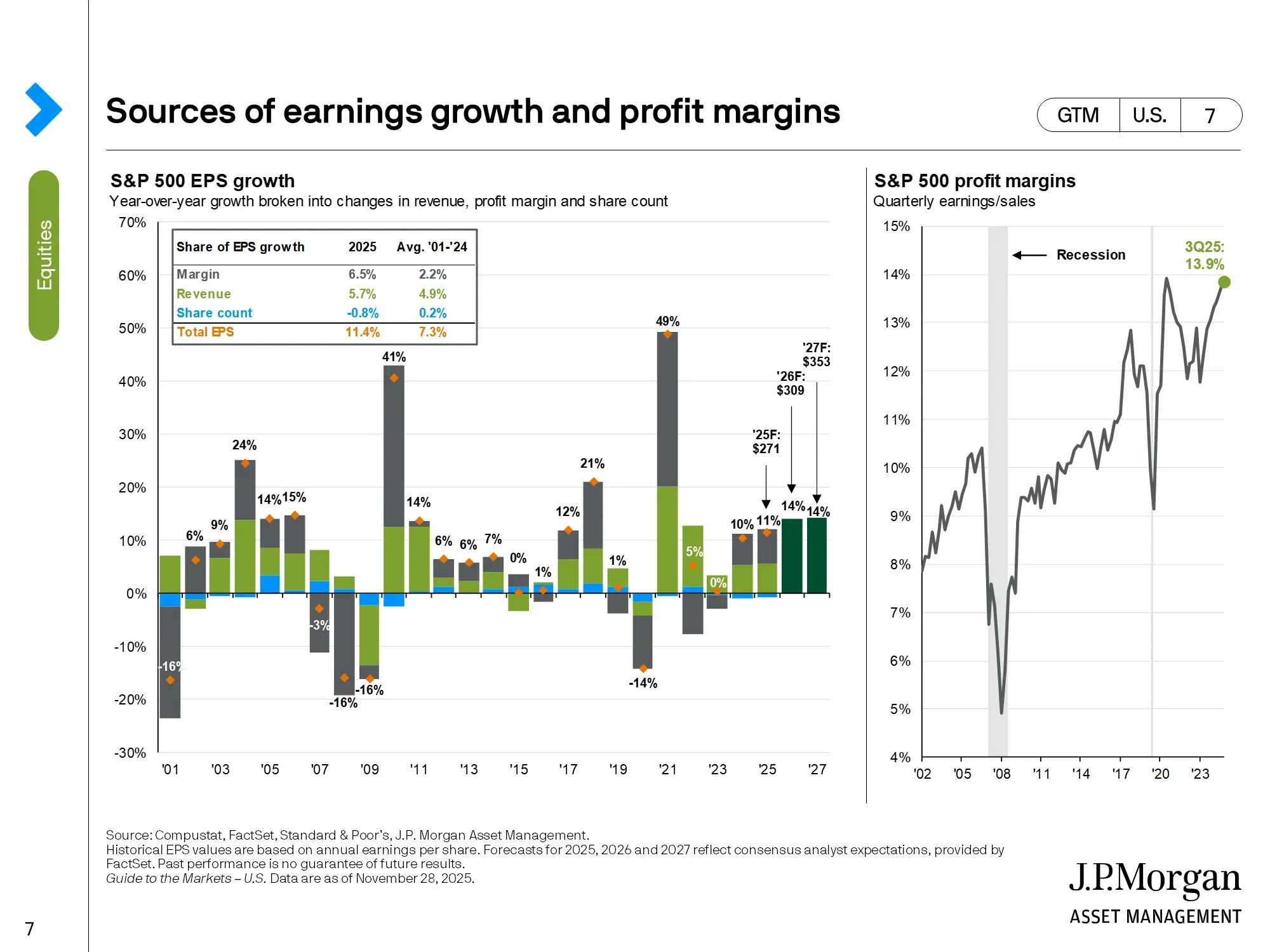
According to a Bank of New York Mellon report, margins have come in stronger than expected, driving the market rally. JPMorgan’s analysis shows that margins are on an uptrend, with the third quarter experiencing nearly 14% margins for S&P 500 companies. In the recession that followed the Great Financial Crisis, margins plummeted to under 5%. The COVID-19 recession was a shallower downturn, and during the period, margins fell more modestly, holding just above 9% level.
Source: JPMorgan<
3. Economy Chugging Along
The Fed’s Summary of Economic Projections (SEP) issued as part of the central bank’s December meeting announcement shows that economic growth is expected to continue at a fairly decent clip even as inflation continues to cool off.
US GDP Growth Outlook
Source: Statista
4. Fed’s Benevolence
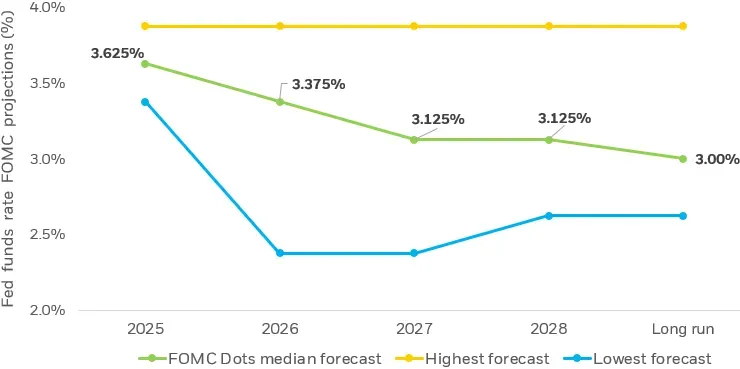
The dot-plot chart released by the Fed earlier this month shows that the median estimate foresees a gradual reduction in rates through 2026. This factor could lead to sector rotation out of current market leaders and into laggards such as small-caps and interest-rate-sensitive stocks.
Fed Rate Trajectory
Source: iShares<
Given expectations that the current Fed Chair, Jerome Powell, will be replaced by a more dovish leader, either Kevin Warsh or Kevin Hassett, rates could become more accommodative than currently foreseen.
5. AI Spending Will Continue To Be A Tailwind
The U.S. artificial intelligence (AI) market is expected to explode despite the rising chatter of a bubble. According to Precedence Research, the market size is expected to rise to over $850 billion in 2034 from $146 billion in 2024.
US AI Market Size
Source: Precedence Research<
In a note released on Wednesday, Wedbush analyst Daniel Ives said:
“We believe that 2026 will be another strong year for the tech trade with the AI Revolution front and center as the AI infrastructure getting built out throughout 2025 will lead to transformational monetization opportunities into 2026 and beyond.”
The analyst expects big tech capital spending (capex) to be in the $550 billion to $600 billion range.
For updates and corrections, email newsroom[at]stocktwits[dot]com.<
Stay updated with all the latest Business NewsShare Market NewsIPOsGold PriceDA Hike8th Pay CommissionAsianet News Official App