Troubling signs: Hindi, Kannada cannot fit in one frame anymore
Synopsis
The protest against the "imposition" of Hindi in Bangalore metro triggered by online campaign "#NammaMetroHindiBeda" CM Siddaramaiah: Hindi is just a language spoken in the North Indian states But now signages at the Bengaluru metro stations have been masked in order that pro-Kannada activists be appeased
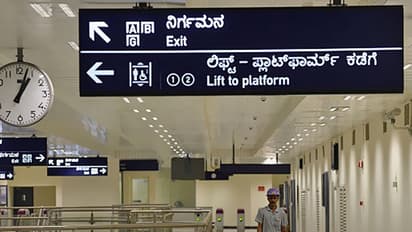
Signs at the Kempegowda and Chickpete stations in Bengaluru's Metro earlier had wordings in Kannada, English and Hindi. But since July 3, the Hindi wordings have been masked to appease radical pro-Kannada activists. Though BMRCL officials have not made any official statement regarding the incident, sources said it was done by Metro officials following a tip off that some groups were planning to vandalise or blacken the signs as a mark of protest.
Triggered by online campaign "#NammaMetroHindiBeda", the protest against the "imposition" of Hindi in the Bengaluru Metro has been gaining momentum over the last couple of weeks. Recently, the Kannada Development Authority (KDA) also issued a notice to the Bangalore Metro Rail Corporation Ltd (BMRCL) on the issue.
It is even more shocking that a learned leader like Karnataka's CM Siddaramaiah spoke Hindi being an imposition! Reportedly, the CM, during his recent visit to Delhi, said that he would lodge a protest with the Centre on imposition of Hindi.
With that single statement, the CM has alienated so many people in the state and the city. Statements like these also encourage violence against non-Kannada speakers and also given wind to a feeling of distrust and hatred against Hindi speakers in the state. With the state polls are coming up next year, it seems the CM is doing all he can to retain his vote bank.
But here's the thing - Bengaluru is a cosmopolitan city. The silicon city of India is home, or at least a rented home, to lakhs of software engineers, chartered accountants, IT professionals and more. Needless to say, not all of these residents are from Bengaluru or even Karnataka.
We speak of freedom of speech, language and expression. But then why is the mere presence of a Hindi sign an ‘imposition’? Why is this being made into a fight of ‘ours and yours’ North and South’?
After all, why are signs placed? They have no greater purpose than to help one get directions to a particular destination. It is just making things easier for non-Kannada, non-English speakers to understand routes.
People travel throughout India seeking solace in the fact that wherever they go, at least one of the languages – Hindi or English - will be understood. The real imposition is the expectation that everyone should know how to read the regional language - even if they come for a brief visit or a few years stay for a job.
Just by using Hindi on the signboards you are showing courtesy and helping your North Indian brethren and sometimes their elderly parents when they are in the city.
When I asked the newsroom their opinion, I got to hear the ‘other side’ of the debate. I was told history is to blame. While in the North everyone is vociferous about using Hindi and shun the use of English, Kannadigas fear that Kannada will once again be wiped out from the signboards, as it was in the days just after the 'Raj' left the country. They spoke of a time when Kannada was removed from the signboards in Karnataka post offices and railway stations. 'Imagine having no way to use your mother tongue in your own state!' they declared.
They fear that with Hindi slowly creeping in, it will be the same saga all over again. Most seem to feel it is ‘mandate’ that is being implemented in the case of Metros. Is it a central government mandate?
Now I feel that the advocates for uniformity of language and promoters of Hindi as a national language may have hurt their own cause by taking it to the extent of being 'intolerable'. Already in North India there is the belief that Hindi is a national language. Probably if the North Indians had been more tolerant of the people who come from South India then this debate would not have arisen in the first place. I find it hard to say, but : As you sow, so shall you reap.
Stay updated with the Breaking News Today and Latest News from across India and around the world. Get real-time updates, in-depth analysis, and comprehensive coverage of India News, World News, Indian Defence News, Kerala News, and Karnataka News. From politics to current affairs, follow every major story as it unfolds. Download the Asianet News Official App from the Android Play Store and iPhone App Store for accurate and timely news updates anytime, anywhere.