How Does Cauvery Water Reach Bengaluru? The Engineering Behind Your Tap Water
Synopsis
How does Cauvery water reach Bengaluru homes? Explore the journey from T.K. Halli to the city, including water purification, three major pumping stages, pipelines and reservoirs that supply households.
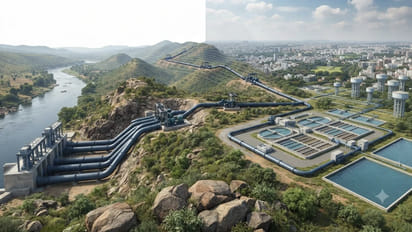
Every time residents in Bengaluru turn on a tap, water flows into their homes almost instantly. However, the journey behind this everyday convenience involves a complex network of pipelines, water treatment plants, powerful pumping stations and storage reservoirs. Although the Cauvery River is located around 100 km from Bengaluru, supplying its water to the city is not as simple as laying a pipeline from the river to people's homes. Bengaluru's geographical elevation poses a major engineering challenge, as water has to be transported uphill before it can be distributed across the city.
From purification at T.K. Halli to multiple stages of pumping and distribution, several processes ensure that Cauvery water reaches households across Bengaluru. A social media video shared by the Instagram page Kathe Helthini explains how this extensive water supply system works.
Why Is Supplying Cauvery Water To Bengaluru A Challenge?
One of the biggest challenges in bringing Cauvery water to Bengaluru is the difference in elevation between the river and the city. Water naturally flows downhill due to gravity, but Bengaluru is situated at a considerably higher elevation than the Cauvery River's water source.
Therefore, simply connecting the river to the city through a long pipeline would not be sufficient. Water needs to be lifted through a series of pumping stations to overcome the difference in elevation. This requires substantial infrastructure, powerful pumps and a carefully planned water distribution system.
Cauvery Water Is First Treated At T.K. Halli
Before reaching household taps, river water must undergo purification to make it suitable for consumption. Cauvery water is transported to the treatment facility at T.K. Halli, also known as Thorekadanahalli, where it passes through several stages of treatment.
The purification process begins with aeration, during which water is brought into contact with air. Chemicals such as alum are then added to help suspended impurities clump together and settle. The water subsequently passes through filtration units, where finer impurities are removed. Chlorination is carried out as the final disinfection step to eliminate harmful microorganisms.
Once the treatment process is complete, the water is ready to be transported through the supply network towards Bengaluru.
Three Major Pumping Stages Lift Water Towards Bengaluru
After purification at T.K. Halli, the treated water has to travel uphill towards Bengaluru. This is where the city's extensive pumping infrastructure becomes essential. Instead of relying on a single pumping station, the Cauvery water supply system uses multiple stages to lift and transport water.
The key stages described in the video are T.K. Halli to Harohalli, Harohalli to Tataguni, and Tataguni towards Bengaluru. At each stage, powerful pumps help move the water through large pipelines, overcoming the elevation difference between the source and the city.
According to the video, the water is lifted by approximately 450 metres during its journey. This multi-stage arrangement makes it possible to transport large quantities of water over long distances and deliver them to Bengaluru's distribution network.
From Tataguni To Homes Across Bengaluru
Once the water reaches Tataguni, it is conveyed towards large storage reservoirs in Bengaluru. These reservoirs play an important role in managing the city's water supply and ensuring that treated water can be distributed to different areas.
From the storage facilities, water moves through a network of large and smaller pipelines. It is gradually supplied to different localities, streets and residential buildings before finally reaching household taps.
This extensive distribution network connects the major water supply infrastructure outside Bengaluru with homes and other establishments across the city.
Cauvery Water Supply To 110 Villages Under Stage V
The fifth stage of the Cauvery Water Supply Project is intended to extend the network to 110 villages in the Bengaluru region. The project expands access to Cauvery water beyond the established city supply network, covering areas brought under the expanded urban limits.
The video also highlights the scale of the water supply system, referring to a daily supply figure of around 77.5 crore litres. The project involves an extensive network of pipelines, treatment facilities, pumping stations and storage infrastructure to transport and distribute water across the region.
The Engineering Behind Every Glass Of Water
For Bengaluru residents, getting water from a household tap may seem like a simple everyday convenience. However, every glass of Cauvery water represents a long journey involving river infrastructure, scientific purification, powerful pumps and an extensive pipeline network.
From the Cauvery basin to T.K. Halli, Harohalli and Tataguni, the water passes through several stages before reaching the city. While gravity naturally pulls water downhill, engineering makes it possible to lift and transport it uphill to homes across Bengaluru.
Stay updated with the Breaking News Today and Latest News from across India and around the world. Get real-time updates, in-depth analysis, and comprehensive coverage of India News, World News, Indian Defence News, Kerala News, and Karnataka News. From politics to current affairs, follow every major story as it unfolds. Download the Asianet News Official App from the Android Play Store and iPhone App Store for accurate and timely news updates anytime, anywhere.